EVERETT — Boeing secured two prominent deals, one military and one civilian–with a Chinese airline that hasn’t bought Boeing airliners in ten years.
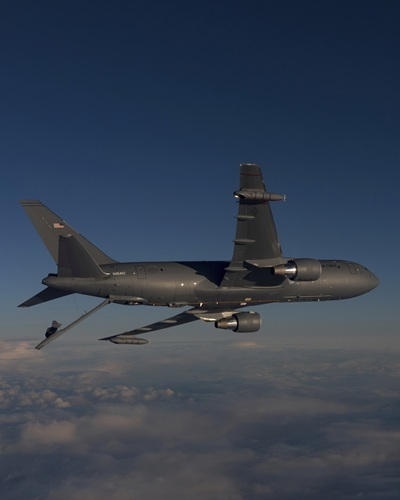
The U.S. Air Force awarded Boeing a contract for 15 additional KC-46A Pegasus tankers. Complimenting that military deal, China Southern Airlines filed paperwork that its subsidiary Xiamen Airlines agreed to purchase 50 Boeing 737-8 narrowbodies with a valuation of $7.4 billion. No financial figures were released in connection with the Air Force contract.
In total, 203 KC-46A multi-mission aerial refuelers are on contract or in service globally, providing advanced capability for the joint force and allies. This includes 116 delivered to the U.S. Air Force, six to the Japan Air Self-Defense Force and two to the Israeli Air Force.
Since delivery of the first KC-46A Pegasus in 2019, the U.S. Air Force’s KC-46A fleet has exceeded 180,000 flight hours, reflecting high utilization across training, operational sorties and global deployment missions.
The KC-46A’s rapid reconfigurability enables the aircraft to support a broad range of missions, including humanitarian assistance and disaster relief. It is frequently used to transport critical supplies, including recent support for the Denton Humanitarian Assistance Program, helping deliver aid where it is needed most.
The aircraft also supports strategic deterrence and global readiness. Recent bilateral training between the U.S.A.F. and the Japan Air Self-Defense Force exhibits the KC-46A’s role in strengthening stability in the Indo-Pacific. Long-range missions, including deployments from Travis AFB to Japan, further demonstrate the aircraft’s ability to extend reach, support allies and sustain readiness for complex, theater-wide operations by the Air Force and Air National Guard.
The Xiamen Airline deal arrived after President Donald Trump told CNBC Monday he expected China to purchase another 250 Boeing aircraft, following his meeting with Chinese President Xi Jinping at the APEC summit last week.
“By the way, I sold 250 Boeings to China, and I think they’re going to do another 250,” Trump remarked on CNBC.
In May, China approved an initial purchase of 200 Boeing aircraft for Chinese airlines following Trump’s visit to Beijing, marking the country’s first commitment to purchase U.S.-made Boeing aircraft since 2017, according to the White House. It’s unclear whether the order announcement by Xiamen Airlines’ was part of that commitment.
China Southern, which owns a 55% stake in Xiamen Airlines, said the actual purchase price would be lower than the combined list price because of discounts offered by Boeing. The company did not disclose the final purchase price, citing confidentiality provisions in the agreement.
The aircraft are scheduled to be delivered in batches between 2031 and 2034, with the purchase financed through a combination of internal funds and external financing, the filing showed. The transaction remains subject to shareholder and relevant Chinese government approvals.
China Southern said the purchase would support Xiamen Airlines’ planned relocation to the new Xiamen Xiang’an International Airport and the expansion of its route network.
The agreement follows the group’s recent purchase agreement for 137 Airbus A320neo–family aircraft, the filing showed. China Southern said sourcing aircraft from different manufacturers would help diversify its fleet and improve operational flexibility.
Other Asian carriers, including Philippine Airlines and Malaysia Aviation Group, have also announced Boeing aircraft orders this month.
According to Reuters, Boeing had been largely shut out of new orders from the world’s second-largest aviation market since the 2017 deal amid trade tensions between Beijing and D.C., though it has still been delivering planes from older orders.
Boeing and rival Airbus forecast China will require around 9,000 new jets by 2045 to meet demand, more than any other global region.