Footage of explosive-laden drones diving toward Russian military vehicles, hovering over airfields and striking soldiers has become familiar in the war in Ukraine.
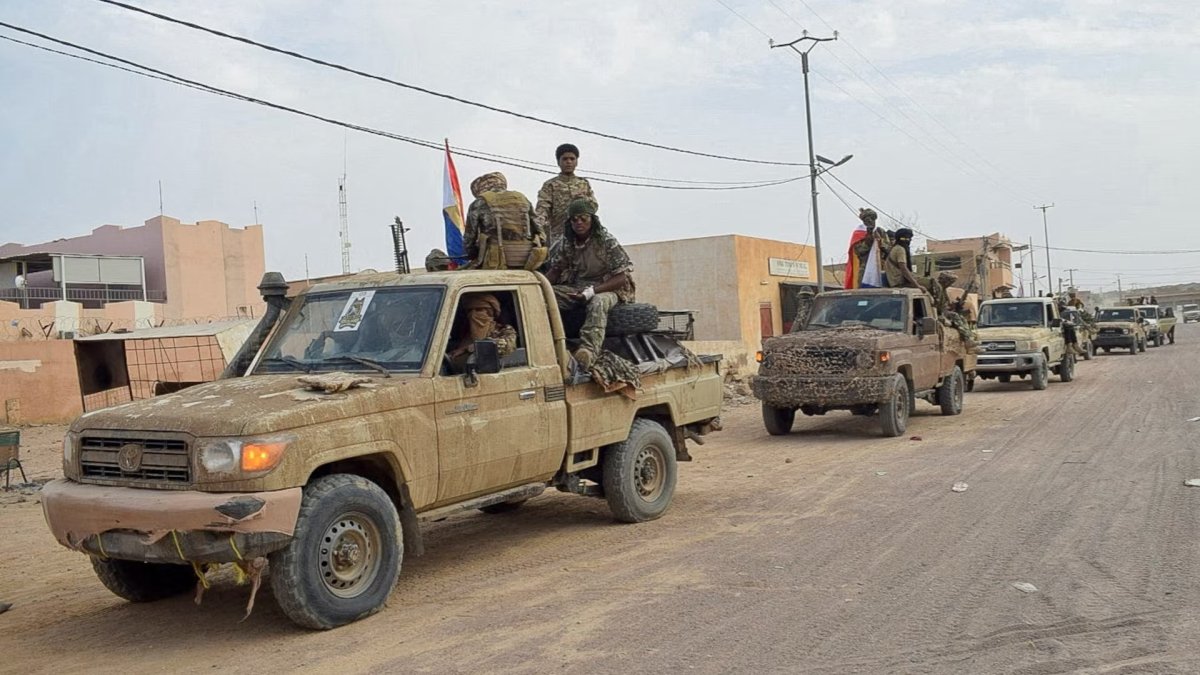
But these attacks are taking place thousands of miles away, in Mali, where insurgent groups are using battlefield tactics developed in Ukraine to challenge government forces and their Russian military allies.
Videos filmed during coordinated attacks in April by Tuareg-led terrorists and an al-Qaeda affiliate show how inexpensive first-person-view (FPV) drones are changing the balance of power across the Sahel, a vast region south of the Sahara Desert.
Armed with explosives and costing just a few hundred dollars, the small commercial drones have given insurgents a way to threaten military bases, aircraft, fuel depots and other strategic infrastructure that governments once protected with overwhelming air power.
The growing threat extends beyond Mali. Militants in Burkina Faso, Niger and other parts of West Africa are increasingly deploying drones for reconnaissance and attacks, while similar tactics are emerging in other conflict zones, from the Middle East to Asia and South America.
The shift has also created a growing security challenge for African governments, whose expensive military equipment and critical infrastructure are increasingly vulnerable to relatively cheap weapons operated by non-state armed groups.
Reuters reporting shows that Ukraine’s efforts to weaken Russian military influence have extended into Africa, including training separatists in Mali to conduct drone attacks against Russian personnel.
Beyond Kyiv’s support for the separatists, the broader proliferation of drone technology has allowed militant groups to acquire capabilities once largely reserved for national militaries.
“In the past, the state always had the monopoly of the sky. It was the one thing they could control,” said Niccola Milnes, an independent senior counterterrorism and security adviser.
“Now that non-state actors can access these drones cheaply and modify them and attach payloads, it’s obviously completely upended that,” she said.
Ukrainian training brings new tactics to Mali
The transformation began gathering momentum in 2023, when FPV drones fitted with basic explosives became increasingly common on Ukrainian battlefields.
The technology was relatively inexpensive, commercially available and easy to adapt for military purposes. As Ukrainian forces and their Russian adversaries refined their use, the tactics and expertise began spreading to other conflict zones.
In Mali, separatist fighters say Ukrainian personnel provided training that helped them develop their drone capabilities.
Russia began supporting Mali’s military government in 2021 through the deployment of the Wagner mercenary group, which helped fight jihadist insurgents and Tuareg-led separatists.
In 2023, Russia’s Defense Ministry established Africa Corps, a paramilitary force that replaced Wagner and absorbed many of its fighters.
That same year, Ukrainians trained members of the separatist movement in drone operations during a 30-day course held outside Mali, according to Mohamed Elmaouloud Ramadane, a spokesman for the group, now known as the Azawad Liberation Front (FLA).
Ramadane said the training helped prepare the group’s dedicated drone unit but denied that Ukrainians had participated directly in its military operations. He declined to identify the drones used by the group or provide further operational details.
Reuters could not independently establish the identities of the Ukrainian trainers or determine who organized the program.
Ukraine’s military and intelligence services did not respond to requests for comment. Its Foreign Ministry, however, rejected accusations by Mali and Niger that Kyiv was supporting armed groups and interfering in the region’s internal affairs in a Nov. 2 statement.
Russia’s Defense Ministry also did not respond to questions.
Ukraine has increasingly targeted Russian military assets beyond its own borders. On Sunday, Ukrainian forces sank a Russian naval corvette in a Libyan port using maritime drones, another example of Kyiv extending its campaign against Moscow’s military presence abroad.
Ukrainian Foreign Minister Andrii Sybiha defended the operation, saying Russia was using military deployments and logistical infrastructure outside its territory, including in Africa, to sustain its war against Ukraine.
Mali’s government did not respond to detailed questions about the allegations of Ukrainian involvement. Foreign Minister Abdoulaye Diop has nevertheless acknowledged the growing danger posed by drones.
“The ability of our armed forces to adapt to drone attacks has therefore become a critical issue,” Diop said at an arms fair in Bamako on Nov. 9.
Low-cost weapons, expensive consequences
The separatists’ first major deployment of one-way attack drones came in July 2024 during fighting around Tinzaouaten, a town near Mali’s border with Algeria.
Ramadane said the FLA’s specialized Unit 6 drone team used kamikaze drones against Malian soldiers and their Russian allies, roughly 10 months after completing the training program.
Al-Qaeda-linked terrorists had already begun experimenting with the technology.
In September 2023, JNIM, an al-Qaeda affiliate, used a quadcopter to drop two improvised explosive devices on a rival militia in central Mali’s Mopti region. Neither device exploded, and no casualties were reported, according to the Armed Conflict Location & Event Data (ACLED) project.
Since then, both the frequency and sophistication of attacks have increased, with JNIM emerging as the region’s most prolific militant drone operator.
Previously unpublished ACLED data reviewed by Reuters recorded 187 drone attacks by JNIM between 2023 and mid-November. The FLA and its predecessors accounted for additional attacks, bringing the combined total to 235 across four West African countries.
JNIM has relied primarily on drones that drop explosives, although analysts say it increased its use of kamikaze attacks in 2026.
Daesh-linked groups have also incorporated drones into their operations, using them for surveillance, battlefield coordination and attacks.
Daesh West Africa Province, for example, has carried out 15 attack-drone operations since 2024, most of them during clashes with Nigerian forces, according to ACLED.
Although its capabilities remain less advanced than those of some rival groups, Daesh has sought to improve its technical expertise. U.N. experts reported last year that the organization had dispatched 13 trainers from the Middle East to share drone-operating skills with affiliated groups in the region.
Reuters could not establish whether JNIM had benefited from any of the training provided to the FLA.
The origins of the drones used by the insurgents also remain unclear. Security experts believe the groups acquire commercially available models through smuggling networks before modifying them to carry explosives.
The relatively low cost of the technology has created a major imbalance between attackers and defenders.
“The economics favour the attacker: a munition costing a few hundred dollars can threaten aircraft, fuel depots and bases that are worth millions,” said Justyna Gudzowska, executive director of investigative and policy group The Sentry.
“The same pattern is visible in Burkina Faso and Niger,” she added.
JNIM combines drone strikes with ground offensives
The growing use of drones has strengthened JNIM’s ability to coordinate attacks across the Sahel.
The alliance, formed in 2017 through the merger of four jihadist groups, carried out 81 attacks in 2025 and another 96 through October 2026, according to ACLED.
Its fighters have increasingly combined drone operations with ground assaults on military installations, allowing them to strike from multiple directions and complicate government responses.
In February 2025, JNIM deployed explosive-equipped FPV drones against military positions in Djibo, a town in northern Burkina Faso.
Two months later, the group carried out its only known drone attack in Togo, a kamikaze strike that killed five soldiers.
The threat became particularly visible during JNIM’s coordinated April offensive in Mali, which included attacks that killed the country’s defense minister outside Bamako and targeted the capital’s main airport.
Footage subsequently released by the group showed drones striking Russian and Malian personnel at Sevare-Mopti airport in central Mali.
The videos, verified by Reuters, showed FPV drones diving toward targets across the airport grounds. JNIM identified several of the Russian personnel through flags superimposed on the footage.
Eight more Russians were targeted on a rooftop, while seven Malian soldiers were shown being attacked inside and around a nearby building.
The footage illustrated how drones can give insurgents the ability to strike military installations without exposing large numbers of fighters to direct confrontation.
Heni Nsaibia, ACLED’s senior West Africa analyst, said the technology had expanded the operational reach of militant groups while reducing their vulnerability to government retaliation.
“Drones also allow them to monitor military movements, conduct reconnaissance, and gather information during large-scale coordinated offensives and attacks on military bases and camps,” he said.
Despite their growing use, JNIM’s drone operations have not demonstrated major technological advances. The group continues to rely largely on dropping improvised explosives, including 60-millimeter mortar bombs, rather than more sophisticated kamikaze systems.
A study published in July by the Policy Center for the New South suggested that this approach reflected limited access to advanced equipment and a shortage of skilled operators.
It also offers a practical advantage: drones that release explosives can return to their operators and be used again.
“Unlike kamikaze strikes, which by default destroy the drone on impact, a drone dropping IEDs can return and be used again,” wrote the study’s authors, Milnes and Rida Lyammouri.
“This allows JNIM to maintain the region’s highest tempo while preserving its inventory.”
FLA demonstrates growing drone sophistication
While JNIM has carried out the largest number of attacks, the FLA has developed some of the most advanced drone capabilities among non-state armed groups, according to Milnes and Lyammouri.
Its Unit 6 team demonstrated the potential of coordinated drone operations during the July 2024 battle around Tinzaouaten, inflicting heavy losses on Malian forces and their Russian allies.
The group reached another milestone in March when it deployed approximately 25 drones in two waves against an air defense system at the airport in Gao, northern Mali’s largest city.
The operation was the first known drone-swarm attack by a non-state armed group in the Sahel, according to the study.
The FLA also released footage of multiple FPV strikes during the April offensive, including attacks on personnel it identified as Russian fighters in Kidal.
The growing sophistication of these operations has exposed weaknesses in the region’s military defenses, particularly the limited ability of government forces to disrupt drone communications.
Milnes said Sahel governments had yet to demonstrate effective electronic jamming capabilities against the insurgents.
The Policy Center for the New South study documented 245 drone strikes and found only 10 instances in which government forces used interception, electronic jamming or surface-to-air missile systems against the attacks.
The FLA has also adopted fiber-optic FPV drones, which transmit control signals through physical cables rather than radio frequencies. The technology, widely used in Ukraine, allows operators to bypass conventional electronic jamming systems.
The spread of these tactics has also prompted Russia to adjust its military operations in Mali.
According to a report published this month by the Conflict Insights Group, Russia’s Africa Corps has been deploying ZALA Lancet suicide drones in an effort to regain the initiative against insurgents.
Videos published in October also showed Shahed-style attack drones, similar to those extensively used by Russia in Ukraine and during the Iran war, striking FLA strongholds near the Algerian border.
African governments race to catch up
Militant groups are not the only ones expanding their drone capabilities. Governments across Africa have been acquiring increasingly sophisticated unmanned aircraft to strengthen surveillance, reconnaissance, defense and strike operations.
Many rely on larger, long-range platforms, including Türkiye’s Bayraktar drones and China’s Wing Loong and CH-4 systems.
Türkiye’s Bayraktar TB2 and Akinci models can carry guided weapons, giving government forces considerably greater firepower and operational range than smaller commercial drones.
Burkina Faso recently displayed an advanced air defense system acquired from China. However, analysts question whether such expensive systems are suited to countering insurgents who rely on small, inexpensive drones.
Nate Allen, an associate professor of security studies at the Africa Center for Strategic Studies, said larger military drones would remain important but warned that cheaper systems were likely to play an increasingly decisive role in future conflicts.
“So far, it is non-state armed actors, and not Africa’s militaries, that are most effectively taking advantage of this shift,” he said.