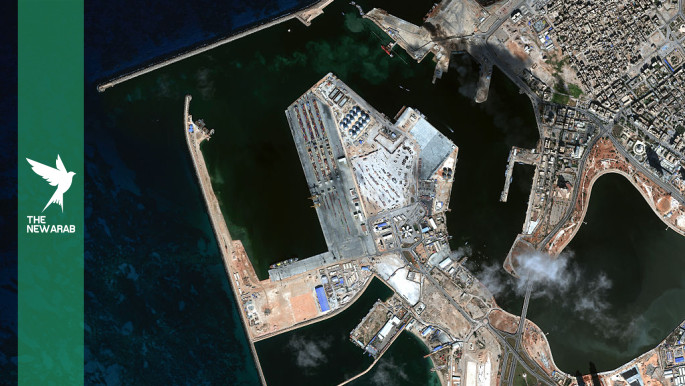
The Ukrainian government has confirmed that its naval drones hit the Russian corvette Merkury and Russian dry cargo vessel MV Angara over the weekend. The former was reportedly sunk while docked at the port of the eastern Libyan city of Benghazi.
Ukraine’s strikes on Russian assets in eastern Libya have become the latest indicator that Kyiv’s reach has expanded across the wider maritime region beyond the Black Sea and the Caspian Sea.
“It appears that Ukraine is threatening one of Russia’s most vital remaining maritime trade routes,” Paul Warburg, a geopolitical analyst who closely tracks the Russia-Ukraine conflict, told The New Arab.
The war between Ukraine and Russia has recently intensified, with the Crimean Bridge seriously damaged ahead of Russian President Vladimir Putin’s visit to Shenzhen, China.
“That bridge collapse closed the only channel past Crimea that was deep enough for heavy maritime traffic, effectively blocking off the Sea of Azov,” Warburg added.
“The route through the Sea of Azov was a vital entry point to Russia’s interior canal system, and the only alternative route into that canal system with access to open ocean is around the vicinity of Saint Petersburg.”
The Security Service of Ukraine (SBU) is the counterintelligence agency reportedly behind the attacks. The SBU has taken a lead role in tracking and targeting Russian interests in the Middle East and North Africa.
The Ukrainians said the Russian ships were travelling as part of a convoy along Russia’s “Libyan Express” route through the Mediterranean. The naval drones were launched from a mothership by the SBU.
Peace talks recently held in Abu Dhabi have yielded few results, other than a POW exchange. As the Russia-Ukraine conflict continues to stretch into the Middle East, how will it impact Russia’s positioning in the region?
Russia’s Libyan footprint
Moscow began growing its influence in Libya during the second Libyan civil war, sending private military contractors to back the militias in eastern Libya.
“Russian forces have been present in eastern Libya since at least 2019 through what used to be known as Wagner forces,” Alissa Pavia, a non-resident senior fellow with the Atlantic Council’s North Africa Program, told The New Arab.
In Libya’s eastern region, Russia has established strong ties to Khalifa Haftar, the Libyan strongman who controls a rival Libyan government based in Tobruk. This relationship has allowed Moscow to access airbases, ports, and facilities to maintain a logistical node between the Mediterranean and Africa.
Russia began growing its influence in Libya during the second Libyan civil war, sending private military contractors Wagner to back militias in the east. [Getty]
“They helped Khalifa Haftar mount an offensive over Tripoli, which failed, and solidify Russia’s power projection in the Mediterranean,” Pavia added.
Haftar and his son, Saddam, control the Libyan National Army (LNA), the rival Libyan faction based in Tobruk.
Following the fall of the Bashar Al-Assad regime in late 2024, the Russian military began to transfer its assets from Syria to eastern Libya. Along with the port facilities, Russia has six airbases in eastern Libya as part of its regional network.
Moscow is keen to maintain a transportation network that links the Africa Corps, the Russian security firm that ultimately replaced Wagner. Using Libya-based installations, Russia can pursue their interests in sub-Saharan Africa, most notably Chad and the Central African Republic.
The recent Ukrainian attacks in Libya have forced Russia to consider its position in North Africa and beyond.
“This may also have a side effect of pressuring Russia’s Africa Corps, which is supplied through Libya, but it’s unlikely that this was the main focus of the mission,” Warburg told The New Arab.
Diplomatic implications
In response to the incident, the United Nations Support Mission in Libya (UNSMIL) posted a statement that stressed “Libya’s sovereignty, territorial integrity, the security of its citizens, and its resources must be fully respected”, but avoided blaming Ukraine.
For its part, the Libyan government based in Tripoli also condemned the attack. The Foreign Ministry posted on Facebook, “The continuation of the war between Russia and Ukraine gives neither side the right to conduct military operations on Libyan territory or in its territorial waters.”
Libya’s prime minister, Abdul Hamid Dbeibeh, heads the Government of National Unity (GNU), the internationally recognised interim government of Libya based in Tripoli.
However, Libyan sources have told Reuters that the Ukrainians have their own presence in western Libya, training the forces loyal to the GNU. Tripoli has called for Russia to pull out of eastern Libya but still aims to maintain diplomatic relations with Moscow.
Vantor satellite image shows a cargo vessel moored alongside a concrete quay in Benghazi on 22 November as smoke billows over the adjacent waterfront. [Satellite image (c) 2026 Vantor]
“Ukraine has had a contingent of personnel in western Libya since 2024-25 when it struck a deal with Debibah’s GNU. In exchange for access to Libya’s West, Ukraine provides training to Libyan forces as well as deterrence against Russia,” Pavia explained to The New Arab.
“Ukraine wants to demonstrate its reach beyond the Black Sea maritime route. The Mediterranean is important to Russia because it uses its waterways to divert sanctioned oil through shadow fleets and support its forces in sub-Saharan Africa.”
Ukraine has struck Russian interests in Africa before, including allegedly targeting Russian contractors assisting the Rapid Support Forces (RSF) in the Sudan conflict.
Elsewhere in the Sahel, Russia has previously faced setbacks with attacks by Tuareg rebels and Al-Qaeda affiliate groups in northern Mali. In November 2026, reports said that Russia had lost some 300 fighters from attacks in Mali.
Rebels with the Azawad Liberation Front have indicated their objective is for Russia to withdraw and stop its support to the Junta ruling in Bamako.
Russia, although facing multiple security dilemmas, still retains significant partnerships in North Africa, most notably with Algeria, and will attempt to shore up its security interests in the region.
“If anything, Russia allocating resources to Africa would be a benefit to Ukraine, as any assets taken there are de facto being taken away from the current frontlines,” Warburg said.
“On its own then, pressuring Russia in Libya does not seem to be a sufficient explanation for Ukraine’s actions here. We have to look at the broader picture and the surrounding context.”
What’s ahead for a divided Libya?
The internationally recognised government in Tripoli is still looking to shore up a long-term political agreement that helps the country achieve stability after years of instability.
Dbeibeh has worked to build up his government’s relations in the region, including a visit to Egypt, which has previously backed the rival government of Khalifa Haftar in the east.
Egypt recently restored relations with Tripoli, including opening an embassy in the capital. Cairo is keen to expedite the energy and power grid projects that Egypt has with Libya.
For its part, Turkey, the primary backer of the Tripoli government, has been engaged in serious negotiations with Haftar to achieve long-term stability by forging a unity government.
Regarding the recent attacks, Dbeibeh publicly voiced concern, calling the security incidents with Russia and Ukraine a “dangerous gamble” that posed a threat to Libya.
The tensions come as US Libya envoy Massad Boulos is working to finalise a unity agreement that strengthens Libya’s national government and sees the country hold new elections.
However, privately, the presence of Ukraine in western Libya might be an asset to Dbeibeh’s long-term interests. “The timing is relevant because the United States is brokering a power-sharing agreement between the rival parties, the GNU and LNA,” Pavia told The New Arab.
“The agreement would see Dbeibah as prime minister and Haftar as President. Ukraine was only capable of striking Russia with the GNU’s consent, which Dbeibah likely gave to impose his leverage on the negotiations and express his dislike for the current agreement.”
Distrust and tensions between the two Libyan factions remain. However, the overlap of the Russia-Ukraine conflict into North Africa might yet generate new outcomes in Libya that remain to be seen.
Christopher Solomon is a Middle East analyst, researcher, editor, and writer based in the Washington, DC area. He is the author of the book In Search of Greater Syria (Bloomsbury)
Follow him on X: @ChrisGSolomon
Edited by Charlie Hoyle