On Christmas Eve 1944, Marines serving in the 6th Division crowded around a parade ground on Guadalcanal, an island in the South Pacific where American and Japanese forces had fought a major battle two years earlier. The players wore dungarees or shorts, with no protective gear between them and the field’s hard dirt and sharp coral. The Marines called it the Football Classic, but it later became known as the Mosquito Bowl.
Prior to their service, the men on the field had played at some of the country’s biggest football programs. Between the 4th and 29th Regiments were three former All-Americans and seven college captains. A few had been drafted into the NFL before the war interrupted their careers.
All told, 65 Marines played in the Mosquito Bowl. Just over three months later, the 6th Marine Division invaded Okinawa, Japan, where 15 of those players were killed.
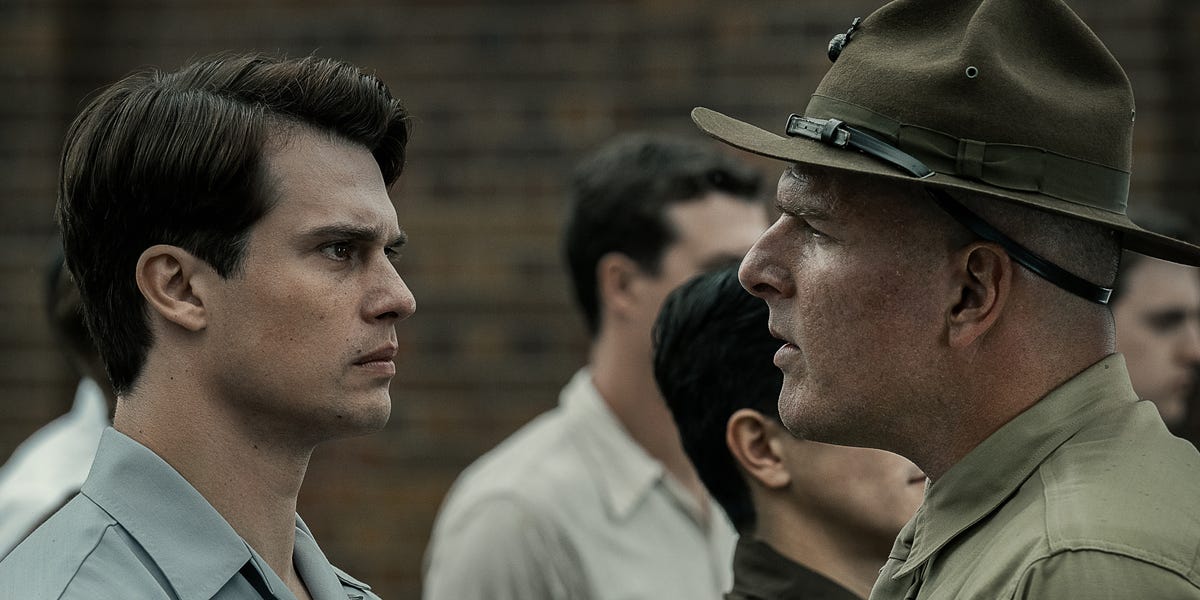
Buzz Bissinger told their story in his 2022 nonfiction book, The Mosquito Bowl: A Game of Life and Death in World War II. Now, director Peter Berg has adapted the book for Netflix’s The Mosquito Bowl. Here’s what to know about the real-life game.
How Did the Mosquito Bowl Begin?
Guadalcanal had been the site of fierce fighting earlier in the war. By late 1944, the island was being used to train and organize the 6th Marine Division for its next operation. Their destination was still a secret.
The 4th and 29th Regiments soon began arguing over who had the stronger football roster. Their commanders gave them a chance to settle it on the field.
The Marines went all-out for the big game, printing programs and rigging a public-address system so an announcer could call the action. Regimental bands performed before kickoff, with the division’s commanding general watching from a coconut-log bench. The Armed Forces Radio Service, nicknamed “The Mosquito Network” even broadcast the game to service members across the South Pacific.
At least 1,500 Marines gathered around the field. Warm beer was available, and bets were quietly placed on the outcome.
Who Played in the Mosquito Bowl?
Netflix’s film concentrates on four players whose football careers were interrupted by the war.
John McLaughry arrived on Guadalcanal with a season of NFL football behind him. He captained Brown’s team in 1939, where his father coached, and earned All-American honors before joining the New York Giants in 1940. He helped organize the 4th Regiment’s team and played in its backfield.
Two of his teammates came from the University of Wisconsin. Dave Schreiner had been a two-time All-American end and the Big Ten’s most valuable player in 1942. The Detroit Lions selected him 11th overall in the 1943 NFL draft.
Bob Bauman had played tackle and punted for Wisconsin. He had already enlisted in the Marines when the Chicago Bears drafted him in 1943. He and Schreiner later served as first lieutenants in the same company.
The 29th Regiment had Tony Butkovich, a fullback from the small Illinois mining town of St. David. He began college at the University of Illinois before transferring to Purdue through a military training program.
Butkovich led the country with 833 rushing yards during Purdue’s undefeated 1943 season. He scored 16 touchdowns in seven games, a school record he still shares. The Cleveland Rams chose him with the 11th pick in the 1944 NFL draft, though he never got to play for them.
How Did the Mosquito Bowl End?
The Football Classic kicked off at 2:15 p.m. on December 24. The teams had agreed to play touch football, but the arrangement quickly gave way to full tackling.
The coral tore through clothing and skin. McLaughry wrote home that his dungarees were “torn to hell” and his knees and elbows were a “bloody mess” by the end of the game. Neither regiment managed to score. In the final minutes, the 29th Marines were moving the ball when Bob Spicer of the 4th intercepted a pass. The game ended in a 0-0 tie.
A rematch was proposed, but Colonel Alan Shapley, commander of the 4th Marine Regiment, wouldn’t allow it. His Marines were preparing to return to combat, and he didn’t want them risking injuries in another game.
What Happened to the Players After Guadalcanal?
The 6th Marine Division left Guadalcanal in March 1945 and landed on Okinawa on April 1. The battle continued for nearly three months and became one of the deadliest campaigns of the Pacific war.
Butkovich, 23, was killed by a sniper on April 18. Bauman was wounded the same month. On June 6, he was given command of A Company and died in combat that day.
Schreiner, a platoon leader in the same company, was hit during one of the final operations of the battle. He died on June 21, only hours before the Marines announced that organized resistance on the island had ended. His final letter reached his parents four days after his death, before they’d learned he had been killed.
After making it home from Okinawa, McLaughry returned to football. Brown hired him as head coach in 1959, and he stayed for eight seasons.
By the time the fighting on Okinawa was over, 15 of the 65 soldiers who played in the Mosquito Bowl had died, and about 20 more had been wounded.
How to Watch The Mosquito Bowl
The Mosquito Bowl is now streaming on Netflix.
Director Peter Berg, who helmed Friday Night Lights, adapted The Mosquito Bowl: A Game of Life and Death in World War II for the movie. “This is very much a reality-based film,” Berg told Netflix’s Tudum. “We are representing forces larger than ourselves—honoring the men of the Marine Corps who sacrificed their lives in 1944 and 1945.”
Nicholas Galitzine stars as McLaughry and Bill Skarsgård plays Bauman, with Ray Nicholson as Butkovich and Tom Francis as Schreiner.

Eric Spitznagel is a frequent contributor to magazines like Playboy, Esquire, and the New York Times, and was employed for over two decades by the Second City comedy theater, where Stephen Colbert was his Secret Santa _twice.