
Satim.co
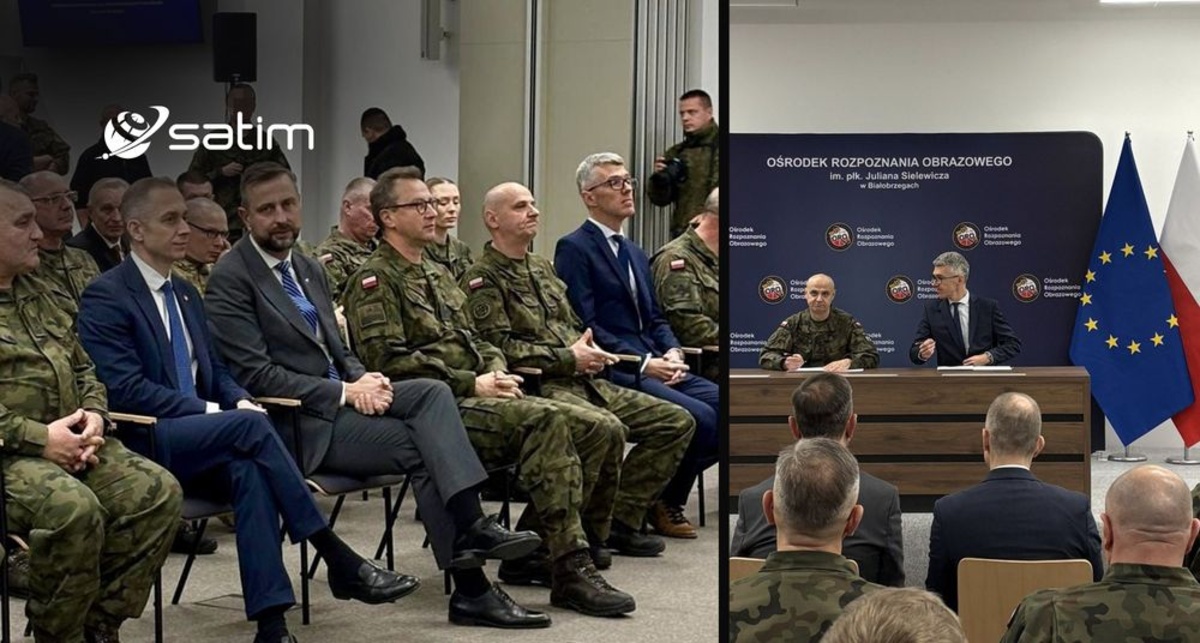
Poland’s Ministry of National Defence opened a new building for its Imagery Intelligence Center (Ośrodek Rozpoznania Obrazowego, ORO) in Białobrzegi on Nov. 25 and signed an agreement with SATIM, a Kraków software company, to adapt AI algorithms to radar-satellite data and train military analysts. The military already flies four radar satellites, so the scarce resource is no longer images but the people and software that read them. The software that anchors the effort was bought on a single bid, and no independent accuracy evaluation of it appears in the public record reviewed for this article.
Poland Owns Four Radar Satellites, So Reading Images Is Next Limit
Until recently, Poland relied on imagery from systems owned by other countries, and in urgent situations the military could not always get the pictures it needed, said Col. Leszek Paszkowski, head of the Agency for Geospatial Reconnaissance and Satellite Services (ARGUS), in an Interia interview. That has changed. In an interview published Nov. 3, Paszkowski told Defence24 that Poland has eight military satellites in orbit, four MikroSAR radar and four MikroGlob optical, with two more radar and two French-built optical satellites to join them for 12 by the end of 2027. Deputy Defense Minister Cezary Tomczyk echoed that timeline on Nov. 25 and called satellites “the eyes of the Polish army,” as translated here from his Polish remark.
The radar system, called MikroSAR, was built by a consortium led by Finnish satellite maker ICEYE, with WZŁ-1, part of the PGZ defense group, providing the ground segment. The contract was worth about €200 million ($219 million) according to Defence-Industry.eu, and each satellite can image at a resolution of up to 25 centimeters (9.8 inches). Forsal put the same program at PLN 860 million gross (approximately $210 million) when it was signed.
More satellites mean more images. Paszkowski said ARGUS expects image volume that cannot be processed by hand, and that no system can yet replace an analyst, so the agency is pursuing AI and machine-learning tools that can search imagery for military activity or vehicles with set characteristics. SATIM’s president, Jacek Strzelczyk, has gone further, saying the constellations Poland is acquiring will produce thousands of images a day, a claim that appears in sponsored content on Defence24 and is a vendor’s estimate.
Nov. 25 Agreement Covers POLSARIS Data Adaptation and Analyst Training
The agreement was signed by Paszkowski and Strzelczyk, for the ministry and SATIM respectively, with Deputy Prime Minister and Defense Minister Władysław Kosiniak-Kamysz and Tomczyk attending. It covers developing and deploying technology that automatically detects and classifies objects in synthetic aperture radar (SAR) imagery, and SATIM will help the armed forces adapt AI algorithms to data from the POLSARIS constellation, part of MikroSAR. It also includes knowledge transfer and specialist training so analysts can use automated SAR analysis in daily operations. Kosiniak-Kamysz said innovation, space activities and AI are helping create a new kind of armed force that does not yet have a name. Space24’s report disclosed no financial terms, duration or milestones for the agreement.
ORO is a specialized military unit that acquires, processes and analyzes satellite and aerial imagery for the armed forces and state security, and it operates within ARGUS. The Białobrzegi site has long been tied to satellite intelligence. A 2015 Rzeczpospolita report on the then-new unit said the town near Warsaw would host Poland’s only ground station for receiving satellite data. Space24’s coverage of the opening gives no building details beyond its location and opening date, and the reports reviewed do not say whether it houses that ground station.
Single Bid and Expedited Procedure Marked PLN 15 Million OREC Purchase
The agreement follows a software purchase made public on Nov. 12 and 13. The contract with SATIM Monitoring Satelitarny is worth exactly PLN 15,073,650 (approximately $3.68 million). It buys SATIM software that Space24 identifies as OREC, a server version with 30 client interfaces plus a separate radar-data simulator for creating military equipment signatures, both on perpetual licenses, with 12 months of technical support.
The tender was run by the 2nd Regional Logistics Base for ARGUS, only one offer was submitted, and the military justified an expedited procedure by citing threats on the eastern border and a need for faster identification of objects, terrain changes and activity seen from orbit. Tender documents date the signing to Oct. 28, while Space24 reports the order as placed at the start of November. The sources reviewed do not state which legal basis allowed a single-bidder, expedited award, so that question remains open.
Reports disagree on where delivery stands. Spider’s Web reported delivery scheduled for the end of November, while Space24 says ARGUS already uses OREC and SATIM says it has been handed to ORO as end user. Both can be true if delivery is staged, but no source explains it.
How Does AI Read Radar Images, and Why Is It Hard to Check From Outside?
SAR satellites send microwaves toward the ground and record what bounces back, which lets them image day or night and through heavy cloud. What comes back is how strongly each surface returns the signal, not a picture the way a camera records one, and NASA notes that the side-looking geometry makes SAR imagery hard to interpret. In a release published by Technode, SATIM describes SAR analysis software that detects and classifies hundreds of objects across vessels, aircraft and vehicles and produces alerts, reports and machine-readable outputs. The release does not name OREC.
Three facts make independent checking difficult. First, the package includes a simulator that creates equipment signatures, and research on SAR target recognition shows that models trained on synthetic images often generalize poorly to real measurements: Camus, Le Barbu and Monteux found that simulated images do not closely match real radar measurements, and they reported 75% accuracy for their own approach built to cope with that gap. That paper does not test OREC; it shows why accuracy measured on simulated or vendor data may not carry over to real operational data. Second, the SATIM release states no accuracy figures, and the product claims that have circulated come from the company or from sponsored content. A sponsored Defence24 article attributes to SATIM more than 300 object classes and recognition with up to 95% accuracy, without saying what test conditions apply. Third, the European Union’s AI Act excludes military systems placed on the market or put into service exclusively for military, defense or national security purposes, so its transparency rules do not apply by default, though the exemption does not cover a system later used for civilian or law-enforcement purposes.
The human side matters as much as the algorithm. In a Bloomberg Businessweek report published Feb. 28, 2024, Col. Joseph O’Callaghan of the 18th Airborne Corps said human analysts identify targets correctly about 84% of the time, compared with roughly 60% for the Maven targeting system, figures the report attributes to him rather than to a formal test. A separate study of West Point cadets found they showed less automation bias, the tendency to over-trust machine output, than the general public, which suggests training can change how analysts treat software. Spider’s Web’s own caution fits that point: automatic identification can be wrong, so results need checking against other information, and the tool is meant mainly to shorten the time from receiving an image to analyzing it. That is the part of the Nov. 25 agreement that outside observers will be able to judge over time: whether the training component produces analysts who verify the software rather than defer to it.
SATIM Also Supplies Rheinmetall for Germany’s SPOCK-1 Program
SATIM is a Kraków company that develops AI for automated analysis of SAR imagery. Its chief technology officer, Stanisława Porzycka-Strzelczyk, said she was glad the technology had earned the trust of the ministry, ARGUS and ORO, as Space24 reported it. SATIM signed a technology supply agreement with Rheinmetall to support a German customer’s SAR program. Spider’s Web identifies that program as SPOCK-1 and says it entered operational testing in early November. At the MSPO 2026 defense fair, the company showed a new version, OREC Evolve, which received a commendation from the Operational Commander of the Armed Forces in the military reconnaissance category, according to Defence24’s sponsored article.
What Is Still Unknown About Building, Funding and AccuracyThe agreement’s value and length. No financial terms, duration or milestones have been reported.The building. No size, cost, schedule or capabilities are public, and it is not stated whether it houses the ground station.Accuracy. The public record reviewed contains no independent accuracy figures for OREC or for the models SATIM will adapt to POLSARIS data.Funding relationship. It is not stated whether the training and algorithm work follows on from the OREC purchase or is funded separately.Procurement basis. The legal basis for the single-bid, expedited award is not stated in the sources reviewed.
For readers tracking Poland’s military space program, the practical takeaway is that the satellites are the settled part: four radar spacecraft are in orbit and Polish operators run them. The open question is whether software chosen on one offer, bundled with a simulator that generates equipment signatures and outside EU AI rules by default, can be shown to work on Polish radar data. Independent testing, published accuracy figures and analyst training results would answer it. Until they appear, accuracy figures for OREC remain company claims.
Exchange rates as of Nov. 25, 2026 (National Bank of Poland and European Central Bank); conversions are approximate.
Frequently Asked QuestionsCan radar satellites see through clouds?
Yes. SAR imaging works regardless of time of day or weather, including heavy cloud cover, and Space24 presents radar data as a complement to optical sensors rather than a replacement for them.
How many military satellites does Poland have?
Eight in orbit as of Paszkowski’s Nov. 3 account, four radar and four optical, with 12 planned by the end of 2027. Six of the 12 are to be radar and six optical.
Does the EU AI Act regulate military AI like OREC?
Not by default. Article 2(3) excludes military-only systems used exclusively for military, defense or national security purposes, and Recital 24 treats national security as a Member State matter. A system used later for civilian or law-enforcement purposes can fall back into scope.
Who checks whether OREC’s detections are correct?
The sources reviewed name no independent evaluator. Paszkowski has said no system can replace an analyst, and the Nov. 25 agreement includes specialist analyst training.