Yasin Gungor
25 November 2026•Update: 25 November 2026
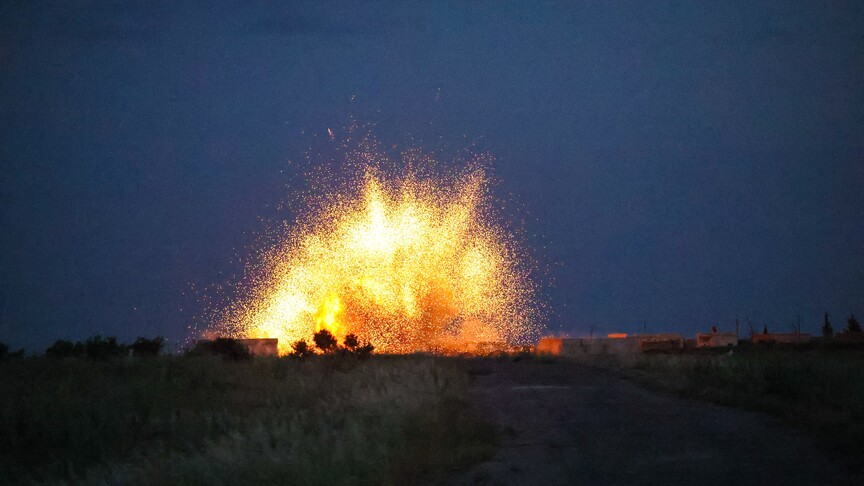
Following a court challenge and under government safety measures, the US Army early Wednesday carried out a controlled detonation of 4.4 metric tons of deteriorating lead azide explosives at an army ammunition plant in the Midwestern state of Iowa.
Adam Telle, acting secretary of the army, said the controlled blast “exceeded all expectations” and was a “huge success,” adding that “the threat of an uncontrolled spontaneous detonation has been eliminated.”
Praising soldiers for their precision and thanking US President Donald Trump for mobilizing a “whole of government approach,” Telle added that officials are closely monitoring the US Environmental Protection Agency’s (EPA) sensor array across the area and have recorded “no readings so far above 0.0.”
“Early reports from Iowa are that the army’s mitigation efforts have far exceeded expectations,” Trump said following the operation in Middletown.
Maj. Gen. Eric Shirley, commanding general of the US Army Sustainment Command, told an interagency briefing that immediate overhead imagery confirmed that all the lead azide barrels were definitively eliminated, with no secondary explosions, debris kickout, or infrastructure damage in or around the installation.
Tarayıcınız video oynatmayı desteklemiyor.
Air, soil, and water samples
He said mister systems ran continuously during the blast and that fire trucks applied more than 3,600 gallons (13,627 liters) of aqueous foam, which accounted for most of the visible plume, adding that the operation reduced health and safety risks to residents in Middletown and surrounding Iowa communities “as close to zero as is absolutely humanly possible.”
The EPA deployed teams to collect air, soil, and water samples around the site.
“The lead levels are coming in so low that it is equaling no detection. That’s coming from some sensors closest to the detonation,” EPA Administrator Lee Zeldin told CNN.
Zeldin also encouraged residents to wipe down outdoor surfaces frequently touched by children, including playsets and railings, with a wet cloth.
He said officials were prepared to take comprehensive measures to mitigate any risks to surrounding communities.
Separately, Federal Emergency Management Agency Administrator Cameron Hamilton told Fox News that explosives connected to a timed charge appeared to have fully ignited.
Hamilton described the operation as “a fully and complete successful detonation.”
Missouri Gov. Mike Kehoe, whose state borders Iowa to the south and sits along the projected path of any airborne dust plume, said that preliminary analysis shared by federal partners and Iowa Homeland Security and Emergency Management indicates “the mitigation measures appear to have been successful and the explosion was well-contained.”
Authorities evacuated residents within 8 kilometers (5 miles) of the plant before the blast and ordered those within 32 kilometers to shelter in place.
The operation followed an order late Monday from the US Court of Appeals for the Eighth Circuit clearing the detonation, after Trump temporarily paused the plan pending judicial approval and consultation with Iowa Gov.-elect Rob Sand.
Officials had warned that the aging bomb-making chemicals, stored in 68 drums since 2009, posed a growing risk of spontaneous explosion if left untreated.