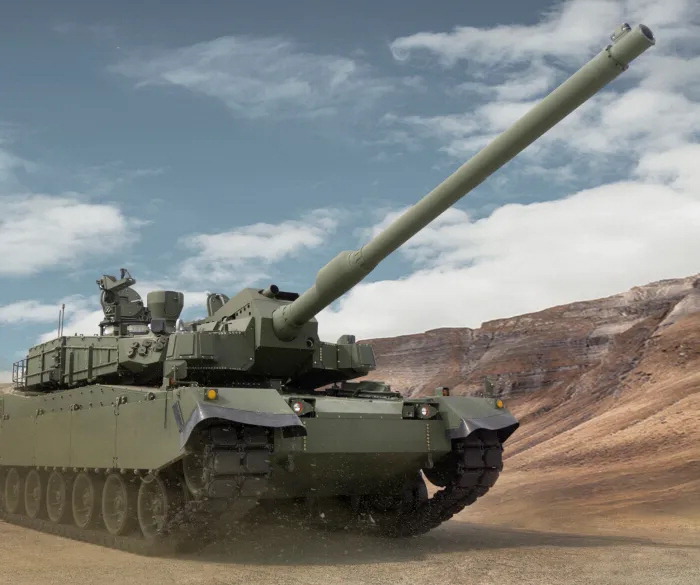
 사진 확대 Hyundai Rotem’s K2 tank.
As drones have emerged as a key tactical factor capable of determining the outcome of battles, South Korea’s first tank equipped to intercept drones will be unveiled next year. According to defense industry sources on the 28th, Hyundai Rotem, the manufacturer of the K2 tank, South Korea’s flagship tank, will launch a prototype of a Korean-made drone-interception active protection system (APS) next year. Hyundai Rotem has been developing the Korean APS in cooperation with Israel’s Rafael Advanced Defense Systems since last year, and the first product optimized for the K2 tank is now set to be released.
An APS is a defensive system that detects incoming antitank missiles, rockets and other threats before launching interceptor munitions to destroy them before they hit the tank. In the wars in Russia and Ukraine and conflicts in the Middle East, inexpensive drones have repeatedly disabled costly tanks. Even tanks protected by thick armor are vulnerable to drones that attack their relatively less-protected upper sections. As more drones are equipped with antitank weapons or used to strike vulnerable areas, APS technology has emerged as a key factor determining tank survivability.
Rafael Advanced Defense Systems, the defense contractor that developed Israel’s Iron Dome air-defense network, which has recorded an interception rate in the 90% range, possesses substantial interception capabilities. Hyundai Rotem aims to gain an edge in future global tank procurement competitions by strengthening the drone-interception capability long regarded as a chronic weakness of South Korean tanks. The company plans to build its first prototype in South Korea next year and verify its performance. It also intends to be ready to shift immediately to mass production if orders are secured.
The world’s major tanks are already moving toward adopting active protection systems. The U.S. M1 Abrams has been fitted with Rafael Advanced Defense Systems’ drone-interception weapon system, the Trophy active protection system (APS), since 2022. Germany’s Leopard 2 has also been mass-producing models equipped with Trophy since last year. The ability to independently detect and intercept incoming threats, in addition to firepower and mobility, has become an essential requirement for next-generation tanks.
The K2 is regarded as one of the world’s most advanced tanks, equipped with a 120 mm smoothbore gun, an autoloader and an advanced fire-control system. However, its ability to defend against drones has been cited as a weakness. As U.S. and German tanks competing in global procurement contests have successively adopted APS, calls have grown for the K2 to upgrade its protection system. If the Korean-made APS is installed on the K2 from next year onward, it is expected to address much of this weakness. Securing a protection system tailored to the K2, rather than purchasing a foreign system without modification, could also improve its competitiveness in upgrades required by export customers and in follow-on logistics support.
[Reporter Kim Jeong-hwan / Reporter Choo Dong-hoon]
This article has been translated by GripLabs Mingo AI.