
The Defense Department has selected four vendors for a pilot program that aims to expand the operational use of high-energy laser and high-powered microwave capabilities within the homeland, according to a Pentagon release issued Monday.
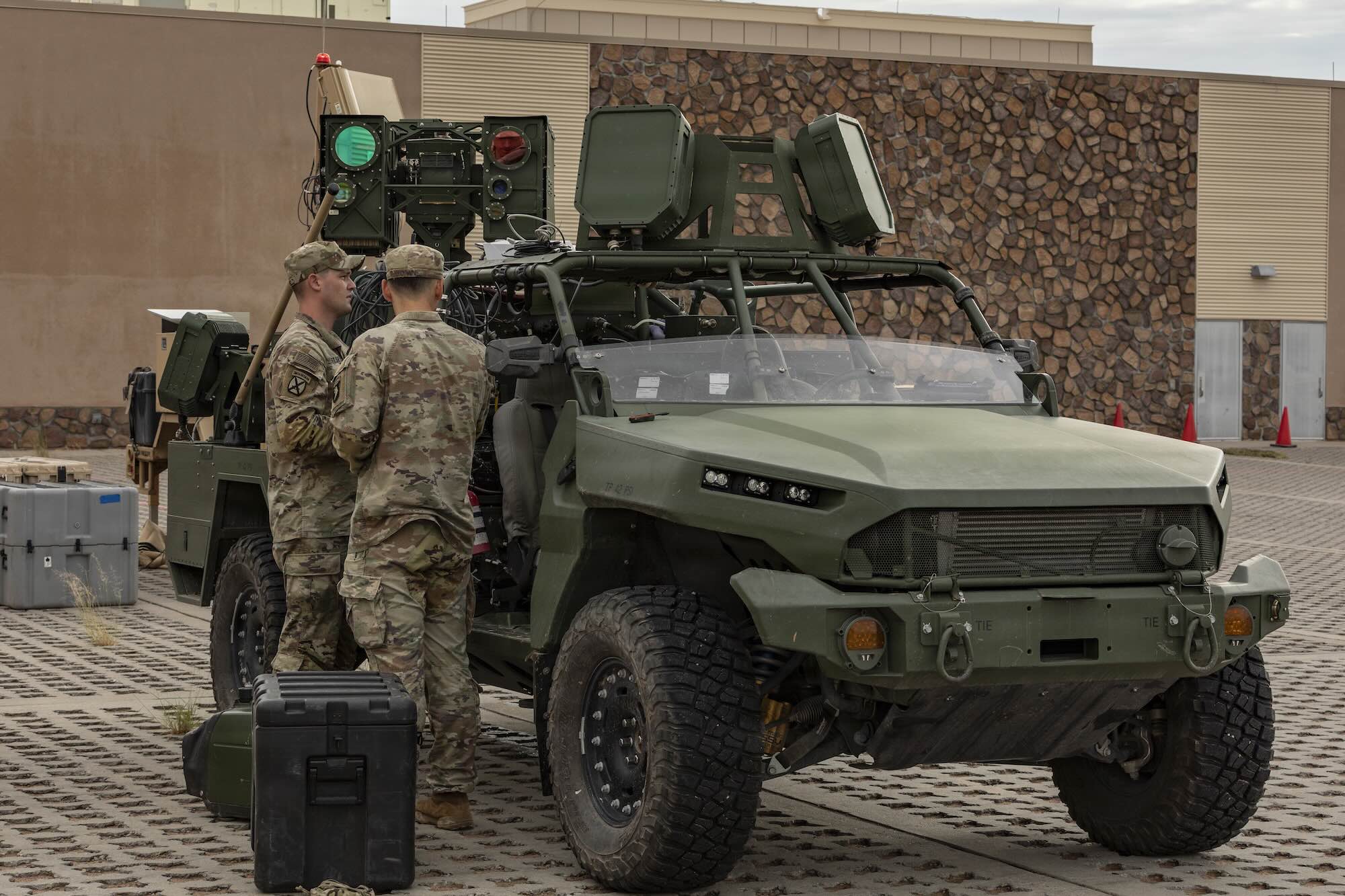 U.S. Soldiers assigned to 1st Armored Division, Joint Task Force–Southern Border (JTF–SB) in support of Operation Ardent Vanguard, prepare an Army Multi-Purpose High Energy Laser (AMP-HEL) system mounted on an Infantry Squad Vehicle (ISV) for assessment during an exercise at Fort Bliss, Texas, Sept. 16, 2026. Photo by Sgt. Dominic Atlas.
The pilot was ordered by the fiscal 2026 National Defense Authorization Act and is run by Joint Interagency Task Force 401, the Army-led organization created to consolidate counter-small-UAS activities across federal agencies and allied partners. The release said the task force will conduct the program in “close coordination” with the Federal Aviation Administration, U.S. Northern Command and the military services. The program is meant to produce real-world data on operational requirements, costs and best practices for directed-energy systems.
The four systems
The selected systems are AeroVironment’s Palletized High-Energy Laser, Epirus’s Leonidas high-powered microwave system, Kord’s Firefly High-Energy Laser and Boeing’s Compact Laser Weapon System. The release does not say which system will go to which installation.
“High-energy lasers and high-powered microwave systems are tools that can be effectively used in a layered drone defense,” said Army Brig. Gen. Matt Ross, director of Joint Interagency Task Force 401, in the release. “This pilot program will test these capabilities in an operational environment so we can understand how best to integrate and sustain them to defend the homeland.”
Ross also framed directed energy as one layer among several. “There is no silver bullet, or one size fits all solution to countering the threat of drones,” he said. “Directed energy gives commanders another option within a layered defense, complementing existing counter-UAS capabilities with a scalable, safe, and effective way to respond to drone threats.”
The pilot arrives as the Army is already using directed energy on the southern border. Pentagon News reported August 31 that service members with Joint Task Force-Southern Border used the Army Multipurpose High Energy Laser to stop three hostile unmanned aircraft believed to be linked to drug cartels, the first use of the system against cartel-linked drones along the border.
Airspace safety after El Paso
The release put heavy emphasis on coordination with the FAA. That partnership follows a February incident in which the agency temporarily closed airspace around the airport in El Paso, Texas, after a miscommunication among federal agencies over Customs and Border Protection’s use of a counter-drone laser. CNN later reported that the laser was on loan from the Army.
Since then, the task force has worked with the FAA on a risk assessment during a high-energy laser demonstration in New Mexico. The release said the system “posed a minimal risk to the National Airspace System.” The FAA said in an April 10 release that it and the Pentagon completed a safety assessment after observing demonstrations the previous month, and announced a safety agreement for a high-energy laser counter-drone system to protect the southern border.
“Following a thorough, data-informed Safety Risk Assessment, we determined that these systems do not present an increased risk to the flying public,” said FAA Administrator Bryan Bedford.
Sites and next steps
JIATF-401 named five host installations in May: Fort Huachuca, Arizona; Fort Bliss, Texas; Naval Base Kitsap, Washington; Grand Forks Air Force Base, North Dakota; and Whiteman Air Force Base, Missouri. The Pentagon said then that the locations were chosen to support testing across diverse environments and mission sets, including the southern border, and that deployment plans would be finalized with installation commanders over 180 days so operations could begin later this year.
“We showed that directed-energy systems can counter drone threats while preserving the safety of air travelers,” said Scott McLellan, deputy director of JIATF-401, at the time of the May announcement. “This pilot program now allows us to translate that progress into evolving operational capability for the homeland.”
The task force will also hold a directed-energy shoot-off in December at Dugway Proving Ground, Utah. The release said the Defense Department and the task force will continue to evaluate additional directed-energy systems beyond the four selected. Ross said in August that systems that perform well at the shoot-off could be bought on the spot, Breaking Defense reported, and task force officials have said additional locations could be announced.