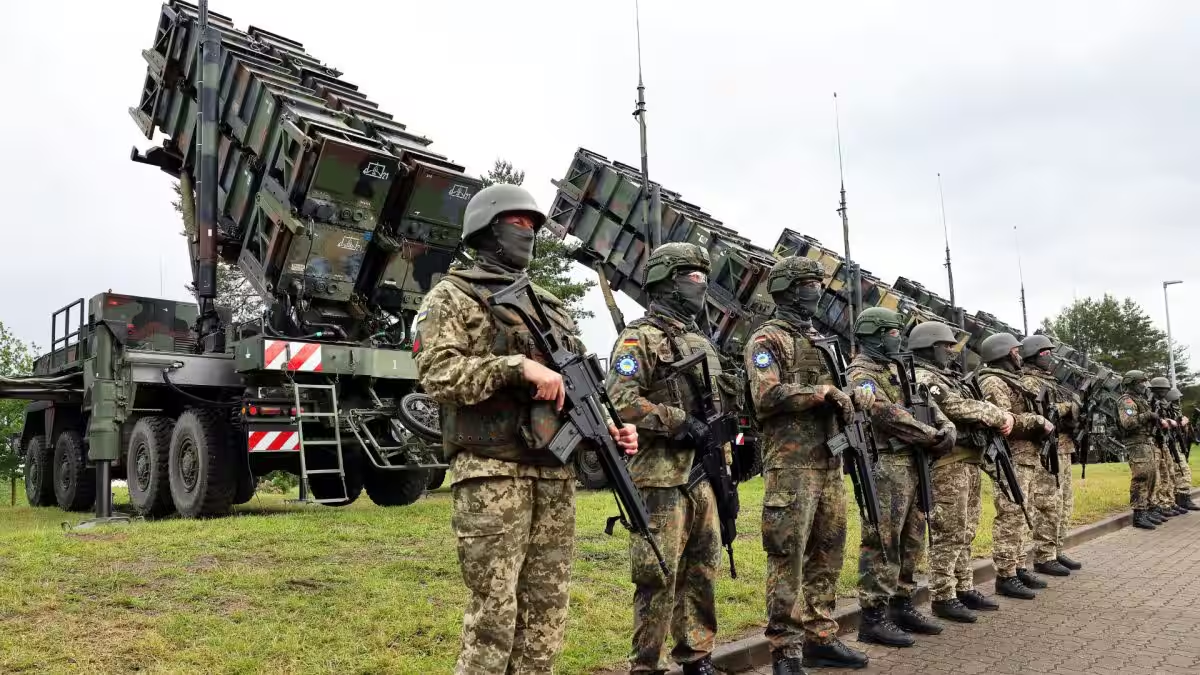
Ukraine has reportedly run out of US-made Patriot interceptor missiles as Russia escalates its attacks on Ukrainian cities and energy infrastructure. With limited alternatives, strained Western weapons supplies, and growing tensions between Donald Trump and Volodymyr Zelensky, how will Kyiv defend itself against Russian ballistic missile strikes?
Ukraine has reportedly exhausted its available supply of US-made Patriot interceptor missiles, raising concerns about its ability to defend major cities and critical infrastructure against Russian ballistic missile attacks.
While Ukraine has several air defence systems capable of intercepting drones and cruise missiles, its ability to stop some of Russia’s fastest and most destructive ballistic weapons depends heavily on advanced interceptors that are expensive, difficult to manufacture and increasingly scarce.
What happened to Ukraine’s Patriot missile supply?
Ukraine has run out of Patriot interceptor missiles, according to a source familiar with the situation who spoke to CNN on Thursday.
The shortage has left the country increasingly vulnerable to Russian ballistic missile attacks, particularly against major urban centres and essential energy infrastructure.
The immediate concern follows a Russian assault overnight into Wednesday when missiles struck three power plants in Kyiv and targeted energy infrastructure in Kharkiv.
The attack killed four people in the Ukrainian capital and injured 25 others as more than 600,000 residents lost electricity.
According to the source cited by CNN, “almost all the ballistic missiles from the last strike were not intercepted due to lack of the (interceptor) missiles.” Ukraine’s Air Force had previously reported shooting down four Russian ballistic missiles during the assault.
 More from Explainers
Ukrainian officials have repeatedly warned that the country was approaching the limits of its available supply, with President Volodymyr Zelenskyy publicly appealing to allies for additional missiles.
Ukrainian officials had told CNN in August that the country had almost exhausted its interceptor stocks. Zelenskyy said he was spending his days making “millions” of phone calls to allies in an effort to secure more supplies.
He also indicated that Ukraine possessed only around a tenth of the interceptor missiles it urgently required.
The situation briefly appeared more promising in September, when Zelenskyy said Ukraine “will receive a license to manufacture Patriot missiles” from the United States. However, US President Donald Trump did not confirm that he would approve such an arrangement, and the proposed licence did not materialise.
With Russian attacks continuing and temperatures beginning to fall, the immediate question is whether Kyiv can secure additional interceptors before further strikes damage its electricity supply and other critical infrastructure.
What are Patriot missiles?
The Patriot, short for Phased Array Tracking Radar for Intercept on Target, is an advanced ground-based air defence system developed in the United States.
It is used by the US military and several Nato allies to protect strategic locations from airborne threats, including ballistic missiles, cruise missiles and military aircraft.
The system was developed by defence companies including Raytheon, now part of RTX, and Lockheed Martin.
Its importance lies in its ability to engage threats that are difficult for conventional air defence systems to intercept, particularly ballistic missiles travelling at extremely high speeds.
A Patriot battery brings together several components that work in coordination to detect, track and destroy incoming weapons.
Radar system: The AN/MPQ-65 radar tracks airborne threats and supplies information needed to engage them.
Engagement control station: Operators use this command facility to assess incoming threats and direct the system’s response.
Launch stations: Mobile launchers carry interceptor missiles that can be fired against selected targets.
Interceptor missiles: Different variants, including PAC-2 GEM-T and PAC-3 MSE, provide the system’s ability to engage different aerial threats.
The PAC-3 MSE interceptor is particularly important when confronting ballistic missiles. It uses hit-to-kill technology, meaning it destroys a target through a direct collision rather than relying solely on the blast of a conventional proximity-fused warhead.
This capability matters because ballistic missiles descend towards their targets at tremendous speeds, leaving air defence crews with little time to respond. Some of the weapons used by Russia, including Iskander-M ballistic missiles and the air-launched Kh-47M2 Kinzhal, present particularly difficult interception challenges.
The Kinzhal is described by Russia as a hypersonic missile, while the Iskander-M is a short-range ballistic missile. Both are designed to reach targets quickly, complicating the task of detecting, tracking and engaging them before impact.
Other systems available to Ukraine, including NASAMS, IRIS-T and older Soviet-designed S-300 batteries, contribute to the country’s wider air defence network. They can be used against various combinations of aircraft, cruise missiles and drones.
However, they do not provide an equivalent substitute for the Patriot’s specialised ballistic missile defence capability. Europe’s SAMP/T system, which uses Aster 30 interceptors, offers another option for engaging certain ballistic threats, but its availability is limited.
Intercepting a relatively slow-moving drone and destroying a ballistic missile travelling at several times the speed of sound require different capabilities. Without suitable interceptors, even an operational Patriot launcher cannot provide its intended protection against incoming ballistic weapons.
Why does Ukraine need Patriot missiles to fight Russia?
Russia’s campaign against Ukraine has increasingly involved attacks on energy infrastructure, industrial facilities, military installations and major population centres.
The ability to defend these targets has become especially important as the country approaches another winter amid the continuing war.
Russian attacks have combined different types of weapons, placing pressure on Ukraine’s air defence network.
Large numbers of Shahed-type attack drones can be deployed alongside cruise missiles and ballistic weapons, forcing Ukrainian defenders to identify and respond to threats arriving from different directions and at different speeds.
This places considerable demands on air defence crews and their ammunition supplies. Interceptors must be allocated across multiple locations, while commanders have to decide which facilities require the strongest protection.
Patriot batteries have helped Ukraine defend major cities and strategically important sites, including locations around Kyiv and other urban centres.
With fewer Patriot interceptors available, Ukraine’s military may have to prioritise the most strategically important targets. Protecting one location could mean accepting greater risks elsewhere, particularly if Russia launches several waves of missiles.
The challenge is not simply the number of launchers available. A functioning battery requires suitable missiles to engage incoming threats, and each interceptor used reduces the ammunition remaining for subsequent attacks.
Ukraine could also be forced to rely more heavily on alternative systems to protect important urban areas and infrastructure. Moving shorter-range systems away from other positions, however, could create new vulnerabilities.
Reduced protection along parts of the front could give Russian aircraft greater opportunities to operate closer to Ukrainian positions. Russian Su-34 fighter-bombers, for example, can deploy guided glide bombs, including weapons from the FAB-500 and FAB-1500 families, against Ukrainian defensive positions.
A decline in protection against ballistic missiles could also end up undermining public confidence, disrupting commercial activity and threatening the work of diplomatic missions and international aid organisations.
Patriot missiles cannot prevent every attack, nor can air defence alone determine the outcome of the war. But their scarcity makes it more difficult for Ukraine to protect its most important assets against weapons that can cause extensive damage in a short period.
What role has the Iran war played in depletion of Patriot missile stocks?
Unlike many conventional weapons, advanced air defence interceptors cannot be replenished quickly. Their production involves specialised rocket motors, radar seekers, guidance electronics and other complex components.
Manufacturing capacity, the availability of materials and the time required to assemble and test each missile all limit how quickly new supplies can reach the battlefield.
Global production of PAC-3 MSE interceptors had previously been around 400 to 500 missiles annually, before more recent expansion efforts. But supply-chain constraints put the lead times at approximately 18 to 24 months for some components and production orders.
During an intensive missile attack, defenders may have to fire several interceptors to counter incoming threats. Across a prolonged conflict, the resulting expenditure can outpace the rate at which manufacturers deliver replacements.
The missiles are also expensive with individual interceptors costing between $3 million and $5 million, depending on the variant and other factors.
The ongoing conflict in West Asia has added pressure to the defence market for advanced air defence weapon as US military forces and regional partners used substantial quantities of interceptors to defend commercial shipping and allied positions against missile and drone attacks.
These operations have involved several weapon types, including Patriot interceptors, Terminal High Altitude Area Defense (THAAD) missiles and Standard Missile variants used by naval forces.
The result is competition for weapons that are already difficult to produce in large quantities. The United States must consider the needs of its own armed forces and its commitments to partners in the West Asia and Indo-Pacific, alongside requests for assistance to Ukraine.
European countries seeking to purchase American interceptors for transfer to Kyiv also face the challenge of securing supplies from a constrained production pipeline.
Even when governments are willing to provide financial assistance or buy weapons on Ukraine’s behalf, deliveries depend on manufacturing capacity, procurement arrangements and competing requirements.
Has the rift between Trump and Zelenskyy worsened the crisis?
In recent days, the Trump administration has faced criticism over a deal to import Russian diesel. Zelenskyy said he felt betrayed by the arrangement and maintained that Ukraine would continue attacking Russian oil refineries.
The disagreement has broader implications because the US administration has also pressed Ukraine to halt strikes against Russian energy infrastructure.
Washington has linked the conflict to rising global diesel prices, with Trump increasingly blaming the war between Russia and Ukraine for fuel-price increases ahead of the US midterm elections.
Zelensky has sought to make additional air defence supplies a central part of the dispute. In an interview with the Financial Times, he said he could agree to stop Ukraine’s attacks on Russian energy facilities only if Kyiv received more Patriot interceptors at a “minimum.”
He also alleged that Washington’s response to his requests for additional air defences was to restrict a different form of support, saying “when he asked for more air defences the American response was to weaken Starlink’s service.”
On Wednesday, Zelensky renewed his appeal for American assistance, stating, “The American president has all the effective and necessary tools to bring peace closer through strength, justice, and pressure on the aggressor. We ask for additional packages of Patriot missile interceptors for Ukraine.”
Earlier this week, two European officials told CNN that the Trump administration had warned Ukraine and its European partners that Washington could suspend European purchases of American weapons and halt intelligence-sharing arrangements supporting Kyiv if Ukraine continued its deep strikes against Russian energy facilities.
One mechanism potentially affected by such a decision is the Prioritized Ukraine Requirements List, known as PURL. It allows participating European countries to finance purchases of American weapons intended for Ukraine. If Washington suspended or disrupted those purchases, future deliveries of Patriot interceptors could be put at risk.
What alternatives does Ukraine have?
Ukraine has several options for strengthening its air defences, but none offers a straightforward replacement for the Patriot’s ability to engage certain ballistic missiles.
Europe’s SAMP/T air defence system
France and Italy could help Ukraine by accelerating deliveries of SAMP/T systems and their Aster 30 interceptors. The European system offers a capability to engage certain ballistic missile threats and could help reduce Ukraine’s dependence on American equipment.
However, European countries have limited inventories of these systems, and expanding production takes time. Additional deliveries would therefore depend on both political decisions and the availability of equipment and ammunition.
FrankenSAM systems
Ukraine and the United States have worked on adapting Western missiles for use with older Soviet-designed air defence launchers.
These hybrid arrangements, commonly referred to as FrankenSAM, include integrating weapons such as the RIM-7 Sea Sparrow and AIM-9M with legacy systems including the S-300 and Buk.
Such adaptations allow Ukraine to make greater use of available equipment and ammunition.
They can contribute to defending against drones and cruise missiles, but they do not provide a like-for-like substitute for Patriot interceptors against demanding ballistic missile threats such as the Iskander-M and Kinzhal.
F-16 and Mirage 2000 fighter aircraft
Western-supplied F-16s and Mirage 2000s can also contribute to Ukraine’s air defence. Equipped with appropriate air-to-air weapons, these aircraft can engage certain cruise missiles and attack drones, potentially reducing the burden on ground-based systems.
Their usefulness is nevertheless limited by the type of threat. Fighter aircraft cannot simply replace specialised ground-based interceptors when it comes to stopping fast-moving ballistic missiles.
Their role is to strengthen the wider defence network rather than eliminate the need for Patriot systems.
Domestic missiles and long-range strike drones
Ukraine is also seeking to expand its domestic weapons production, including long-range missiles and strike drones such as the Palianytsia rocket-drone.
Rather than relying exclusively on intercepting incoming Russian weapons, Kyiv can attempt to disrupt the attacks before they take place. Striking Russian missile production facilities, weapons depots and airfields could complicate Moscow’s ability to sustain its campaign.
This approach, however, is not a direct substitute for air defence. Even successful attacks on Russian military infrastructure cannot guarantee that Ukraine will be able to prevent incoming missiles from reaching their targets.
Ultimately, Ukraine needs a layered defence in which different systems perform complementary roles.
With inputs from agencies