The US Defense Intelligence Agency (DIA) has assessed that China could place space-based directed-energy weapons in orbit by the late 2020s. The forecast appears in the DIA’s 2026 edition of its “Challenges to Security in Space” report, underscoring that US intelligence agencies now identify both China and Russia as the primary threats in the militarization of space.
According to the report, China already possesses multiple ground-based laser systems capable of dazzling, degrading, and damaging low-orbit satellites. The DIA went further, projecting that by the late 2020s China could deploy directed-energy weapons in space and develop even more powerful ground-based systems capable of threatening satellites in orbit. Directed-energy weapons use concentrated electromagnetic energy—such as lasers or high-power microwaves—to disrupt or damage targets. Lasers can temporarily blind a satellite’s optical sensors or, at higher power levels, damage sensitive components, while other forms such as high-power microwaves can disrupt a satellite’s electronics.
The report also noted that China has tested ground-based anti-satellite missiles and demonstrated satellite refueling in geostationary orbit last year. Geostationary orbit lies roughly 36,000 km above the equator, and China is the first country to demonstrate such refueling capability beyond low-Earth orbit. The DIA also said China has tested a robotic arm capable of grappling spacecraft in space and operates a fleet of TJS-series satellites that maintain persistent proximity to foreign spacecraft.
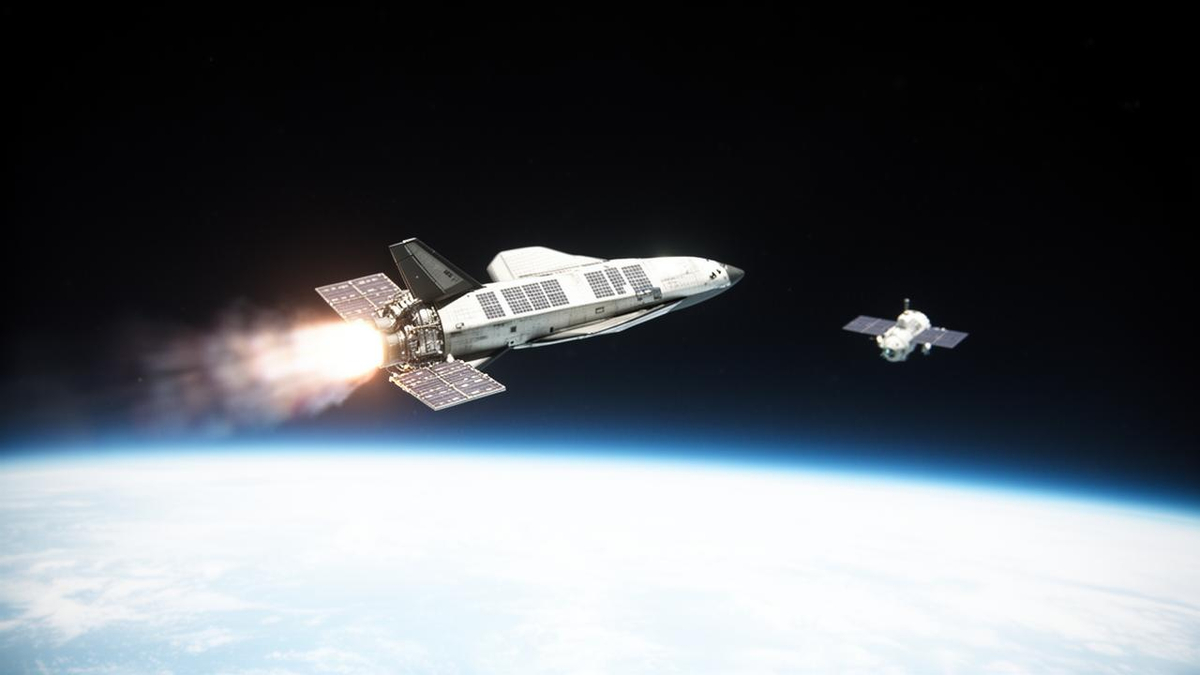
Observations surrounding China’s secretive Shenlong spaceplane were also fleshed out in the report. High-resolution imagery of Shenlong captured by a US commercial satellite in 2024 was made public for the first time in the DIA report. The craft’s configuration—featuring delta wings, a payload bay door, a dark-colored thermal protection blanket, and a rear-mounted solar panel service module—is assessed to closely resemble the X-37B spaceplane operated by the US Space Force.
The imagery was taken by commercial imaging firm Vantor, then known as Maxar, in 2024. The company supplies global reconnaissance imagery to the US military and intelligence agencies, using non-Earth imaging (NEI) technology that repoints Earth-observation satellite telescopes to photograph objects in space. A US Space Force official disclosed Maxar’s observation at a conference held in South Korea in 2024, but this marks the first time the US Department of Defense has released the original-resolution imagery to the public.
Shenlong has flown four missions since 2020, with its longest flight lasting nine months. The fourth mission vehicle, launched last February, is currently in orbit. It is not publicly known how many of the spaceplanes China possesses. The US Space Force operates two X-37Bs on a rotating basis, and of its eight missions to date, the longest lasted two years and six months from launch to landing. Most of the X-37B’s orbital activities are also classified.
Like the X-37B, Shenlong is launched inside the payload fairing of a conventional rocket, operates in orbit like a satellite, and autonomously lands on a runway without a crew when its mission is complete. The DIA explained that the spaceplane’s “enhanced maneuverability” makes it better suited to certain missions than traditional satellites. Shenlong has so far flown only in low-Earth orbit at altitudes of several hundred kilometers, but the US Space Force’s X-37B once climbed to an altitude of more than 24,000 miles (about 38,600 km) before using aerobraking to shape its reentry trajectory.
Spaceplanes can also deploy small satellites from their payload bays. China recently demonstrated the ability to capture objects in orbit as well. According to an analysis of publicly available orbital tracking data by astrophysicist Jonathan McDowell, the Shenlong currently in orbit released a small satellite last June and retrieved it in July, repeating the same experiment in August and September.
The report also assessed Russia. The DIA said that despite the broad weakening of Russia’s space industry following its invasion of Ukraine, Moscow continues to develop a range of weapons systems to disrupt or destroy satellites. Among the kinetic-energy weapons capable of permanently disabling satellites is the Burevestnik, which is launched from a modified MiG-31 fighter jet to attack satellites. The DIA explained that this system can place a weapon into a satellite’s orbit with no warning or very little warning time. Another system, Nivelir, destroys other satellites by firing a projectile from a satellite, and the Russian military simulated such an attack in 2020. Last April, Russia launched small satellites into orbits near ICEYE, a commercial radar satellite that provides reconnaissance imagery to Ukraine, and one of them reportedly approached to within tens of meters earlier this month before withdrawing.
US intelligence agencies also reiterated their existing assessment that Russia is developing a nuclear-armed satellite. US officials first disclosed that possibility in 2024. The DIA warned that a nuclear detonation in space could disable or degrade thousands of government and commercial satellites and create radiation belts that could persist for years. The Cosmos 2553 satellite, launched in February 2022, was cited as a related case. At the time, Russia said the satellite was intended to test electronic systems in a special orbital environment. US intelligence agencies this year described Russia’s development of a nuclear-based space weapon as “the single greatest threat to global space systems.”
The report also covered the military space programs of Iran and North Korea. The DIA classified them as emerging space powers and concluded that the space security environment is becoming increasingly multipolar.
Market observers suggest the assessment could spur demand related to space surveillance and reconnaissance and satellite protection. As technologies such as non-Earth imaging that use commercial satellites to identify a rival’s secret space assets become commercialized, government and military contracts could increase. Conversely, there are concerns that if countries rush to deploy space-based weapons, the risk of space debris and collisions could grow, raising insurance premiums and operating costs for private satellite operators. The US Space Force operates a constellation of surveillance satellites in geostationary orbit and has recently added satellites with refueling capability that reduce maneuverability constraints. US Air Force Secretary Troy Meink said last month that the US Department of Defense had deployed weapons in space, making the United States the first country to officially acknowledge possessing orbital weapons.