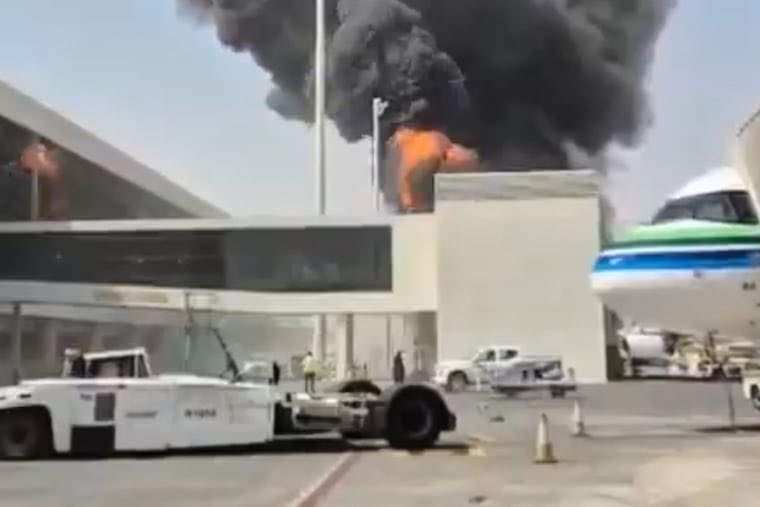
 America-friendly Saudi Arabia has been hit several times by Iran-backed Houthi rebels based in neighbouring Yemen, and some of the attacks have killed Indian expatriate workers. Photo courtesy: X/ @DefenseNewsIN
Twenty-two Indians, including 14 seafarers, have been killed in the ongoing Middle East (aka West Asia) conflict and India is “deeply concerned” over the overall situation in the region, the Ministry of External Affairs (MEA) said on Wednesday.
MEA spokesperson Randhir Jaiswal said that three Indians were killed in Saudi Arabia. “We are deeply concerned about the ongoing conflict in West Asia. We have lost 22 Indian nationals in the conflict, including 14 seafarers,” he said at his regular media briefing.
VIDEO | MEA spokesperson Randhir Jaiswal says, “We are deeply concern with the ongoing conflict in the West Asia. So far, we have lost 22 Indian nationals, including 14 seafarers…” pic.twitter.com/KlQ00wRwF0
— Press Trust of India (@PTI_News) October 28, 2026
“We remain in close touch with our community in the Gulf region for their safety and wellbeing. Three Indians have lost their lives in Saudi Arabia,” said the MEA official.
1/4
Saudi Arabia spends $75B+ a year on defense. Yet in Oct 2026, Houthi missiles and drones have hit Riyadh Airport, Dammam Airport, and Aramco’s Dhahran HQ at will.
3 core lessons for India on why “checkbook air defense” fails in a war of attrition: 🧵👇 pic.twitter.com/u4n8QN8yIh
— Defense News IN (@DefenseNewsIN) October 26, 2026
This year’s Middle East conflict began at the end of February, following attacks on Iran by the United States and Israel.
New Delhi has been consistently calling for finding a solution to the conflict through dialogue and diplomacy.
🇮🇳🇺🇸 India just told the U.S. to stop attacking ships in the Persian Gulf.
3 Indian sailors are dead after a US strike hit the MT Settebello in the Gulf of Oman yesterday. 24 Indians were aboard.
On the same day, a second Indian vessel, MT Jalveer, also came under fire off… https://t.co/iBgnYK2pYM pic.twitter.com/kBS9T548xx
— Mario Nawfal (@MarioNawfal) June 11, 2026
Despite a ceasefire agreement of sorts between the United States and Iran — inked by both sides in June — there has been a sudden escalation in tensions in the Middle East recently, as the Yemen-based Houthi militia entered the conflict and carried out several strikes on Saudi Arabia.
India has been voicing serious concern over the Houthi attacks on Saudi Arabia’s civilian infrastructure and economic assets, including Riyadh airport and Aramco headquarters.
New Delhi has said that such strikes undermine regional stability and threaten freedom of navigation through the Bab-el-Mandeb strait.
Egypt’s parliament has authorised military support for Saudi Arabia to defend against Houthi attacks.
The move comes amid growing threats to the strategic Bab el-Mandeb Strait, a vital gateway to Egypt’s Suez Canal.
🔴 LIVE updates: https://t.co/CGN2TYxg31 pic.twitter.com/chlwzZcCAM
— Al Jazeera English (@AJEnglish) October 26, 2026
The Iran-backed Houthi militant group had attacked Saudi Arabia’s East-West oil pipeline, which is considered very crucial for supply of crude oil.
Ever since the conflict involving Iran disrupted shipping through the Strait of Hormuz, the East-West pipeline has served as a critical bypass for Saudi Arabia’s oil exports.
The Houthi attacks have also triggered concerns over the safety of the Bab-el-Mandeb shipping lane.
Bab-el-Mandeb is one of the world’s most critical maritime chokepoints, located between the Horn of Africa and the Arabian Peninsula. It connects the Red Sea to the Gulf of Aden and the Arabian Sea.