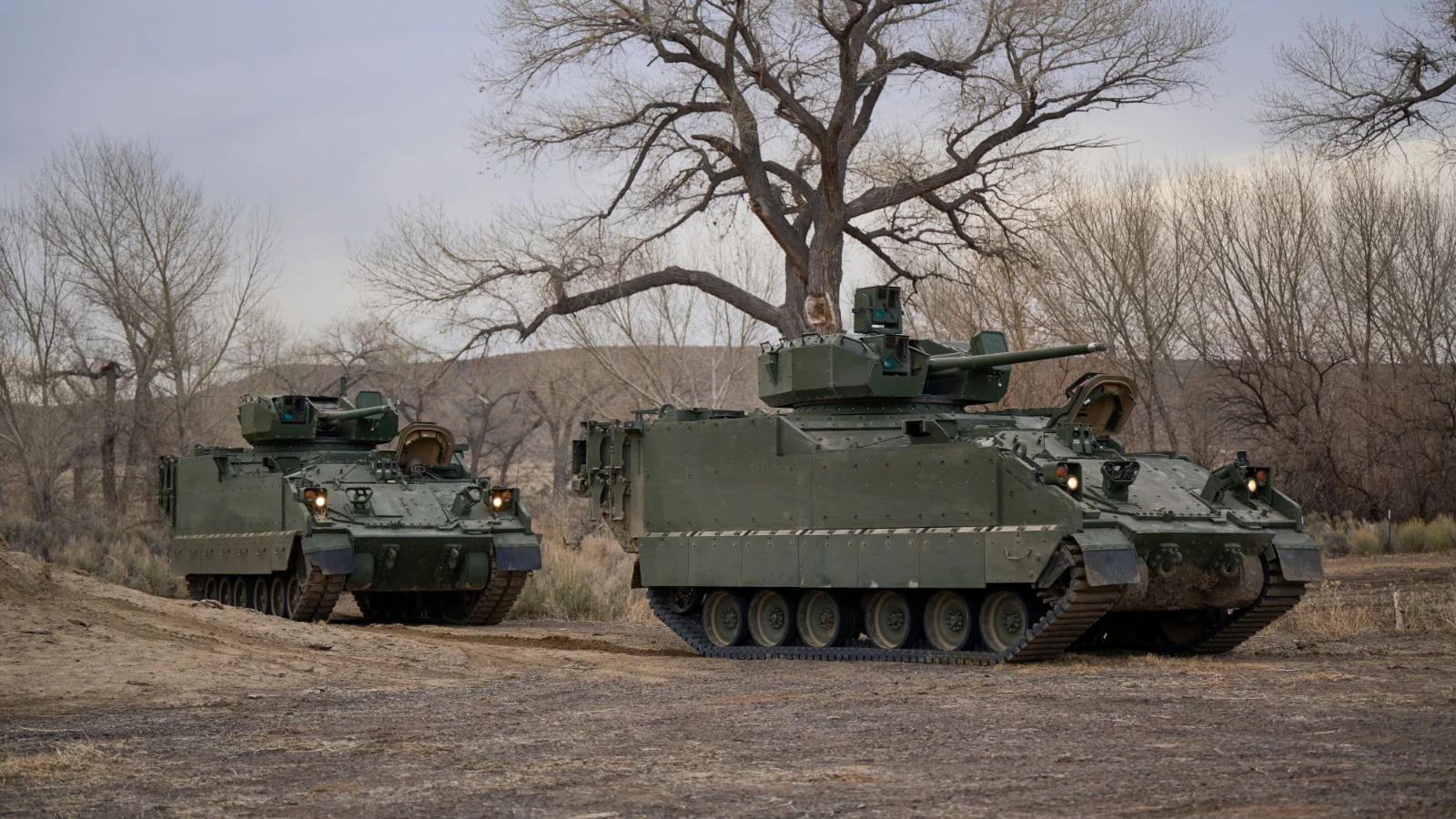
BAE Systems has added turrets to the AMPV turning the US Army’s M113 replacement into a potential IFV. This approach could provide a quick and effective route to a new IFV capability.
By Sam Cranny-Evans, editor of Calibre Defence, published on September 24, 2026.
BAE Systems Inc has delivered two Armored Multi-Purpose Vehicles (AMPV) armed with a Kongsberg Medium Calibre Turret to the US Army’s Transformation in Contact Unit, according to a September 22 press release.
Using internal R&D funding to the tune of $17 million, BAE states that the vehicles – which it calls AMPV 30 – were delivered in April this year to support the US Army’s Transformation in Contact 2.0 (TiC 2.0) initiative. Since then, they have been through a series of live firing trials and field evaluations to benchmark the vehicles against what US soldiers require, the press release states.
TiC 2.0 is prioritising organic C-UAS capabilities as well as electronic warfare and C2 dispersal to improve the survivability of mechanised formations. It is also supporting some conceptual work around the use of UGVs and drones at lower echelons.
Under TiC 2.0, units taking part in Combat Training Center rotations at the National Training Center or Joint Readiness Training Center, are issued prototype hardware and updated software suites directly. Feedback from those users is sent back to Program Executive Offices and industry partners, allowing software updates to be pushed in days or weeks and hardware configurations to be modified prior to formal deployment.
So, speed is essential for the TiC 2.0, and BAE emphasised that the AMPV 30s were developed in just six months, using the vehicle’s common top-plate, which allows a variety of turrets to be installed including automated mortars, amongst other things. BAE has invested in eight turreted prototypes in two years to support the US Army’s modernisation, the release adds.
The AMPV 30s also include a C-UAS capability, 360-degree situational awareness cameras, and a cross-platform hand-off capability.
AMPV background
The AMPV is based on the hull of the Bradley fighting vehicle. Instead of repurposing old hulls, however, the programme is introducing newbuilds in a bid to replace the US Army’s fleet of M113s. The full-rate production contract was awarded in 2023 and by late-2025, the company had delivered more than 500 AMPVs. The programme funding exceeds $3.2 billion and has delivered vehicles to several armoured brigade combat teams. BAE has supported several experimental efforts within the programme, which is important to note, as those efforts do not necessarily mean the US Army has plans to field the AMPV 30.
Calibre comment: The value of IFVs

One of the AMPV 30 vehicles in the hands of the US Army’s 1st Cavalry Division. The airburst ammunition carried by the turret is the C-UAS capability. Credit: US Army photo by Spc. Michelle Lessard-Terry
There is some operational analysis that shows IFVs have little value. That assessment is often based on the assessment that adding a cannon to an APC will encourage the crew to fight with it, exposing them to tanks and ATGMs amongst other things. The argument is that APCs should simply deliver infantry to an offensive, allowing them to do most of the fighting, presumably with the assumption that artillery, tanks, or airpower have suppressed the enemy.
The merits of this line of thinking do seem plausible in a vacuum, but it also ignores an equally straightforward logic. For example, in Ukraine, vehicles and their crews very quickly became separated from their wider units, and there are accounts of similar events occurring in Iraq. Israeli accounts from the Six-Day war also indicate that tanks and their crews could become separated, forced to fight independently. In that scenario, if an APC meets an IFV, it will be outgunned and it is very likely that the crew and vehicle will be destroyed. In a more unmatched scenario, where infantry have to face an IFV without support, the situation can be far worse. The following is an account from a Ukrainian soldier in 2022:
“Russian BTR vehicles I think are worse than tanks. The gun on them fires faster and they carry soldiers. If we see a BTR there are soldiers near it. If we see a tank sometimes it is alone and easier to destroy. Wounds from these are horrible. A whole leg can be removed. A shot to the body makes someone almost explode. They are easy to destroy but not good to fight directly.”
So, with that in mind, the addition of a turret to the AMPV is a sensible continuation of the IFV capabilities that the US Army has had since the 1980s. Yes, the Bradley replacement is underway, but the US Army – like most armies – is under pressure to modernise quickly and cost-effectively. With the AMPV already entering service, the “quick” addition of a turret could provide a very quick route to increasing infantry lethality.
The lead image shows two AMPVs with the Kongsberg Medium Calibre Turret. Credit: BAE Systems.