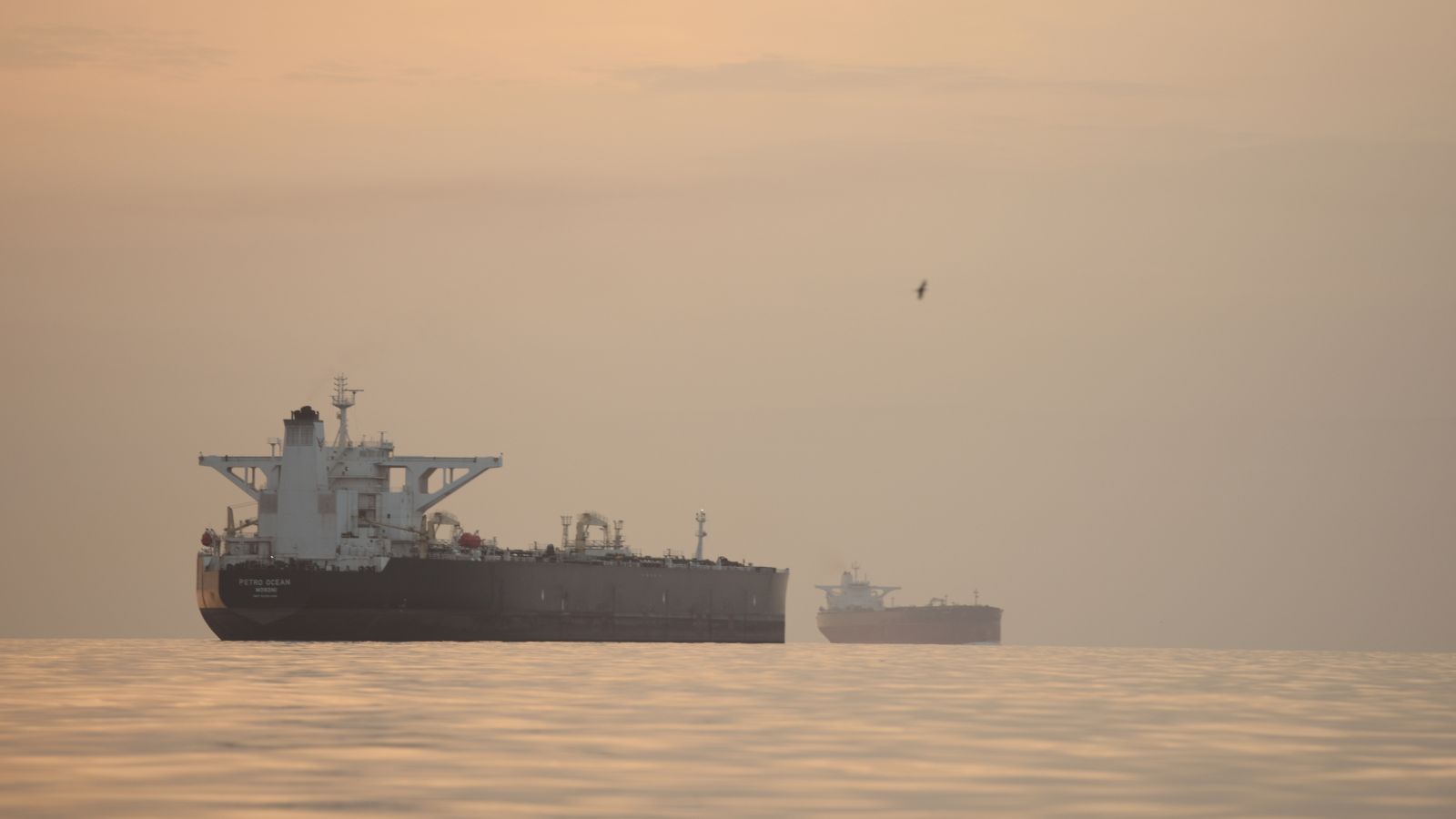
The United States has carried out fresh strikes in Iran’s Qeshm Island, US officials told The Wall Street Journal, even as President Donald Trump said talks with Tehran are making progress. The attack is the latest in a series of limited strikes that Washington has carried out in secret in recent weeks, according to the newspaper.
Some officials said the strikes were defensive and meant to stop Iran from attacking commercial ships in the Strait of Hormuz. Trump told reporters that “we haven’t been doing any fighting for months”, the Journal says.

The strike came as Trump said a deal is taking shape and as Iran said its plan to reopen the strait could now start within two days. No agreement has been announced, and the eight-month war is not over. Voters in the US go to the polls today in the midterm elections.
What happened at Qeshm Island?
The US official, who spoke on condition of anonymity, told AP that the targets were Iranians who used surface-to-air missiles against US assets. Some officials told the Journal the strikes were defensive, meant to stop Iran from attacking commercial ships in the Strait of Hormuz.
The attack appeared to be limited and not a return to full war. It came after Trump had said the US would not launch new strikes before the midterms. The Journal says it is the latest in a series of limited strikes that Washington has carried out in secret in recent weeks. The last attacks known before this one were in early September. US Central Command did not respond to a request for comment from Reuters.
Story continues below this ad
Express InfoGenIE · Iran war
Why Qeshm Island matters
Iran’s biggest island sits at the mouth of the Strait of Hormuz, the route for a fifth of the world’s oil. Tap the map points and cards.
As of Tuesday, Nov 3, 2026. The Qeshm strikes are a developing story. Ship positions on the map are illustrative, not live tracking.

PersianGulf
Gulf ofOman
IRAN
OMAN
UAE
OMAN
Bandar Abbas
Qeshm
Strait of Hormuz


Ships on the lanes (illustrative)
Qeshm Island
Strait of Hormuz
Tap a map point
Qeshm IslandStrait of HormuzPersian GulfGulf of OmanShipping route
Qeshm Island
Iran’s Qeshm is the largest island in the Persian Gulf (Britannica). It runs parallel to Iran’s coast, separated from the mainland by the narrow Clarence Strait, and sits beside Bandar Abbas at the western mouth of the Strait of Hormuz, overlooking the shipping lanes.
Strait of Hormuz
The only sea passage between the Persian Gulf and the open ocean. About 34 km (21 miles) wide at its narrowest; ships use one inbound and one outbound lane, each about 3 km (two miles) wide, with a buffer between them (US Energy Information Administration).
Persian Gulf
Home to the oil and gas exporters of Saudi Arabia, Iraq, Kuwait, Qatar, the UAE and Iran. For Iraq, Kuwait and Qatar, Hormuz is the only sea route out to world markets.
Gulf of Oman
Open water beyond the strait, leading to the Arabian Sea and on to Asia. The UAE’s bypass pipeline ends at Fujairah on this coast, letting some oil skip Hormuz.
Shipping route
Tankers and cargo ships thread the lanes between Iran’s islands and Oman’s Musandam peninsula. IMF PortWatch counted about 89 transits a day in February 2026; in March, after the war began, it was under 5 (as reported by EnergyNewsBeat, Sep 19).
Tap a card to see why it matters
1Qeshm’s location 2Shipping security 3Oil and gas
Strategic location
Why Qeshm sits at the centre of the story
Qeshm lies just inside the Persian Gulf at the mouth of the Strait of Hormuz, along Iran’s coast and beside Bandar Abbas. From its southern shore, the inbound and outbound shipping lanes run close by on their way through the strait.
No. 1largest island in the Persian Gulf (Britannica)
34 kmwidth of the strait at its narrowest (US EIA)
3 kmwidth of each shipping lane (US EIA)
Nov 2explosions reported on the island (IRNA)
One US official described the strikes as “defensive measures against Iranians using surface-to-air missiles against US assets”, The Jerusalem Post reported. Another said they appeared limited and were not a return to major combat.
Shipping security
Why the conflict keeps coming back to ships
Since the US-Israeli war on Iran began on Feb 28, traffic through the strait has collapsed and recovered in waves as ships were attacked and the US imposed a blockade on Iranian ports.
Feb 2026, before the war
89
Average daily transits through the strait, IMF PortWatch, as reported by EnergyNewsBeat (Sep 19).
30+incidents in October, the most in any month of the war (UKMTO)
145incidents recorded since Feb 28 (UKMTO)
10,000+US personnel enforcing the blockade of Iranian ports (US Central Command)
95%of ships in recent months crossed safely, Central Command says
UKMTO and Central Command figures as reported by The National, Oct 31. UKMTO counts only incidents reported by verified vessels.
Oil and gas
How disruption in Hormuz reaches the world
20mbarrels a day of crude and products passed through in 2025
25%of world seaborne oil trade
~20%of global LNG trade, mostly from Qatar
80%of the oil was bound for Asia; nearly 90% of the LNG
International Energy Agency, figures for 2025.
Oil through Hormuz, barrels a day. War-time figures: averages for March to May, and the IEA’s August estimate, as reported by EnergyNewsBeat (Sep 19).
Pipelines that bypass the strait can carry only part of the volume: the IEA estimates 3.5 to 5.5 million barrels a day of spare capacity, mainly Saudi Arabia’s East-West line to the Red Sea and the UAE’s line to Fujairah.
What are Trump and Vance saying?
Trump on a deal: At the Lincoln Memorial Reflecting Pool in Washington, DC, on Monday, he said a deal was “coming together very nicely” and linked it to the fall in oil prices. He also said Iran wants a deal and has asked the US to stop targeting its leaders, and that the US will do so, according to Anadolu.
Trump on the war: He said he did not know if it could be called a war, as “we haven’t been doing any fighting for months”. The war has cost US taxpayers at least $47 billion.
Trump on strikes: Reuters says he raised doubts about following through on a threat to resume strikes. On Sunday, he told Right Side Broadcasting Network that Iran would either make a deal or the US would end the war.
Vance: He said the US has made progress, has set no deadlines, and that Trump keeps military and non-military options. He said any deal needs a firm commitment, which can be checked, that Iran will not rebuild its nuclear programme. He said the US had destroyed it.
The letter: Vance sent a letter last week to Iran’s security chief, Mohsen Rezaei. Trump said it dealt with help on medical supplies and other things. Rezaei said the US tone has changed and called it a good sign, but gave no details and said he had not replied.
What does Iran want?
Iran says its seven-step plan has not changed but can now start within two days, not a week, foreign ministry spokesman Esmaeil Baghaei said. The plan includes a quick reopening of the Strait of Hormuz and a return to talks on its nuclear programme. Iran’s conditions are:
An end to the US naval blockade of Iranian ports
The repeal of sanctions
A guarantee that strikes will stop
A full ceasefire across the region, especially in Lebanon
Baghaei gave no sign that Iran had changed its demands or that Washington had accepted the plan. Iran also wants guarantees that the US will keep its side of any deal, AP says, as the US and Israel have twice attacked Iran during talks on its nuclear programme.
Iranian state media said Supreme Leader Mojtaba Khamenei gave the government powers to speed up talks, and President Masoud Pezeshkian said the same, according to Reuters. Khamenei also told military chiefs that any response to a threat should be immediate and not limited by geography. Foreign Minister Abbas Araghchi said Iran is ready for both diplomacy and conflict.
Why does it matter for the midterms and oil?
Politics: The midterms decide control of Congress. Reuters says the war is a leading cause of high gasoline prices and Trump is under pressure to end it.
Oil on Monday: Brent crude settled $8.66, or 7.63%, lower at $104.77 a barrel as hopes of talks grew. Trump claimed a fall of almost $10 a barrel, which is more than the figure Reuters gives.
Oil on Tuesday: After the strike report, Brent rose 48 cents, or 0.5%, to $105.25 by 0104 GMT. US West Texas Intermediate crude was up 47 cents, or 0.5%, at $96.93.
Market view: Tim Waterer, chief market analyst at KCM Trade, said the report put some risk back into the price after markets had begun to expect talks to lead somewhere.
Supply: The Strait carried about a fifth of the world’s crude oil and gas before the war. Brent ended October at a six-month high on fears of new escalation after the midterms, Reuters says. October also saw the most attacks on ships in the Strait since March.
How did the war begin?
The US and Israel attacked Iran on February 28, and Iran hit back across the region, according to Anadolu. A memorandum signed by Washington and Tehran in June did not end tension over security arrangements and shipping through the Strait.
Story continues below this ad
 Motorists ride past portraits of Iran’s Supreme Leader Mojtaba Khamenei in Tehran, Iran. (AP Photo/Vahid Salemi)
Thousands of US troops remain in waters off Iran to keep the blockade, and a third aircraft carrier is on its way. An AP analysis found that Iranian strikes on more than two dozen US bases have caused billions of dollars in damage.
Netanyahu’s push: Two regional officials and a third person told AP that Israeli Prime Minister Benjamin Netanyahu pressed Trump for new strikes after the US election in a call over the weekend. Trump did not commit. AP says a return to war could hel p Netanyahu form an emergency government after he lost his majority in last week’s election. Other US allies in the region warn that more strikes would destabilise the area.
Carlson’s claim: Commentator Tucker Carlson wrote on X that Netanyahu is pushing Trump so hard that the US may be within days of a nuclear strike on Iran. He said the target would be Pickax Mountain in central Iran, where Israeli intelligence claims Iran has restarted nuclear enrichment. He argued that no conventional US weapon can break through the rock above the tunnels, so a nuclear weapon would be the only military option. He said Trump could decide by November 7, but added that Trump is hesitating and is listening to Vance, who argues a deal can be made. Carlson cited an unnamed observer and gave no proof. None of the other reports used here say this, and it has not been confirmed.
Talks: Qatari mediators held two rounds of talks with Iranian officials last week and are working on a plan under which Iran would stop attacks in the Strait in return for the US lifting its blockade, two officials. More talks are planned this week. Iran says contacts with the US continue, after talks with Qatar ended with changed proposals but no breakthrough, Reuters says.
After the vote: Trump has said several times that the US could strike Iran after the midterms.
China: It will send a special envoy to Iran, Oman and Saudi Arabia in early to mid-November, AP reports.