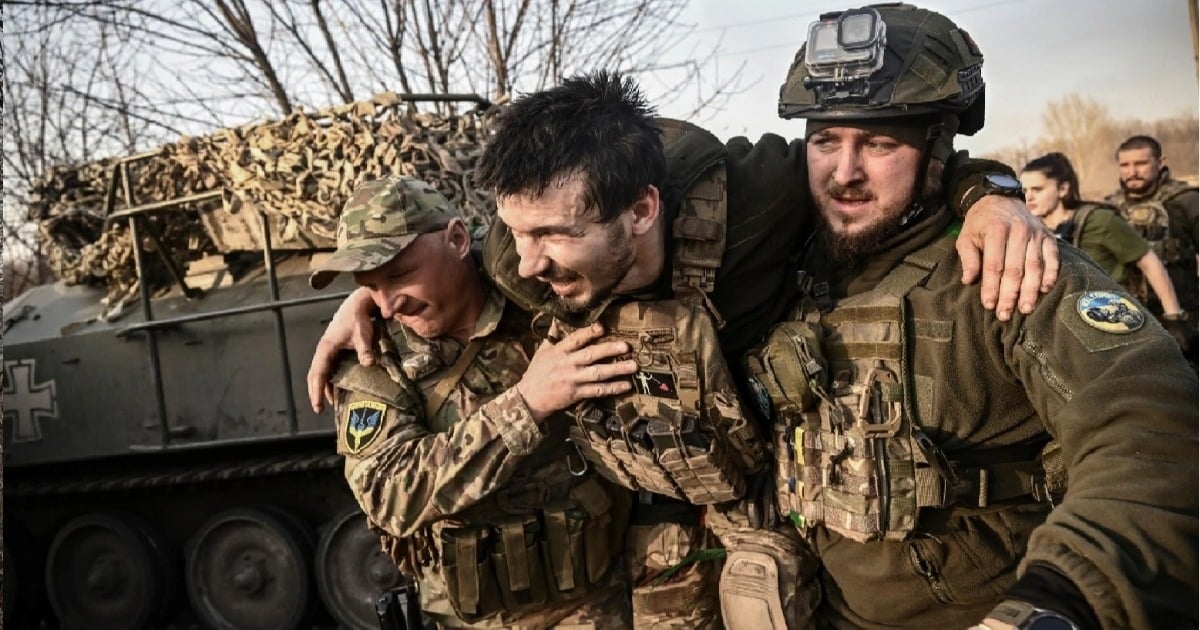

Ukrainian soldiers wounded in combat (Illustrative photo: AFP).
Both Russia and Ukraine have increased their attacks.
According to Rybar news agency, the Russian Armed Forces (RFAF) launched a new large-scale coordinated attack targeting the bridge at Zatoka. Preliminary data indicates the structure was attacked by UAVs, various types of cruise missiles, and FAB glide bombs. In addition to the Odessa region, Geran UAVs also attacked several locations in central Ukraine – including Kyiv – leading to power outages.
The Ukrainian Armed Forces (AFU) continue to deploy UAVs. The Russian Ministry of Defense announced that it had intercepted hundreds of UAVs, while numerous fires continue in Nizhny Novgorod and Samara following previous attacks by Kyiv forces. Power supply disruptions have also been reported across areas controlled by Moscow.
According to Military Summary, a real “storm” has unfolded over the past 48 hours. Moscow deployed a record number of Tu-160 bombers along with 70 Kh-101 cruise missiles, targeting several Ukrainian bridges, pumping stations, and energy facilities. The first frosts will make repairs difficult.
Meanwhile, Moscow is preparing for another large-scale attack, with many strategic bombers already being loaded with cruise missiles. It seems the past two days have only been the “beginning.”
Ukrainian drone attacks have decreased in intensity, with only 212 drones deployed and showing little effectiveness. Meanwhile, Russia is reinforcing the roofs of several oil refineries.
Several notable developments on the ground.
On the Sloviansk front, Ukraine has consolidated its position in Rai-Aleksandrivka and is attacking north of Nykyforovka, according to the Rybar news agency. After prolonged fighting, the AFU has also captured part of the Lypivka region.
From the area near Ozerne, Ukrainian UAVs are disrupting RFAF logistics, further complicating defense operations. However, the Kyiv command has yet to assemble significant forces east of the canal.

Ukraine continues its counterattack along the Sloviansk-Kramatorsk axis and has made some small advances. Russia is using heavy firepower to stop the enemy (Photo: Rybar).
On the Druzhkovka front, Russian forces are believed to have gained complete control of Mykolaivka – located west of Chasov Yar – and secured several positions on the approach to Krasne (Chervone). This improves the tactical situation within the encirclement between Druzhkovka and Chasov Yar, opening up the possibility of complete control of the area. Fighting continues between Aleksiievo-Druzhkovka and Konstantinovka.

Moscow’s forces are taking the initiative in Druzhkovka, making it difficult for Ukraine to defend itself (Photo: Rybar).
On the Zaporizhia side, fierce fighting is taking place in the southern suburbs of Orekhov. On the eastern flank, the RFAF has gained control of Omelnyk and several adjacent wooded areas. Further north, a large “gray zone” remains. The western flank remains stable. Russia is using UAVs to attack numerous enemy positions at Novoyakovlivka, Lukyanivske, as well as areas around Shcherbaky and Stepnohirsk.
The Military Summary channel added that fighting for positions continues along the entire front. Ukrainian counterattacks in the Sloviansk region have been confirmed by images, while the RFAF also gained control of the town of Komar.
Ukraine’s defense system in northern Kharkiv is faltering.
According to the Readovka news website, Moscow’s forces are continuing to lay the groundwork for the collapse of the Ukrainian army’s defenses in northern Kharkiv.
Specifically, the 47th Guards Tank Division of the RFAF made significant advances on the Kharkiv front. They dislodged the 58th Independent Motorized Infantry Brigade (AFU) from the village of Alisovka and the surrounding forest. In addition, Russian troops advanced to the Travyanka River line, thereby consolidating the eastern flank.
This front appears to be a secondary front, with most of the fighting taking place in trenches and intermittent advances. However, the potential of this area is being underestimated. It could become the “key” for the Russian army to break through Ukraine’s Liptsy stronghold – the main line of defense protecting Kharkiv from the north since May 2024.
Currently, one of the top priorities of the Moscow Command remains the Sumy direction and the eastern part of the Kharkiv province, where they are preparing to eliminate the Velykyi Burluk defensive complex.
It should be noted that the Travyanskoye reservoir previously served as a natural boundary for the operational area of the RFAF Northern Group – the force that launched the offensive towards Kharkiv in 2024.
At that time, the Ukrainian side held the Liptsy defensive complex. This was partly due to the RFAF concentrating its main efforts on Vovchansk, while the Kyiv command deployed special forces units of the Main Directorate of Defense Intelligence (GUR), using them as a multi-branch coordinated assault spearhead. As a result, the AFU successfully pushed Moscow’s forces away from Liptsy and stabilized the front.

Map of the Russia-Ukraine conflict in northern Kharkiv on November 2nd. Moscow’s forces have made a new breakthrough, threatening the fortified Liptsy complex (Photo: Readovka).
The RFAF is now conducting combat operations on both shores of Lake Travyanskoye, posing a serious threat to the Liptsy defensive line. If the 47th Guards Tank Division continues its southward advance along the M-20 highway toward Dergachi and Russkaya Lozovaya, it will reach the forested area, from where it could threaten this defensive line from the west.
The Kyiv command will be forced to spread its forces thin, paving the way for the RFAF to neutralize this line of defense. Ukraine’s situation is further complicated by the fact that the forces currently defending both sides of the lake are significantly weaker than those deployed there in the spring and summer of 2024. In this context, having to spread its forces thin could become a matter of survival for the AFU.
Notably, the forest on the other side of the reservoir stretches all the way to the Kharkiv ring road and beyond, right up to the city limits, extending all the way to Kharkio-Severny airport.
Even if the Russian army currently has no plans to attack the capital Kharkiv, their advance toward this forest would be an extremely alarming signal to the enemy. Such a development would undoubtedly attract significant media attention.
The Kyiv command will not be able to ignore this situation due to the serious psychological impact it has. As soon as the AFU begins to face significant pressure in the area, they will likely have to urgently deploy additional reinforcements.
To achieve this, the Ukrainian army would have to mobilize the reserves of the General Staff or withdraw troops from other fronts. Both options would benefit Russia because the Kyiv units transferred to hold this front would no longer be able to participate in counter-offensives in areas where fighting is more intense.
Ukrainian soldiers advanced into the trenches seemingly unaware of the presence of a Russian soldier. Gunfire erupted, leaving the soldier with no chance of survival ( Video : Telegram).
Rumors abound that Russia has complete control of Omelnyk, marking a major turning point for Zaporizhia.
In the northeast, following fierce fighting, the Russian army officially gained complete control of the Omelnyk settlement – a move Rybar had previously mentioned.
This landmark achievement facilitated the RFAF’s preparation of launching positions for subsequent offensives toward Vasynivka, while also paving the way for attacks on Preobrazhenka and disrupting Ukraine’s supply lines in Orekhov.
In northern Omelnyk, Ukraine maintains a presence near the settlements of Svoboda and Shyroke. Further north lies a large “gray zone” where small groups from both sides are present.
The western flank remains relatively stable. Intense fighting continues in the ruined areas of Stepnohirsk, as well as in Prymorske and Plavni, but there are no signs of a significant change in the military situation.
In the reed-covered areas of the former Kakhovka reservoir, clashes involving infantry weapons still occur; however, for understandable reasons, neither side has been able to establish firm control there.

Russian troops are believed to have gained control of Omelnyk, and Ukraine’s supply lines in Orekhov in particular, and the entire Zaporizhia front in general, are gradually being tightened around them (Photo: Rybar).
Given the current steppe terrain of Zaporizhia, the options for advance are quite limited. If Russia inflicts large-scale damage on the bridges across the Dnieper River, the enemy’s supply lines will be severely disrupted – not only at Orekhov but across the entire front, and possibly even other southern fronts.
However, even in that scenario, any advance by the Russian military would inevitably face losses. Therefore, in the near future and under current conditions, small-group combat remains the most viable approach for the RFAF.
Therefore, unlike urban warfare, surviving the cold in the tree-lined plains during winter would be far more difficult – even with numerous fortified positions and strongholds – because not every bunker, once captured, would be an effective refuge against Ukrainian counterattacks or harsh weather conditions.
The Z-Committee channel also confirmed that the Russian military has virtually taken complete control of Omelnyk.
Meanwhile, the Geroman channel questioned why the RFAF didn’t completely encircle the Orekhov region, while also explaining that Russia’s strategy remains the same – creating as many hotspots as possible – like a series of “bleeding wounds”.

Map of the Russia-Ukraine battle on the Zaporizhia front on November 2nd. In this map, Moscow’s forces have almost completely controlled Omelnyk (Photo: Z-Committee).
The Battle of Dobropillia is not yet over.
According to Front Bird’s update on the combat situation in Donetsk as of the end of November 2nd, the most intense fighting continues along the Dobropillia direction.
Tactical advances by the RFAF have been noted on both flanks of the city. Russian troops have expanded their control north of Veseloe Pole, while the Veseloe area itself has fallen into a “gray zone”.

The Russian army continues to capitalize on its victories in Dobropillia, expanding its control along the red arrows (Photo: Front Bird).
In addition, reports indicate that Russian assault units are advancing from Gulevo towards Novofedorovka. Along the Novovodiane-Zolotoy Kolodez line, the RFAF is halting the Ukrainian advance and repelling counterattacks.