The transatlantic fracture: Trump redirects procurement toward Beijing, Minsk, and Moscow
The Southern and Western flanks: maritime fortification and the war economy
Germany and the Eastern border: underground civil defence and tactical fortifications
The operational dilemma: Can European industrial capacity match the Kremlin’s timeline?
Europe’s overarching security architecture is undergoing structural transformation driven by a twin geopolitical squeeze: intensifying hybrid warfare conducted by Moscow and escalating commercial and strategic disengagement from Washington.
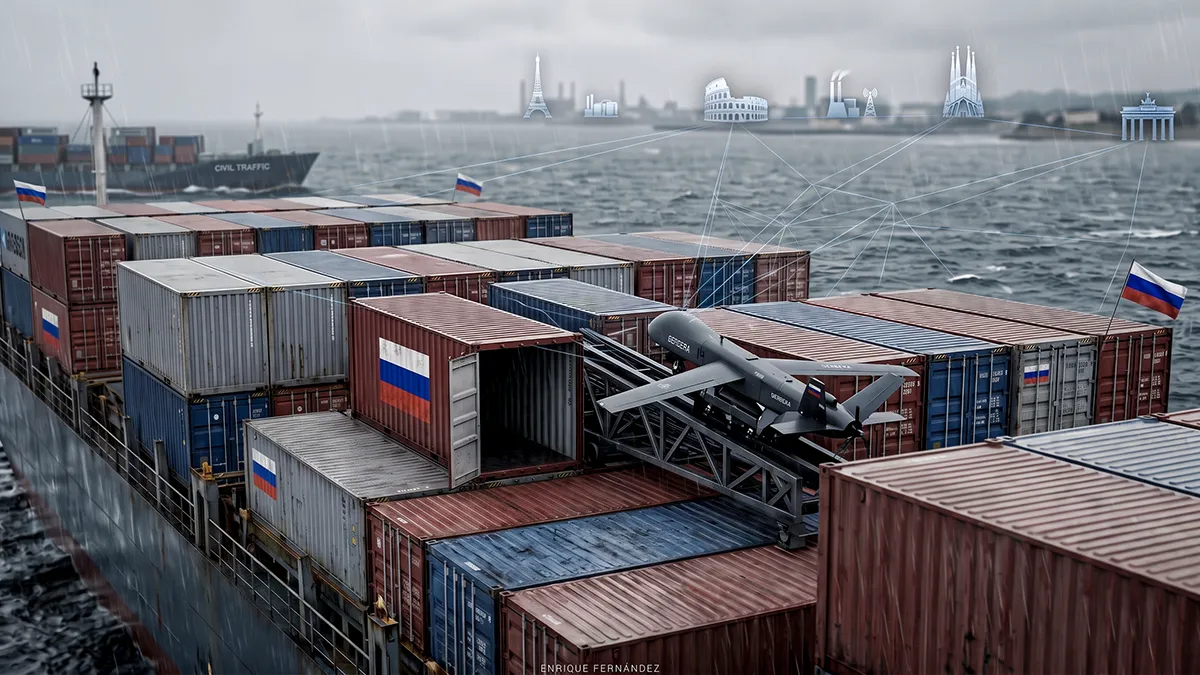
The long-standing strategic assumption that Southern Europe serves as an insulated rear guard has unravelled following a classified report issued by the US Central Intelligence Agency (CIA) circulated to key allied governments. The intelligence assessment warns that the Russian Federation is actively operationalising long-range drone incursions deployed from commercial cargo vessels disguised within civilian shipping lanes across the Atlantic Ocean and the Mediterranean Sea.

Central Intelligence Agency (CIA) Director John Ratcliffe addresses the press alongside US President Donald Trump in the James S. Brady Press Briefing Room at the White House, Washington, DC (US), 6 April 2026 – REUTERS/ EVAN VUCCI
Allied military intelligence sources indicate that the primary delivery system identified for these operations is the Gerbera uncrewed aerial vehicle—a delta-wing drone measuring approximately two metres in length, weighing 18 kilograms, with an operational strike radius nearing 600 kilometres. Concealed inside standard shipping containers aboard vessels within Russia’s maritime «shadow fleet», these systems can be deployed via pneumatic catapult launchers between 200 and 300 kilometres offshore, evading early tracking by conventional radar networks overseen by the International Maritime Organization (IMO).
«They will deploy drones launched from the open sea, concealed inside standard container ships; technically, it presents negligible difficulty. What Moscow seeks is an operational cobweb designed to inflict infrastructure paralysis across European civilian centres», warned a senior Lithuanian defence intelligence official evaluating intelligence shared following direct contacts between Washington and Moscow.

Russian President Vladimir Putin convenes an official meeting at the Kremlin in Moscow, Russia – SPUTNIK/GAVRILL GRIGOROV via REUTERS
The intelligence directive explicitly identifies commercial oil refineries, international aviation hubs, telecommunications landing stations, and submarine data cables across Spain, France, and Italy as direct targets within potential attritional sabotage campaigns engineered to trigger market disruption and domestic political anxiety.
French President Emmanuel Macron confirmed the severity of emerging threats during a formal address: «The hybrid threat posed by Russia to Europe and to France has grown demonstrably more severe, multifaceted, and direct».

French President Emmanuel Macron during a diplomatic press conference – REUTERS/ STEPHANIE LECOCQ
The transatlantic fracture: Trump redirects procurement toward Beijing, Minsk, and Moscow
This physical exposure is compounded by direct economic friction originating from the White House. Donald Trump has widened fractures within the Western alliance by threatening to abrogate foundational trade pacts and impose secondary tariffs against both the European Union (EU) and Canada should they coordinate tariff countermeasures diverging from World Trade Organization (WTO) norms.
In a transactional foreign policy shift that has destabilized diplomatic planning across Brussels and Ottawa, the US administration has initiated bilateral procurement talks with Beijing, Minsk, and Moscow to secure access to critical industrial inputs, refined minerals, and agricultural fertilizers traditionally sourced from Canadian and European producers.

US President Donald Trump reacts during a military flypast alongside Chinese President Xi Jinping during arrival honours at Joint Base Andrews, Maryland (US), 23 September 2026 – REUTERS/ JONATHAN ERNST
A prime manifestation is Washington’s direct engagement with the Belarusian administration of Alexander Lukashenko regarding large-scale potash imports—an essential input for the American agricultural sector—deliberately aimed at replacing Canadian suppliers, who historically accounted for nearly 90% of US potash imports.
This redirection of strategic supply chains toward regimes under Western sanctions shatters the operational premise of an integrated Western front. European capitals face the reality of financing sovereign industrial defence autonomy independently, while simultaneously competing across global raw material markets against a North American ally pursuing transactional trade bilateralism with strategic competitors.

Belarusian President Alexander Lukashenko, strategic ally of Russia and CSTO partner – PHOTO/Kremlin-Konstantin Zavrazhin
The Southern and Western flanks: maritime fortification and the war economy
Confronted with asymmetric maritime threats originating in international waters, Mediterranean and Western European capitals have upgraded operational readiness. In France, the Élysée is accelerating implementation of the Military Planning Law (2024–2030), allocating an unprecedented €413 billion under a national «war economy» framework.
Armed Forces Minister Sébastien Lecornu delivered a direct message before the National Assembly: «This budget ensures France retains credible high-intensity military power against emerging threat vectors. Absent this sustained industrial surge, our forces would be exposed to attritional warfare methodologies that peacetime manufacturing structures cannot counter».

French Minister of Armed Forces Sébastien Lecornu – REUTERS/ ABDUL SABOOR
Paris has instructed major defence conglomerates including MBDA and Thales to double output rates for SAMP/T (Mamba) surface-to-air missile batteries and 155mm artillery rounds, while the French Navy expands maritime air patrols across the English Channel, the Atlantic seaboard, and the Mediterranean approaches.
Italy has intensified operational deployments of its FREMM multipurpose frigates across transit corridors in the Strait of Sicily and the Ionian Sea, tasked with tracking flags of convenience associated with Russian sanctioned crude movements monitored by the International Energy Agency (IEA). While Italian Defence Minister Guido Crosetto has counselled public caution, his ministry is channelling emergency procurement into very short-range air defence (VSHORAD) and counter-UAS electronic warfare suites to safeguard critical forward facilities—notably Naval Air Station Sigonella—and maritime cargo infrastructure in Genoa and Trieste against low-altitude drone saturation.

British Prime Minister Keir Starmer, Polish Prime Minister Donald Tusk, French President Emmanuel Macron, Italian Prime Minister Giorgia Meloni, and German CDU leader Friedrich Merz hold strategic consultations – PHOTO/Presidency of France
In Spain, the Ministry of Defence is accelerating plans to meet the 2% of GDP target established under NATO agreements, fast-tracking procurement contracts to modernise Patriot air defence batteries and acquire advanced NASAMS point-defence configurations. Concurrently, the Spanish Navy maintains enhanced surface patrols covering the Strait of Gibraltar and Mediterranean approaches, while the Joint Cyberspace Command has raised alert levels across supervisory control and data acquisition (SCADA) systems managing electrical grids and liquefied natural gas regasification plants.
Germany and the Eastern border: underground civil defence and tactical fortifications
In Central Europe, contingency planning bridges civilian engineering with wartime budgetary expansion. In Berlin, Federal Defence Minister Boris Pistorius designated 2029 as the definitive operational readiness milestone for the Bundeswehr: «We must achieve complete warfighting readiness (kriegstüchtig) by 2029. We must establish credible deterrence to guarantee conflict is averted», Pistorius told the Bundestag, arguing that German defence outlays must permanently exceed 2.5% of GDP.

French Defence Minister Sébastien Lecornu confers with Polish Defence Minister Wladyslaw Kosiniak-Kamysz, German Defence Minister Boris Pistorius, and Italian Defence Minister Guido Crosetto – REUTERS/ BENOIT TESSIER
To support this posture, Germany is mobilising an estimated €450 billion over the next decade to operationalise the Arrow 3 exo-atmospheric missile shield alongside integrated Iris-T air defence architecture. Beneath metropolitan centres, federal and state engineering teams are surveying underground transit tunnels and public basements in Frankfurt, Berlin, and Munich to refit blast-proof hermetic doors and CBRN filtration systems, preparing emergency civilian fallout shelters against drone saturation strikes or cruise missile barrages.
Along NATO’s eastern frontier, rearmament is taking the shape of reinforced concrete fortifications. Poland leads the alliance proportionally with military expenditure surpassing 4.2% of GDP (roughly €35 billion annually). In addition to integrating American M1A2 Abrams main battle tanks and South Korean K2 armour, Warsaw is constructing the «Eastern Shield» (Tarcza Wschód): a €2.3 billion military engineering programme establishing 400 kilometres of physical antitank ditches, acoustic sensory arrays, and counter-mobility minefields along the borders with Belarus and the Kaliningrad exclave.

Military operators prepare an uncrewed aerial vehicle during joint military manoeuvres in Belarus – REUTERS/ RAMIL SITDKOV
Concurrently, Estonia, Latvia, and Lithuania are constructing more than 600 reinforced tactical bunkers across the Baltic Defence Line. The operational doctrine established in Vilnius, Riga, and Tallinn requires physical border works capable of checking armored advances during the critical initial 48-to-72-hour window necessary for NATO rapid-reaction forces to deploy.
This posture is reinforced by the Nordic total-defence framework: Finland maintains a functioning network of 50,500 subterranean civil shelters capable of protecting 4.8 million citizens (87% of the population), anchored by a conscription model providing 800,000 trained military reservists. In Sweden, the Civil Contingencies Agency (MSB) has updated the distribution of household civil readiness manuals instructing families to maintain autonomous food, power, and medical reserves, mirroring civil protection principles framed by the UN.

Norwegian and Swedish armed forces medical detachments simulate field triage during winter tactical manoeuvres – REUTERS/ YVES HERMAN
The operational dilemma: Can European industrial capacity match the Kremlin’s timeline?
The simultaneous refurbishment of underground rail shelters in Berlin, tactical bunkering across the Baltic states, and military budget growth in Warsaw confirm that Europe has permanently discarded the «peace dividend» doctrines that defined the post-Cold War era.
The fundamental question debated within ministries across Brussels, Paris, and London is not whether European leadership grasps the systemic nature of the threat, but whether the speed of administrative and industrial mobilization can match the timeline pursued by Moscow.
With Europe’s defence-industrial base still working to expand monthly 155mm munition output to levels demanded by sustained attritional warfare, and civilian protection architecture requiring years of infrastructure investment, the continent is engaged in an acute geopolitical race against time.
Whether Europe is structurally prepared for direct conflict will not be decided by multilateral policy communiqués, but by the speed with which protective concrete sets across underground shelters and the consistency with which national budgets sustain long-term strategic rearmament as an existential requirement for European survival.