In August 2026, the UK told the UN Security Council that those “supplying, funding and fuelling the war” in Sudan should choose to stop. In early October, it led a resolution at the UN Human Rights Council to renew the Fact-Finding Mission’s mandate on Sudan, calling for accountability “across the full chain of responsibility”. Then in late October, a year after the fall of El Fasher, the government sanctioned 15 commanders. Foreign Secretary Ed Miliband said “support from all external backers” must end.
The UK appears to be saying all the right things, but is it failing to address the elephant in the room? Namely, its own arms export licences.
It has been well established that the United Arab Emirates (UAE) is a key supplier of weapons to the Rapid Support Forces, a paramilitary group that has repeatedly been accused of committing widespread atrocities and ethnic cleansing, which bear the “hallmarks of genocide”. The UAE also happens to be one of the UK’s largest arms export markets. Such proximity naturally raises concerns as to whether British manufactured arms are ending up in the hands of the RSF in Sudan via the UAE.
The war in Sudan has long been considered a ‘civil’ war. A war between two internal military parties: the Sudanese Armed Forces (SAF) and the Rapid Support Forces (RSF). But the conflict can no longer be understood solely as a domestic war – not least because those powers keeping the conflict alive lie beyond Sudan’s borders.
In recent years, the UK arms industry has been increasingly cooperating with the arms industry in the UAE, despite the growing concerns over the UAE’s role in the conflict.
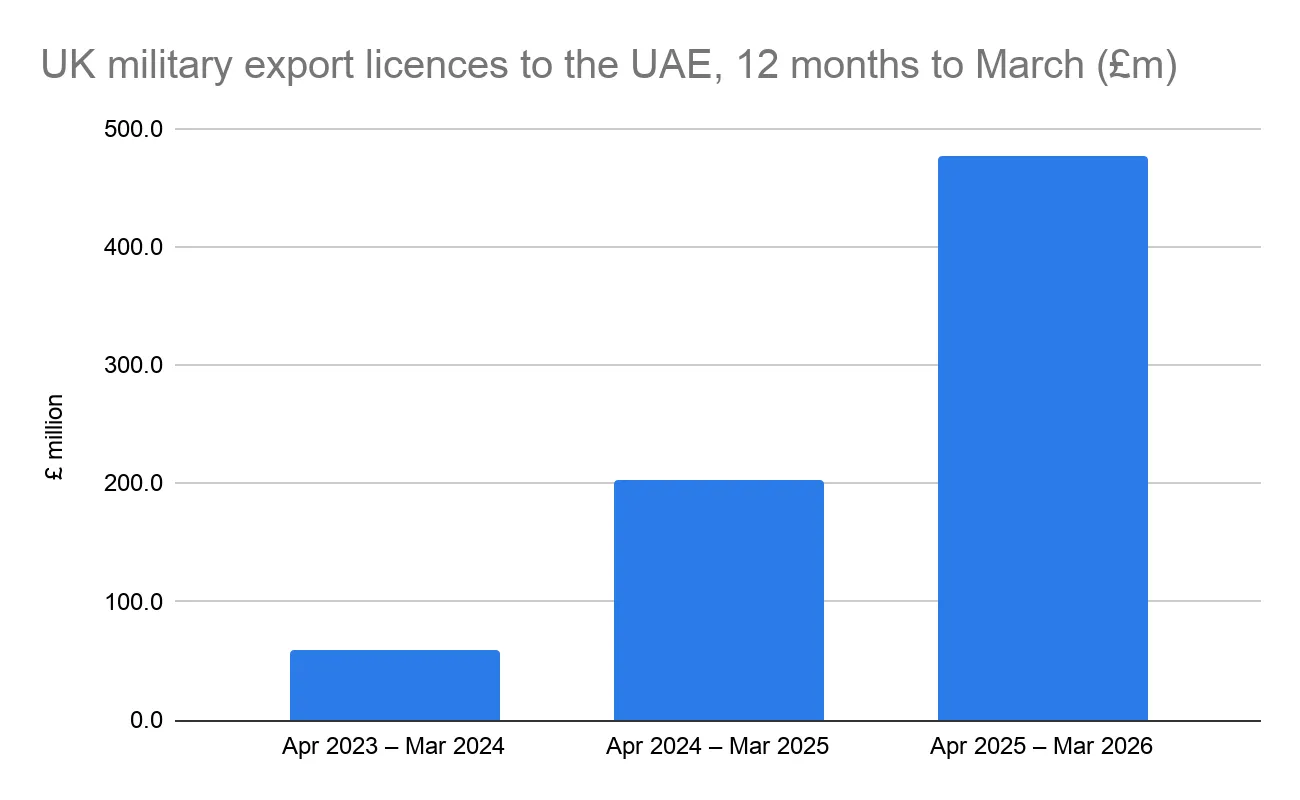
Since the beginning of the war in April 2023, the UK has approved £729 million in military export licences to the UAE. In the first quarter of 2026 alone, licences reached a record value of around £302 million.
 Figure 1: figures that show the upward trajectory of the UK military export licences to the UAE.
So on the one hand, the UK is calling for external actors to stop fuelling the conflict. On the other, it continues to authorise significant military exports to a country which time and time again has been accused of supplying weapons to the RSF.
What raises these concerns is that British manufactured military equipment has been found in Sudan. In June 2024, a letter addressed to the UN Security Council from the Permanent Representative of the Sudan included photographs and detailed records of weapons and equipment recovered directly from the RSF combat sites in Khartoum and Omdurman.
Among the evidence were systems manufactured by Militec, a Welsh company that “specialises in the design and manufacture of small arms target equipment to meet the training requirements of Military and Police forces worldwide”. (Figure 2). Militec says its products are training devices, not targeting systems, and denies exporting them to Sudan.
The company told The Guardian newspaper in 2025 that it “is strictly compliant with UK export control regulations”, that it does not “export any training equipment to Sudan (or any other prescribed country) directly or complicity via a third country”, that its “devices are for training purposes only”, and it does not “manufacture or export small arms, weapons or targeting systems”.
 Figure 2: Militec M3720MN mini pop-up indoor and outdoor target shooting device
Three months after the letter was published, the government not only continued to approve licences for military equipment of the same category, but approved more. Between June 2024 and March 2026, the government approved five ML14 licences (covering equipment which includes Militec products) reaching a total value of £759,000 – according to open licence data from the Campaign Against the Arms Trade. It should be noted that it cannot be established that these ML14 licenses were for Militec.
On top of this, another five ML14 licences were issued as open individual export licences (OIEL). This means the exporter can make unlimited shipments of such equipment to the UAE for between three to five years, and when you apply for an OIEL you do not normally have to provide end-user details. The fact this type of licence is granted, notwithstanding the known risk of diversion to arms-embargoed destinations, says enough.
A second dossier of photographs circulated by Sudanese diplomats in early 2025, showed a Nimr Ajban series Armoured Personnel Carrier (APC) (Figure 3), allegedly recovered from RSF positions. Although manufactured by the UAE, the engine is supplied by Cummins UK specifically for this range of APCs.
 Figure 3: Nimr Armoured Personnel Carrier
The engine’s data plate (Figure 4) reaffirms the source of origin as the UK, given the capitalised inscription “MADE IN GREAT BRITAIN BY CUMMINS INC”. Its specifications are consistent with those advertised by Nimr Automotive in a promotional video for the Ajban 440A range (Figure 5). The plate also shows the date of its manufacture as June 2016.
 Figure 4: Data plate of Nimr series APC engine
 Figure 5: promotional video of the Ajban 440A posted by Nimr automotive in 2018
A Cummins spokesperson told The Guardian newspaper in 2025 that: “Cummins has a strong compliance culture as evidenced by our 10 ethical principles set out in our code of business conduct. Our code explicitly covers compliance with applicable sanctions and export controls in the jurisdictions in which Cummins conducts business, and in some cases our policies go even further than applicable legal requirements. Cummins also has a strong policy against participating in any transaction – direct or indirect – with any arms embargoed destination without full and complete authorisation from the relevant governmental authorities.
“Cummins has a process to thoroughly review all defence transactions to evaluate legal and policy considerations, and under that program we have regularly obtained export licenses where legally required, as well as applied other compliance measures. With respect to Sudan specifically, we reviewed all our past transactions and did not identify any military transactions where Sudan was indicated as the end-use destination.”
How Cummins’ produce ended up in Sudan is unknown, but what is known is that by June 2016 the UK government should have been aware of a UN report that detailed how the UAE had supplied Nimr APCs to armed groups in Libya and Somalia, in violation of a UN arms embargo.
Notably, the British equipment found so far only comes from Khartoum and neighbouring Omdurman, in 2024 and 2025. The RSF has operated across a much wider area, particularly in the south west regions, where little comparable research has been conducted.
There have been no further documented discoveries of British manufactured equipment since the release of the two dossiers. This might well be a gap in the available evidence and not proof of absence.
When questioned in the House of Commons in November last year about the appearance of British arms in Sudan, the government dismissed the concern, on the grounds that the items were “neither bombs nor bullets”. Therefore, they were “unlikely to be making a substantial contribution” to the violence. Labour MP Hamish Falconer said: “I understand it, the article referred to a seatbelt or a harness, which is not a prohibited item; components of an engine; and a target practice item, all exports of which were stopped in 2017.” He did not address the specific British export of arms to the UAE as part of his answer.
The government’s position remains unchanged, where following the release of the UN Fact Finding Mission’s report, it maintained that the UK has “one of the most robust systems of arms export controls in the world”. It stated that it had reviewed more than 3,000 export licences to destinations where there had been allegations of diversion to Sudan, and found “no evidence of UK weapons or ammunition being used in Sudan”.
The wording does not acknowledge components or targeting systems, focusing exclusively on “weapons and ammunition”.
Under the UK’s Strategic Export Licensing Criteria, the government is required to assess a range of risks, including the possibility that military exports could be used to commit or facilitate violations of international humanitarian law, and the risk of diversion to unauthorised end-users. This applies beyond conventional weapons and ammunition to other military equipment, including components and targeting systems.
It is important to note the true impact of the war on those living in Sudan.
“Hardly an hour would pass without us having to go to the cemetery to bury a loved one,” says Omar, 37, whose name has been changed for safety reasons, describing life in Kosti, Sudan, during the peak of the RSF’s siege.
“The RSF bombed the city with drones relentlessly, day and night” he said. Across the White Nile State, he described attacks on hospitals, boarding schools and student accommodation, civilian homes, power stations, fuel depots and trucks transporting goods.
“Thousands of innocent people died.”
According to AOAV’s Explosive Violence Monitor, since the outbreak of the war in April 2023, there have been 16,083 recorded civilian casualties from explosive violence, with 7,838 killed and 8,245 injured.
When the RSF took control of the town where Omar worked, they would break into people’s homes and demand money and gold. He explained that as a means of applying pressure and forcing families to comply “they would shoot a family member or rape the women in front of their families”.
The UAE is not the only external source, as Sudan has witnessed a huge influx of foreign weapons entering the country and changing the military landscape and dynamics of the conflict. From Turkish, Russian and Serbian rifles to Iranian and Chinese drones and Bulgarian mortars, a UN report published in September, documents the exact role of these ‘transnational networks’, with a considerable focus on the UAE, in sustaining military operations whilst expanding capabilities of both parties. It further mentions the role of Colombian contractors, which were hired none other than by the UAE.
Sudan is now the world’s worst humanitarian crisis, and continues to have an immeasurable impact on civilians. Omar explained how only two weeks ago he had experienced a complete black out lasting a week, as he estimated 95% of power stations had been hit. Even now, he receives electricity for only two to three hours every two days.
A neighbour of Omar’s, who arrived in his town six months ago after initially fleeing from El Fasher, recounted how people had resorted to eating animal feed to stay alive. He described how the RSF killed anyone who crossed their paths in the city and made “no distinction between civilians and military personnel, women and children, or the elderly and sick”.
For AOAV it’s unclear what more evidence the UK needs to be concerned that it is inadvertently legitimising and empowering the UAE’s role in this carnage. We believe it should suspend relevant arms export licences to the UAE whilst an investigation takes place to identify how arms are being diverted to the RSF and to what extent UK exports risk contributing to violations of international law.
Some might argue that the UK is reluctant to look closer to home, given the extent of Emirati investment into the country. Successive governments appear unwilling to step on the UAE’s leaderships’ toes, mindful of economic, diplomatic and security ties between the two countries, although their relationship is under current scrutiny.
AOAV’s position, however, is that economic interests cannot take precedence over the UK’s stated commitment to preventing the supply of weapons that are fuelling atrocities.
The UK speaks of the importance of accountability “across the full chain of responsibility”, and that chain must include the UK itself. But can it legitimately call for foreign powers to stop fuelling the war while continuing to approve military export licences to the exact country fuelling it?
It’s about more than just diplomatic statements and sanctions. As long as these external actors continue to fuel the conflict, the conflict will not end, and civilians, like Omar, are left “fully aware that at any moment, they could be the next victim”.
Did you find this story interesting? Please support AOAV’s work and donate.
Donate