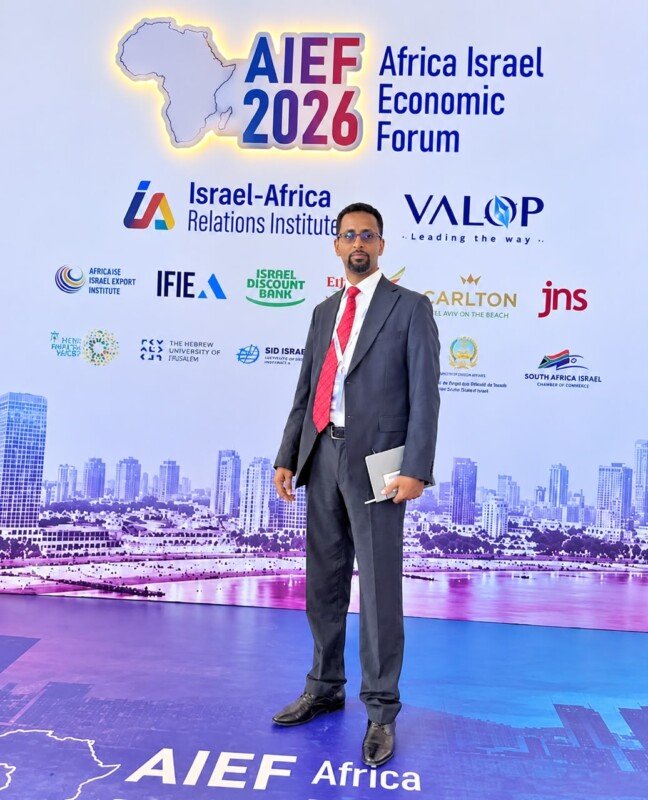
HARGEISA, The manager of the Somaliland Ports Authority, Ali Dirie Ahmed, attended the Africa-Israel Economic Forum in Tel Aviv on November 11, according to a statement from the authority, in a visit that underscores the deepening alignment between Hargeisa and Jerusalem and the strategic role Berbera Port is being asked to play in that relationship.
The forum, held at the Yitzhak Rabin Center, brought together business leaders, investors, and government representatives from across Africa and Israel to discuss economic cooperation and investment. The Somaliland Ports Authority said its participation reflected a commitment to “strengthening international partnerships and advancing cooperation in maritime trade, logistics and investment,” and highlighted Berbera’s position on the Gulf of Aden near the entrance to the Red Sea, its infrastructure, economic zone, and transport corridor to Ethiopia.
Berbera’s Strategic Value
The attendance is the latest step in a relationship that has accelerated since Israel became the first UN member state to recognize Somaliland in December 2025. Somaliland has explicitly invited Israel to establish a presence at Berbera, describing the port and airport as a “gateway to the Bab el-Mandeb and the Red Sea,” as detailed in the coverage of the regional debate over foreign bases. The corridor handles a significant share of global trade, and Berbera Airport has one of the longest runways in Africa.
The port itself has been transformed by DP World, the UAE-based logistics giant, which holds a 51 percent stake and has invested approximately $442 million since 2016. Capacity has tripled to 500,000 TEUs, and turnaround times have been cut from 64 hours to 25 hours. The UAE also maintains a military base near Berbera, and satellite imagery has indicated an expansion of Emirati facilities including radar, hangars, and air-defense positions, as reported in the coverage of the UAE’s military construction.
The Risks of Alignment
The economic opportunity is real, but it comes with strategic exposure. Houthi leader Abdel Malek al-Houthi has warned that any Israeli presence in Somaliland would be considered a “military target.” The UAE base at Berbera has already been targeted by Iranian missiles during regional hostilities, and a Western diplomat told AFP that there is a “widespread assumption” of an Israeli security presence that, if confirmed, could leave the port vulnerable.
Somaliland officials have framed the relationship as defensive and developmental. Khadar Hussein Abdi, Somaliland’s minister of the presidency, said Hargeisa is “not partnering with Israel to be against anyone” and wants to “contribute to peace in the region.” But the distinction between economic cooperation and security alignment is difficult to maintain when the infrastructure in question sits on one of the world’s most contested maritime corridors.
Critical Note
The Somaliland Ports Authority’s presence in Tel Aviv is a signal that Hargeisa sees its future in the Red Sea trade architecture that Israel, the UAE, and the United States are building. Berbera has been transformed from a neglected deep-water port into a node in that architecture, and the economic logic is compelling: a corridor to Ethiopia, a modern container terminal, and a location outside the Houthis’ immediate reach.
But the visit also exposes the risk that Somaliland has taken. By aligning with Israel and the UAE, Hargeisa has made Berbera a potential target in a regional conflict it does not control. The Houthis have said as much. The Iranian missile strikes on the UAE have demonstrated that the threats are not rhetorical. And the underlying political dispute over Somaliland’s status remains unresolved, which means that every economic agreement and security arrangement carries a diplomatic cost with Mogadishu and with the African Union.
For the people of Berbera, the port has brought schools, clinics, and tax revenue. It has also placed their city on a map of targets. The Somaliland Ports Authority’s manager went to Tel Aviv to attract investment. The question is whether the investment will be enough to justify the exposure, and whether Hargeisa has a plan for what happens if the Red Sea conflict escalates and Berbera becomes a front line rather than a gateway.
Recommended Reading On ftlsomalia.com