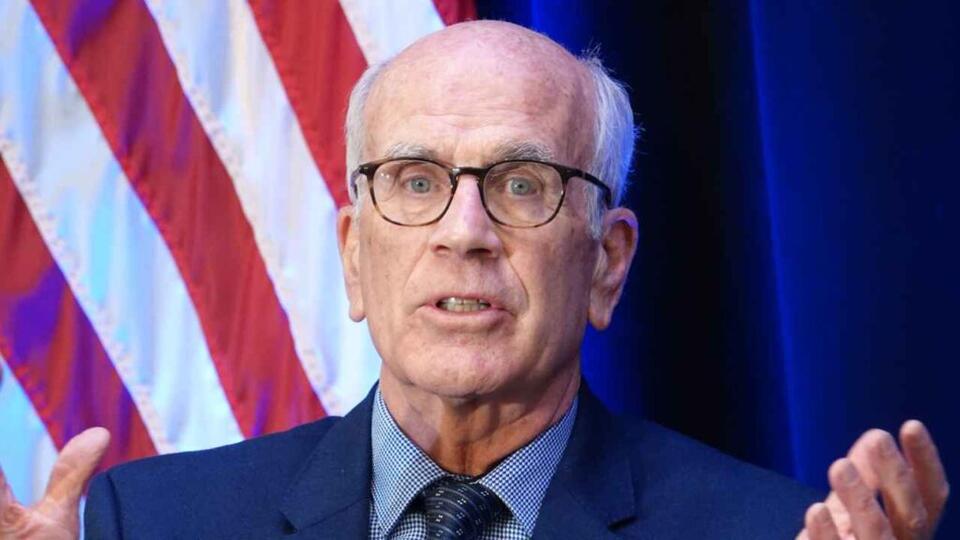
Sen. Peter Welch (D-Vt.) disputed President Donald Trump’s claim that no American service members had died during the preceding five months of the war with Iran, saying 23 U.S. military personnel had died since the conflict began, including nine during the period referenced by the president.
Speaking on the Senate floor November 19, Welch accused Trump of failing to acknowledge the deaths of American service members and questioned the president’s understanding of the human costs of the ongoing military campaign.
The Vermont Democrat read aloud the names of seven fallen service members, saying the Pentagon had not publicly released the identities of two others who had died during the same five-month period.
“Every single day, the president and all of us, should be asking ourselves what justifies the sacrifice that’s being expected of men and women in the military,” Welch said, according to remarks published by his Senate office.
“To deny that we’ve lost any lives in the past five months—when that is totally false—is a terrible indictment of the casual attitude the president has about the consequences of this war on the men and women in the military.”
Welch reiterated the criticism in a November 20 post on X, sharing a video of his Senate floor remarks.
“President Trump said that no soldiers have died in the last five months of the Iran War,” Welch wrote.
“That’s not true.”
Trump Claims No American Soldiers Died in Five Months
Welch’s remarks followed Trump’s November 12 appearance on The Hugh Hewitt Show, during which the president discussed the Iran war, American military operations in the Persian Gulf and the administration’s blockade of the Strait of Hormuz.
During the interview, Hewitt asked whether Trump would hesitate to authorize additional military action against Iran if the administration’s existing strategy failed to achieve its objectives.
Trump said he would not hesitate, arguing that American forces had made substantial progress in the conflict while maintaining control over strategically important waterways.
“Nobody’s been killed in the last five months,” Trump said.
“We haven’t lost a soldier in five months, and we control the Gulf.”
The president made the remarks while contrasting American military operations with the continuing losses suffered by Russian and Ukrainian forces.
Trump also asserted that the United States controlled the Strait of Hormuz and had substantially weakened Iran’s military capabilities.
Asked whether he would maintain the blockade even if it took considerably longer to achieve his administration’s objectives, Trump indicated that he was prepared to continue the operation.
The president’s statement about American military deaths, however, conflicts with reported Pentagon casualty figures showing that U.S. service members died during the five-month period he referenced.
Pentagon Figures Show 23 American Military Deaths During Iran War
According to Pentagon casualty figures reported by The Washington Post on November 13, 23 American service members had died in Middle East operations associated with the war against Iran.
Of those deaths, 11 were attributed to enemy fire and 12 occurred under nonhostile circumstances.
The distinction is significant because the overall figure includes military personnel who died in accidents and other nonhostile incidents connected to operations during the conflict, not solely those killed in direct attacks by Iranian forces.
Nevertheless, the reported deaths include American military personnel who died in July, within the five-month period Trump described during his November 12 interview.
Three American soldiers died in an enemy attack on Muwaffaq Salti Air Base in Jordan in July, according to the reported casualty figures.
Another soldier died during a controlled detonation of an Iranian drone at a military installation in Iraq, while a Navy captain died during an emergency landing in the Arabian Sea.
Those deaths contradict Trump’s statement that the United States had not lost a soldier during the preceding five months.
The overall death toll was also reported by Stars and Stripes on November 19, which cited Pentagon figures showing 23 American service member deaths and more than 850 injuries associated with the conflict.
Welch cited the same overall death toll during his Senate speech, while identifying nine deaths that he said had occurred specifically within the preceding five months.
“I want to honor those brave men and women,” Welch said.
“We’ve lost 23 brave men and women during this war, including nine in the past five months that President Trump wouldn’t even acknowledge.”
Welch Names Fallen U.S. Service Members on Senate Floor
Following his criticism of Trump’s statement, Welch read the names of seven service members who had died during the five-month period, identifying their military ranks, home states and ages.
The senator named Cmdr. Gabriel Edwards of Oregon, 42; Pvt. Isabella Gonzales of Texas, 19; Sgt. Angel Srah Rampersad of New York, 28; and 1st Lt. Tyler James Feehan of Hawaii, 25.
He also identified Sgt. Michael Emmanuel Swinton of North Carolina, 30; Petty Officer 1st Class Sarai Ramirez-Galvan of Texas, 29; and Maj. Bianca Wilkerson of Virginia, 37.
The names and details were included in Welch’s November 19 remarks, as recorded in the Congressional Record.
Welch said the identities of two additional service members who had died during the period had not yet been publicly released by the Pentagon.
The senator emphasized the importance of recognizing the sacrifices of all nine service members, including those whose names had not been made public.
He said members of the Senate had a responsibility to remember those who had died while serving their country, regardless of their political disagreements over the war.
Welch also drew attention to the approaching Thanksgiving holiday and the impact of the deaths on military families.
He said the families of the fallen service members would face the holiday grieving the loss of their loved ones.
His remarks placed the military death toll at the center of the broader congressional debate over whether the United States should continue its operations against Iran.
Welch Calls for End to Iran War
Welch’s criticism of Trump’s casualty statement came during a Senate debate over a War Powers Resolution intended to end U.S. military involvement in hostilities with Iran without additional congressional authorization.
The senator opened his remarks by calling for an end to the conflict and accusing the president of launching a prolonged military campaign without sufficient consultation with Congress.
“The illegal war in Iran must end,” Welch said.
He described the administration’s decision to enter the conflict as a departure from Trump’s campaign promises to avoid prolonged American involvement in Middle Eastern wars.
Welch argued that the war had imposed significant costs on American service members and their families while also contributing to economic disruption through restrictions on shipping in the Strait of Hormuz.
He cited rising diesel and fertilizer prices as examples of the economic pressures associated with the conflict, particularly for American farmers.
The senator also questioned the administration’s strategy for ending the war and argued that Congress should exercise its constitutional responsibilities concerning the use of military force.
Under the War Powers Resolution of 1973, the president is generally required to terminate the use of U.S. armed forces in hostilities within 60 days unless Congress authorizes the operation or another statutory exception applies. The law also provides a limited period for withdrawing forces.
Welch argued that the president’s continued military campaign had exceeded the authority available to him without congressional approval.
The administration has defended its operations against Iran as necessary to protect American interests, counter threats from Tehran and maintain security in the Persian Gulf.
Trump has maintained that American forces have significantly weakened Iran’s military capabilities and that continued pressure, including the blockade, is necessary to achieve the administration’s objectives.
Those competing positions formed part of the Senate’s November 19 debate over H. Con. Res. 93, which sought to direct the president to remove U.S. armed forces from hostilities with Iran pursuant to the War Powers Resolution.
The Senate rejected the measure by a vote of 48-51, leaving the administration’s ongoing military operations unaffected by that particular congressional effort.
Welch voted in favor of the resolution.
Senator Also Calls for Hegseth’s Removal
During the same Senate speech, Welch called for Defense Secretary Pete Hegseth to be removed from office, accusing him of mishandling the war and undermining military leadership.
According to the official statement published by Welch’s office, the senator said Congress should consider impeachment if Trump refused to dismiss Hegseth.
“I believe Secretary Hegseth should be fired,” Welch said.
“And I believe if the president chooses to retain but not fire Secretary Hegseth, the Congress should impeach and the Senate should convict Secretary Hegseth, so that we can stand for the honor and integrity of the men and women of the military.”
Welch criticized Hegseth’s handling of the conflict, military leadership decisions and strikes against suspected drug-smuggling vessels, arguing that the defense secretary had exceeded constitutional limits and damaged military morale.
The senator’s statements represented his political and legal criticisms of Hegseth, rather than findings by a court or congressional impeachment proceeding.
His criticism of Trump’s military casualty claim, however, concerned a separate and directly verifiable factual question.
The president stated during his November 12 interview that no American soldiers had died in the preceding five months. Reported Pentagon casualty figures show that U.S. military personnel died during that period.
Welch cited nine such deaths, while identifying 23 service members who had died in operations associated with the Iran war overall.
By reading the names of fallen service members into the Senate record and repeating his criticism publicly the following day, Welch sought to draw attention to the human costs of the conflict and challenge the president’s characterization of American military losses.
The dispute underscores the continuing disagreement between the administration and its critics over the conduct of the Iran war, its consequences for American service members and the extent of congressional oversight of military operations.