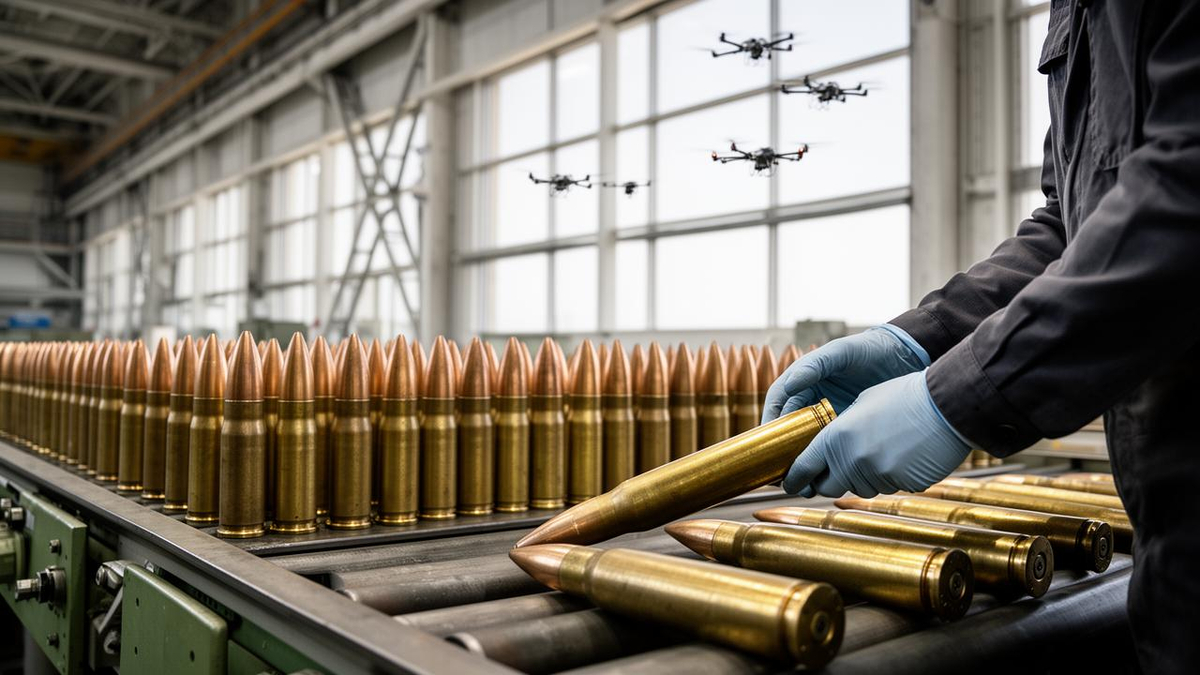
The Russia-Ukraine war, now entering its fourth year, is shifting the battlefield’s core combat power from precision-guided munitions to “consumable weapons.” On one side, drones have established themselves as the central axis of reconnaissance and attack; on the other, artillery shells have become scarce commodities, with production capacity itself emerging as a form of military deterrence. Both trends are creating opportunities for South Korea’s defense industry.
◆ Drones have seized the skies; the ground can no longer hide
On the 20th (local time), Moscow suffered its largest-ever drone attack. Ukraine launched more than 1,000 drones targeting all of Russia, the Crimean Peninsula, and the Black Sea. Russia’s Defense Ministry announced it had intercepted 1,100 Ukrainian drones that day.
Russia responded in kind, deploying 138 drones against Ukraine during the same period. The exchange of large-scale drone attacks between the two countries demonstrates that drones are no longer a supporting force but a central pillar of warfare.
The power of drones extends beyond simple attack capability. According to Defense Express, a Ukrainian military media outlet, Ukraine’s 40th Independent Marine Brigade located and attacked a Russian T-72 tank and D-30 towed howitzer hidden among trees and brush near the Donbas border on the 21st. The equipment had been camouflaged to avoid detection from above, but it could not evade the drone surveillance network.
As traditional camouflage tactics are neutralized, the operational doctrine of existing weapons systems is being fundamentally challenged. Tanks, armored vehicles, and self-propelled artillery must now be operated and defended with the assumption of drone detection and attack.
◆ Europe invests tens of trillions of won in counter-drone systems
The proliferation of drone warfare is not confined to the Russia-Ukraine conflict. As drone use increases in conflict zones worldwide, including the Middle East, major European nations are accelerating their acquisition of drone and counter-drone capabilities.
NATO announced at its July summit’s defense industry forum a plan to invest more than $40 billion (approximately 54.2 trillion won) in counter-drone system development over the next five years. The alliance also plans to expand drone pilot training capacity fivefold by the end of 2027.
The United Kingdom will invest 5 billion pounds in unmanned systems including drones and counter-drone capabilities over the next four years, while Germany has committed 10 billion euros (approximately 15.4 trillion won) to military drones. France has announced plans to invest 8.5 billion euros (approximately 13.1 trillion won) to increase its drone and missile inventory by 400% by 2030.
Reuters has reported that the Ukraine war and Middle East conflicts are driving growing demand in the European defense industry for low-cost interceptor missiles and mass-producible air defense weapons.
◆ South Korea’s defense industry stakes its future on drone warfare readiness
South Korea is also expanding investment, viewing drones as a core future battlefield capability. The 2027 defense budget, based on the government’s proposal, will total 73.2777 trillion won (approximately $54.1 billion), an 8.2% increase from this year. Of this, the drone and counter-drone capability budget is set at 806.1 billion won (approximately $595.2 million), up 127.3 billion won (approximately $94.0 million), or 18.8%, from this year.
The Ministry of National Defense plans to secure approximately 20,000 low-cost drones—including short-range reconnaissance drones and small loitering munitions—by 2030, while also pursuing the introduction of next-generation drone capabilities such as AI-enabled drone swarms. The “K-LUCAS,” a South Korean long-range loitering munition modeled on the LUCAS suicide drone used in the U.S.-Iran conflict, is being accelerated for deployment before 2030, ahead of the original mid-2030s timeline.
South Korea’s defense industry is moving quickly as well. Hanwha Aerospace is co-developing the “Mojave STOL,” a short takeoff and landing unmanned aircraft, with U.S.-based General Atomics Aeronautical Systems (GA-ASI) in the large unmanned aircraft segment. At the “2026 Defense Drone Technology Exhibition” held in Pocheon, Gyeonggi Province on the 16th, the Mojave demonstrated a simulated combat flight, landing on a narrow tank maneuver route rather than a conventional runway before taking off again. In the small and medium military drone segment, the company plans to target overseas markets by integrating drones with existing weapons systems such as the K9 self-propelled howitzer and the Chunmoo multiple rocket launcher.
LIG Nex1 is concentrating on counter-drone technology. The company recently signed a memorandum of understanding with Nearthlab, a drone AI firm, to develop interceptor drones leveraging AI software and autonomous flight technology. The two companies are expected to expand cooperation on interceptor drone derivatives, including hard-kill close-in protection systems for counter-drone operations, as well as domestic and international counter-drone interceptor drone programs.
◆ 155mm shells become consumables; production capacity is deterrence
Alongside drones, 155mm artillery shells have emerged as battlefield consumables. The 155mm designation refers to the shell’s diameter—the standard caliber widely used by Western artillery forces, including those of the United States and Europe. These shells are sold alongside platforms like the K9 self-propelled howitzer and, unlike one-time weapons exports, are consumables that must be continuously replenished for training even in peacetime.
Demand for 155mm shells has surged since the Russia-Ukraine war began in 2022. In early 2023, Russian forces were reportedly firing approximately 50,000 shells per day, while Ukrainian forces fired up to 6,000–7,000. The United States and European nations have increased production, but filling the shortfall in the short term has proven difficult.
In this environment, South Korea—which has steadily maintained its ammunition production base—has emerged as an alternative supplier. While the United States, Germany, the United Kingdom, and France all possess 155mm ammunition production capabilities, they have struggled to absorb the sudden surge in demand. As the K9 self-propelled howitzer has been exported in large quantities to Poland, Australia, Norway, Finland, and other countries, the follow-on market for South Korean-made ammunition has also expanded.
A defense industry source said, “155mm shells are currently being sold as fast as they are produced,” adding, “Even as platform export growth has recently slowed, ammunition has been filling a significant portion of defense exports.”
A 155mm shell consists primarily of three components: the shell body, the fuze, and the propellant charge. In South Korea, Poongsan handles shell body production and final assembly, while fuzes are manufactured by Poongsan FNS, Korea Defense Industry, and Hanwha Aerospace. Hanwha Aerospace is the primary supplier of propellant charges.
South Korea’s ability to establish a 155mm shell production base traces back to its self-reliant defense policy of the 1970s. The development of the KH179 towed howitzer in 1977 marked the beginning of domestic artillery production, and Poongsan—then an ammunition manufacturer—began developing 155mm shells that same year, achieving initial mass production by the second half of the year. Nearly 50 years later, the shells are now fully produced domestically.
Production volume is a military secret, but industry estimates put annual output at 200,000 to 250,000 rounds. The price of a standard 155mm shell was previously in the range of 2 million to 3 million won (approximately $2,200), but it has reportedly risen sharply since the Ukraine war due to supply shortages. Industry sources say that as shell shortages have intensified, the value of the entire supply chain—not just shell bodies but also propellant charges and fuzes—has increased.
Recently, contracts for ammunition and propellant charges between South Korean companies and overseas defense firms have been signed in succession. Hanwha Aerospace signed a 175.9 billion won (approximately $129.9 million) propellant charge supply contract with the UK’s BAE Systems in November 2023, and followed up with an additional contract worth approximately 150 billion won (approximately $110.8 million) with Sweden in October 2025, following an earlier deal in 2024. The company is also investing approximately $2.2 billion (about 3 trillion won) to build a propellant charge production facility in Arkansas in the United States. Beyond simple exports, there is growing momentum to enter supply chains through local production.
In the global market, shell development competition is moving toward firing “farther and more accurately.” South Korea completed system development of a new extended-range 155mm shell with over 30% greater range in 2023 and has entered mass production. A total of 375.4 billion won (approximately $277.2 million) will be invested through next year. The advantage is that it extends the range of existing self-propelled artillery without requiring platform replacement.
Development of precision-guided shells and course-correction fuzes is also underway. Precision-guided shells incorporate an integrated navigation system combining GPS and inertial navigation systems (INS) to reduce impact error to within 10 meters. Course-correction fuzes are a technology that allows existing extended-range 155mm shells to be operated as guided munitions simply by swapping the fuze. They can reduce impact error from the typical 200–300 meters to the tens-of-meters range.
◆ Production capacity is deterrence
What drones and artillery shells have in common is that they are “consumables.” In actual warfare, drones and shells are continuously expended, meaning production, maintenance, and parts supply chains have become integral to warfighting capability.
Professor Joo Kwang-seop of Kangwon National University’s Department of Digital Military Studies said, “As we can see from the Russia-Ukraine war, drones are now becoming the primary combat means.” He added, “Future militaries must develop all-domain operational capabilities centered on manned-unmanned teaming (MUM-T) that integrate space, cyber, air, ground, maritime, and electromagnetic domains.”
He emphasized, “In war, what matters is not only the scale of weapons held but how quickly expended weapons can be reproduced, repaired, and resupplied. Production capacity has now become a pillar of deterrence.”
A defense industry source also noted, “Drones are already being used extensively across the battlefield, and we may see drone applications in ways we cannot yet imagine. Compared to the firepower and destructive capability of missiles, a drone’s destructive power is limited, but the precision attack capability it demonstrates in specific operations can actually feel more threatening.”