Ralf Dombrowski reports on the fourth festival in support of the emergence of a new institution for jazz, improvised music and other forms of contemporary music in Berlin (English version + Ralf’s original German text included)
It has already been a long road. What started it all was the feeling that something was missing. While, on the one hand, Berlin has been a hub for various scenes centred around improvised music for a long time, there are very few clubs, plus from time to time spaces open up which are used for a while. But what has been missing for a long time is a permanent address for jazz and the art forms related to it, a place with the capacity to invite people to collaborate, a centre which can be seen as representative and diverse enough to attract not just artists but also audiences, and public and private sponsors. A decade ago, trumpeter Till Brönner and interested parties such as the German Jazz Union and IG Jazz Berlin took the lead and brought the concept that there should be a ‘House of Jazz’ into the cultural and cultural-political arena. And ever since then, there has been a sequence of plans, followed by negotiations…then rejections…then more plans…
In the meantime a former cinema – L’Aiglon at Kurt-Schumacher-Damm 121 in the former Quartier Napoléon – has emerged as a place which might offer the solution, now that the premises originally planned, the Alte Münze Berlin have been allocated to another purpose. Politicians have been sending out positive signals, and the scene has organised the fourth stop on the way to its own home in the form of a festival (*). Over three evenings at the prestigious Werner-Otto-Saal in the Konzerthaus, ‘Stop Over 4’ offered a taste of what might be possible in a ‘House of Jazz’. Each evening had its own curator, and they were given carte blanche to open up a wide artistic spectrum within the budgets available.
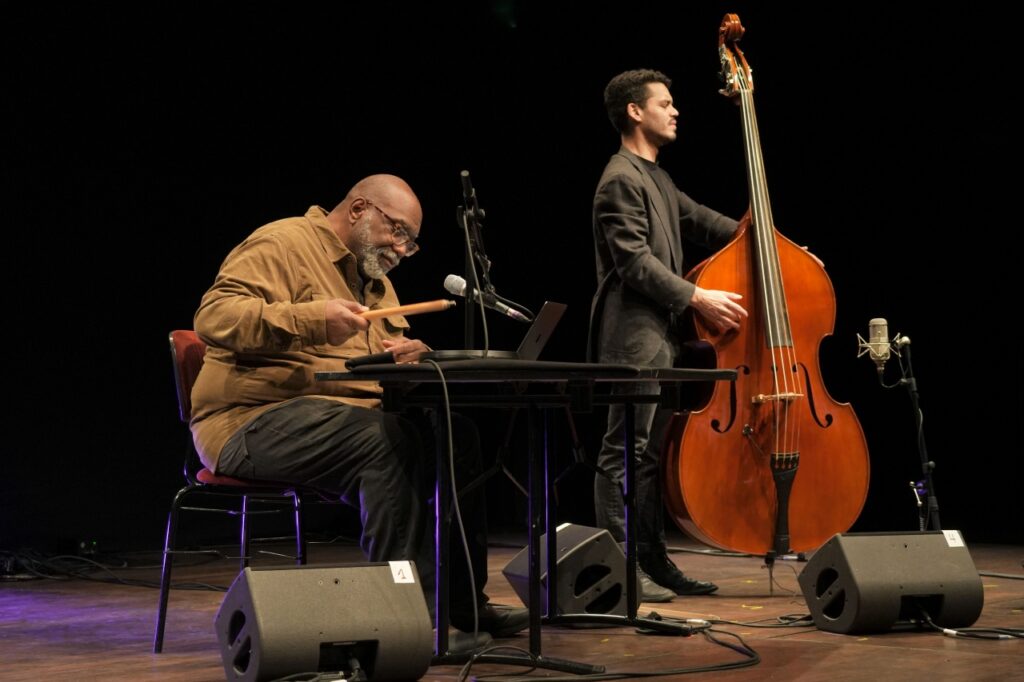 Fred Moten, Brandon Lopez. Photo copyright Ralf Dombrowski
The opening evening was Ingrid Laubrock’s. The New York-based saxophonist presented a programme with the feel of the big city, ranging from music as a sonic fabric to critical statements expressed through poetry. Under the heading ‘Ecstatic Looms,’ violinists Jessie Marino and Angharad Davies and cellist Deborah Walker interwove motivic patterns which had been inspired by the workings of mechanical looms.Yuhan Su and Shinya Lin combined vibraphone, piano and game controller with Michaël Attias‘ saxophone to create a dazzlingly virtuoso mix of improvisation and electronics. The set from New York spoken word poet Fred Moten and double bassist Brandon López oscillated between free improv, socio-critical meaning and dissolving the semantics of words into staccato syllables. Three times jazz; three times completely different.
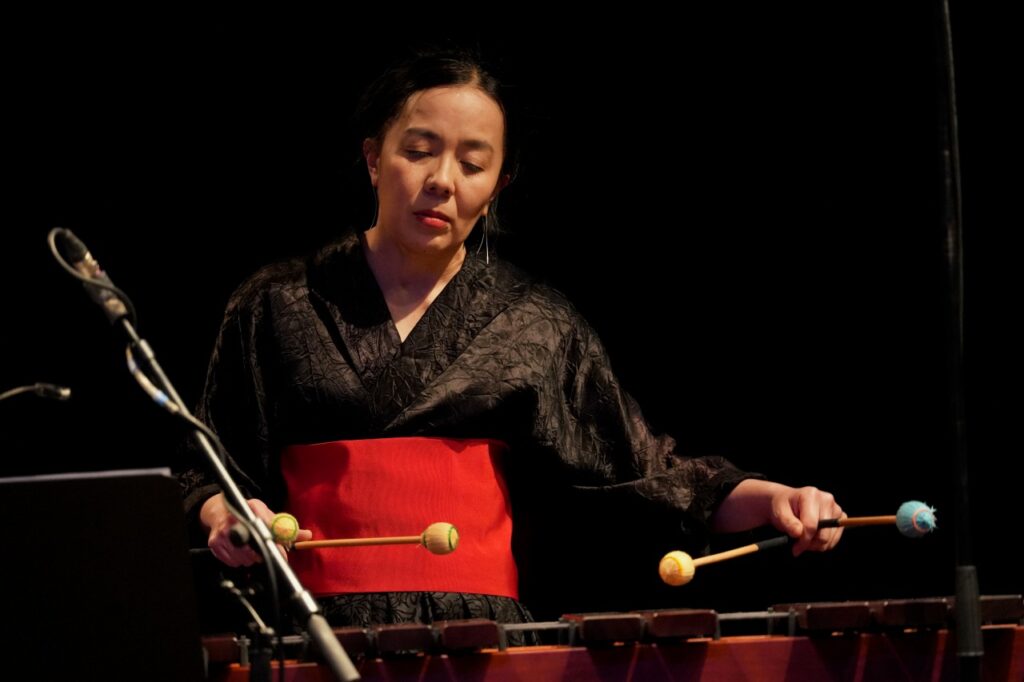 Taiko Saito. Photo copyright Ralf Dombrowski
Pianist Julia Hülsmann took a different direction on the second evening . Marimba player Taiko Saito and her Koko Trio provided a counterpoint to vibraphonist Yuhan Su’s agile, abstract way of playing at the beginning. Her mastery of her instrument found expression in music which was finely balanced down to the last nuance. She danced behind her instrument, letting herself and her partners fly, improvising, opening up the sound space. There was another striking contrast with the duo programme of pianist Emilia Golos and singer Zaza Jasinska, but also a feeling of complementarity. Golos and Jasinska made delicate, personal, sometimes intimate music, captured in short, sparsely instrumented songs, but filled with great emotion. Theresia Philipp’s Pollon Trio with additional strings would probably have been a good fit too, but the musicians had got marooned in the snow on their way to Berlin, so the Melt Trio, who stepped in at short notice, brought the evening to a rocky, powerful and at times hypnotic close.
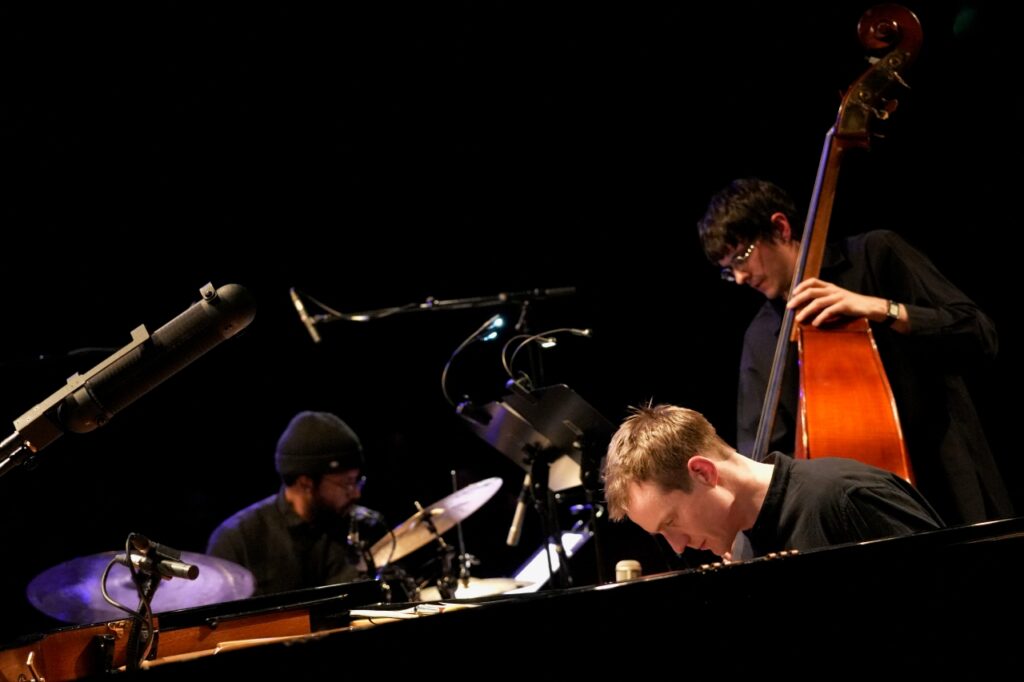 ” An outstanding performance.” L-R: Kayvon Gordon, Elias Stemeseder, Henry Fraser
Photo copyright Ralf Dombrowski
Finally, on the third evening, Christian Lillinger covered the widest range. Kaja Draksler and Irena Z. Tomazin gave a word+sound performance with Dada moments, prepared strings and a grand piano pushed across the room… which somehow felt conventional. The brass quintet Ensemble Apparat with pianist Lorenzo Soulès took on Xenakis, building a bridge to through-composed expressiveness. Pianist Elias Stemeseder, together with bassist Henry Fraser and drummer Kayvon Gordon, brought all of these ideas together in an outstanding performance, playing a continuous set that incorporated hints of folkloric but also modern abstract motifs – a state of forward momentum and constant modification. At the end, Kyle ‘Hprizm’ Austin stepped into the story and remixed sound memories, trip/hip-hop beats and urban sound samples from a DJ’s perspective. Once again, it was aural ecstasy, from a different perspective, but ultimately a return to the beginning of the festival.
What stays in the mind from all this? It was certainly more than just a statement of how comprehensive and creative everything that comes together under the big umbrella of jazz in Berlin can be. And if one now imagines that this excellence, this creativity, this savage expression could be bundled in its own place and continuously added to, changed, discussed and improved, then the reason that there should be a ‘House Of Jazz’ becomes self-evident.
The development of a center for jazz and improvised music is a joint project of the Deutsche Jazzunion, IG Jazz Berlin and Till Brönner.
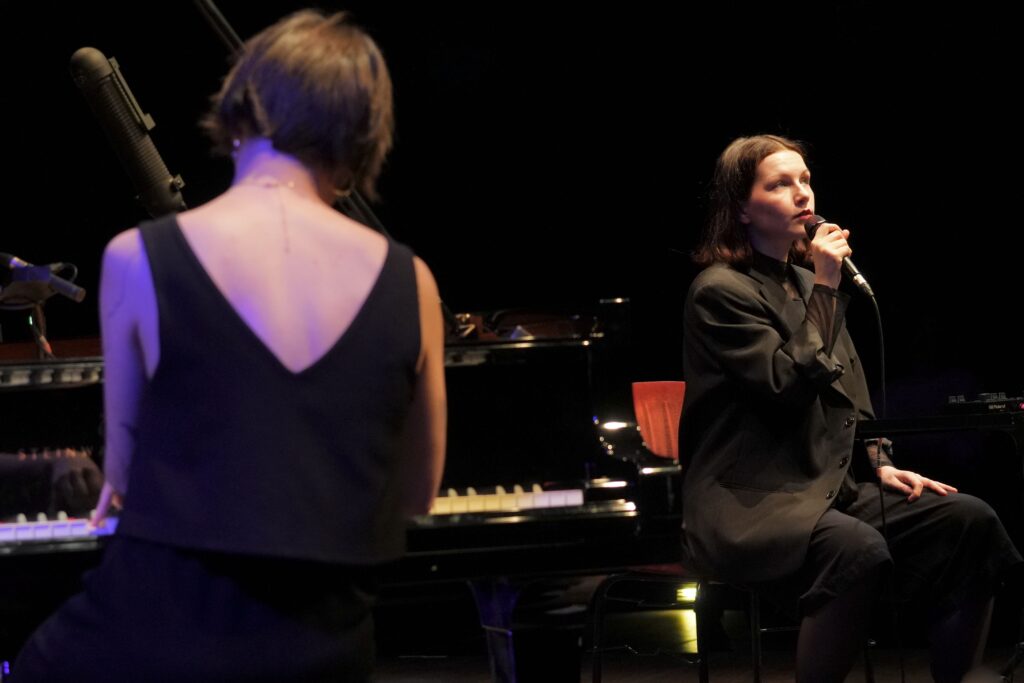 Emilia Golos and Zaza Jasinska
Festival Stop Over 4, 8.-10. Januar 2026, Konzerthaus Berlin
Es ist ein langer Weg. Am Anfang stand das Gefühl einer Lücke. Auf der einen Seite tummeln sich in Berlin seit langem viele Szenen rund um die improvisierte Musik. Es gibt ein paar Clubs, immer wieder auch kurzfristig nutzbare Räume. Aber was ebenfalls seit langem fehlt, ist eine feste Adresse für Jazz und verwandte Künste, ein Ort, der zum gemeinsamen Arbeiten einlädt und der repräsentativ und vielfältig genug ist, um Künstler, Publikum und öffentliche wie private Sponsoren anzuziehen. Bereits vor einem Jahrzehnt preschten der Trompeter Till Brönner und mit ihm Interessenverbände wie die Deutsche Jazzunion und die IG Jazz Berlin vor und brachten ein „House Of Jazz“ ins kulturelle und kulturpolitische Spiel. Seitdem wird geplant, verhandelt, verworfen und wieder neu geplant.
Inzwischen könnte ein ehemaliges Kino die Lösung sein, das L’Aiglon am Kurt-Schumacher-Damm 121 im ehemaligen Quartier Napoléon, nachdem die ursprünglich vorgesehenen Räumlichkeiten der Alten Münze Berlin anders vergeben wurden. Die Politik gibt bislang positive Signale und die Szene organisiert einstweilen den vierten Zwischenstopp auf dem Weg ins eigene Haus in Form eines Festivals. „Stop Over 4“ versammelte an drei Abenden und an renommierter Adresse im Werner-Otto-Saal des Konzerthauses einen Vorgeschmack darauf, was in einem „House of Jazz“ unter anderem möglich sein könnte. Jeder Abend bekam eigene Kurator:innen, denen wiederum die Carte Blanche überreicht wurde, im Rahmen der finanziellen Möglichkeiten ein weites künstlerisches Spektrum zu öffnen.
Abend eins gehörte Ingrid Laubrock. Und die in New York lebende Saxophonistin stellte ein sehr großstädtisches Programm vor, das von Musik als klanglichem Gewebe bis hin zu kritisch poetischen Statements reichte. Die Geigerinnen Jessie Marino, Angharad Davies und die Cellistin Deborah Walker verwoben dabei unter dem Motto „Ecstatic Looms“ Motivmuster zu fein gemusterten Klangstoffen, inspiriert von der Arbeit mechanischer Webstühle. Yuhan Su und Shinya Lin kombinierten Vibraphon, Klavier und Game-Controller zusammen mit Michaël Attias’ Saxophon zum schillernd virtuosen Impulsgemenge von Improvisation und Electronics. Der New Yorker Spoken Word Poet Fred Moten und der Kontrabassist Brandon López changierten wiederum zwischen freiem Spiel, gesellschaftskritischer Bedeutung und semantischer Auflösung von Wörtern in Silbenstakkato. Dreimal Jazz, dreimal völlig verschieden.
Die Pianistin Julia Hülsmann gab dem zweiten Abend eine andere Richtung. Die Marimbaspielerin Taiko Saito wirkte mit ihrem Koko Trio zu Beginn als Kontrapunkt zu Yuhan Sus sportlich abstrakter Spielweise. Auch sie war eine Meisterin des Instruments, aber ihre Musik war fein ausbalanciert bis in die Nuancen. Sie tanzte hinter dem Instrument, ließ sich und ihre Partner fliegen, improvisierend, den Klangraum öffnend. Der Kontrast zum Duo-Programm der Pianistin Emilia Golos und der Sängerin Zaza Jasinska war groß, aber harmonierte zugleich. Sie machten zarte, persönliche, manchmal intime Musik, gefasst in kurze, karg instrumentierte Songs, aber erfüllt vor großer Emotion. Wahrscheinlich hätte Theresia Philipps Pollon Trio mit ergänzenden Streichern gut dazu gepasst. Doch die Musiker:innen blieben auf dem Weg nach Berlin im Schnee stecken und so rockte das spontan eingesprungene Melt Trio mit stellenweise hypnotischer Wucht zum Abendausklang.
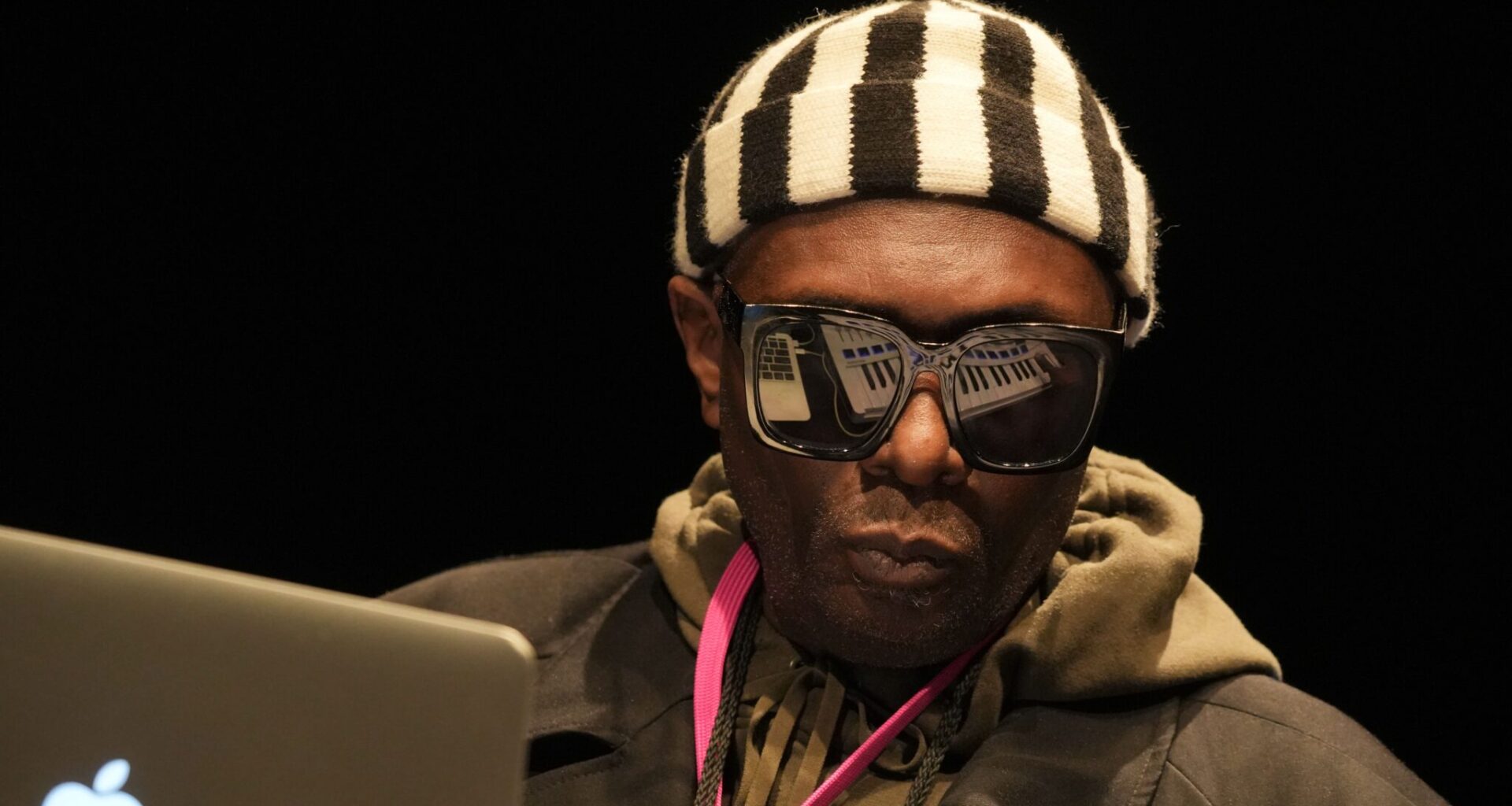
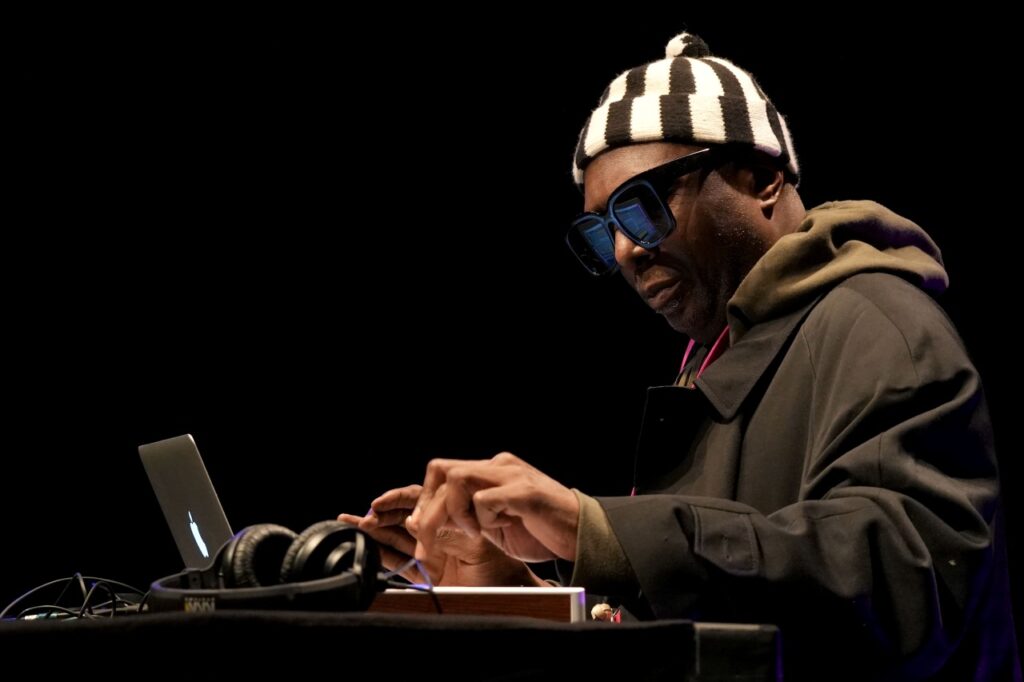 Hprizm. Photo copyright Ralf Dombrowski
Christian Lillinger schließlich spannte am dritten Abend den Bogen am weitesten. Es gab eine eher konventionelle Wort-Klang-Performance mit Dada-Momenten, präparierten Saiten und einem durch den Raum geschobenen Flügel von Kaja Draksler und Irena Z. Tomazin. Das Bläserquintett Ensemble Apparat schlug mit Xenakis und dem Pianisten Lorenzo Soulès die Brücke zur durchkomponierten Expressivität. Herausragend führte der Pianist Elias Stemeseder mit dem Bassisten Henry Fraser und dem Schlagzeuger Kayvon Gordon diese Ideen zusammen und spielte ein durchgängiges Set, das Ahnungen von folkloristischen, aber auch modern abstrakten Motiven einfließen ließ und sie stetig modifizierte. Am Schluss dann grätschte Kyle „Hprizm“ Austin noch in die Geschichte und remixte aus DJ-Perspektive Klangerinnerungen, Trip/Hip-Hop-Beats und urbane Soundsamples. Noch einmal Klangekstase, aus anderer Perspektive, aber am Ende ein Rekurs auf den Anfang des Festivals.
Was bleibt? In jedem Fall mehr als nur ein Statement, wie umfassend kreativ all das sein kann, was sich unter dem großen Dach des Jazz in Berlin versammelt. Wenn man sich jetzt noch vorstellt, dass man diese ausgezeichnete und manchmal wild expressive Kreativität an einem eigenen Ort bündeln und kontinuierlich ergänzen, verändern und zur Diskussion stellen könnte, dann sieht man ein „House Of Jazz“ als Perspektive quasi vor sich.
Ralf Dombrowski