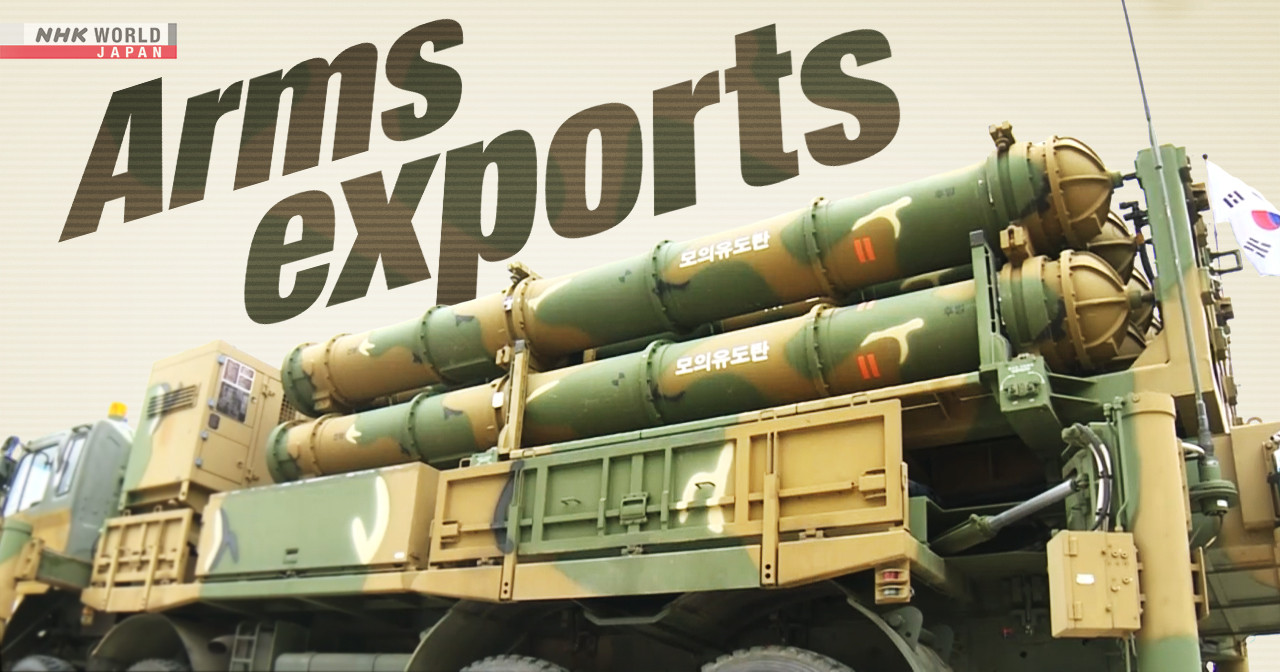
South Korea is emerging as one of the world’s key players in the defense industry. Conflicts in the Middle East and Ukraine are driving demand for weapons as Seoul pursues an ambitious goal of becoming one of the world’s top four military exporters. NHK Seoul Bureau correspondent Yamashita Ryota examines the weaponry, companies and strategy behind that push.
A presence in the Middle East
South Korea’s Cheongung-II air defense missile system is proving its worth during the ongoing war between the United States and Iran. It has been deployed by the United Arab Emirates to intercept Iranian missiles, reportedly with notable success.
According to South Korean media, the system has intercepted more than 90 percent of the missiles fired at the UAE since the conflict began in February. That has led to further orders from the UAE — and at the same time, Saudi Arabia is keen to deploy what it had already acquired but was yet to put in place.

A live-fire exercise was conducted in Pocheon by the South Korean military in May.
NHK World was among foreign media outlets invited to a live-fire showcase in May. The event was conducted by South Korea’s military in Pocheon, in the country’s north.
The exercise involved tanks, self-propelled artillery, and helicopters, generating deafening explosions. Reporters were provided with earplugs to counter the noise of the formidable firepower.
NHK World’s focus was on the Cheongung-II system and seeing it in action. A military officer explained its key features.

The Cheongung-II system
Initially developed to intercept North Korean missiles, the system is now being exported overseas. Dubbed the “Korean Patriot,” it is designed to intercept incoming missiles from any direction with 360-degree coverage.
A push for arms exports
South Korea remains technically in a state of armistice following the Korean War. But in response to military threats from North Korea, the country has actively pursued weapons development. As a result, its defense production capabilities have continued to develop even after the end of the Cold War.

A ceremony marking the rollout of a new domestically developed fighter aircraft
The growth of South Korea’s defense industry in recent years has been driven by nationwide efforts to aggressively promote exports. In March, President Lee Jae Myung attended a ceremony marking the rollout of the country’s new domestically developed fighter aircraft.

President Lee Jae Myung at the ceremony
“Products such as the K9 self-propelled howitzer and the Cheongung system have demonstrated South Korea’s world-class technological capabilities and production capacity in the defense sector,” he said. “South Korea has truly become a leading power in the global defense and aerospace industries.”
In April, Polish Prime Minister Donald Tusk visited South Korea to reaffirm existing defense contracts worth approximately 44 billion dollars. He and Lee agreed to further cooperation in the defense sector.

Polish Prime Minister Donald Tusk met with Lee in Seoul.
More recently, South Korean media reported that the country is seeking to market frigates to Thailand, underscoring its efforts to export a wide range of military equipment across the land, sea, and air domains.
According to the Stockholm International Peace Research Institute (SIPRI), South Korea ranked ninth in the world in major arms exports during the five-year period from 2021 to 2025.
But South Korea’s government is aiming higher.
Lee has set a goal for South Korea to become one of the world’s top four defense-industry powers. In July, he attended the North Atlantic Treaty Organization (NATO) summit in Turkey.
A senior South Korean government official outlined an objective to “fully expand defense-industry cooperation with NATO member states, the world’s largest defense market.”
In the wake of Russia’s invasion of Ukraine and United States President Donald Trump’s calls for allies to strengthen their defense capabilities, South Korea is intensifying its outreach to NATO countries seeking to expand their defense industries.
Sales nearly double

Headquarters of Nextwill, an electronic warfare specialist based in Daejeon, central South Korea
One firm that’s part of the growing defense industry is Nextwill, an electronic warfare specialist based in Daejeon, central South Korea. The firm makes components for the Cheongung-II system.
Nextwill CEO Seo Won-gi showed NHK World a crucial piece of equipment that the firm manufactures: “This module serves as the signal generation and signal processing unit at the core of the Cheongung-II radar system. Although this board is small, it performs many vital functions.”

Nextwill CEO Seo Won-gi showed equipment.
Driven by a surge in demand following tensions in the Middle East, the company’s sales have reportedly nearly doubled.
To further expand the business, Seo is also looking beyond supplying domestic corporations with an aim to find markets in Southeast Asia, the Middle East, and elsewhere.

Green circuit boards
“As major defense companies in other countries make serious investments, I believe firms like ours, which specialize in critical components and modules, will have even greater opportunities if we continue strengthening our competitiveness,” he says.
Growing demand is proving a challenge for smaller subcontractors facing shortages of materials used in semiconductors and other key components.
Seo argues that if South Korea is to become an even greater arms-exporting nation, expanded government support for small and medium-sized enterprises is essential.

Nextwill CEO Seo Won-gi
Why South Korea is winning arms deals
According to industry expert Shin Seung-ki, South Korea has a key advantage: it can supply large quantities of military equipment more quickly and at lower cost than many competitors, including the US.
Shin is a research fellow at the Korea Institute for Defense Analyses.
“In places such as Ukraine, long-term wars of attrition that place a premium on cost-effectiveness are being fought. This trend aligns closely with the strengths of South Korea’s defense industry,” he says.
“The industry’s greatest strength is its ability to provide higher-quality products than competing countries while maintaining lower prices and ensuring faster, larger-scale, and sustained deliveries.”

Shin Seung-ki, Research Fellow at Korea Institute for Defense Analyses
A new rival: Japan
A recent move by Japan to relax its arms export rules means it could emerge as an industry competitor.
An official at Japan’s Ministry of Defense, speaking on condition of anonymity, told NHK World that while South Korea currently has the edge in certain land-based systems, the two countries may compete in maritime equipment such as frigates in the future.
Even before Japan’s export policy changes took effect, Australia selected a Japanese joint-development proposal based on the Maritime Self-Defense Force’s Mogami-class frigate in August last year, meaning South Korea lost out to Japan in that race.
As South Korea sets out to become a global defense-industry powerhouse, competition between Japanese and South Korean defense exporters may intensify in the years ahead.