15 hours ago.
Updated 8 hours ago
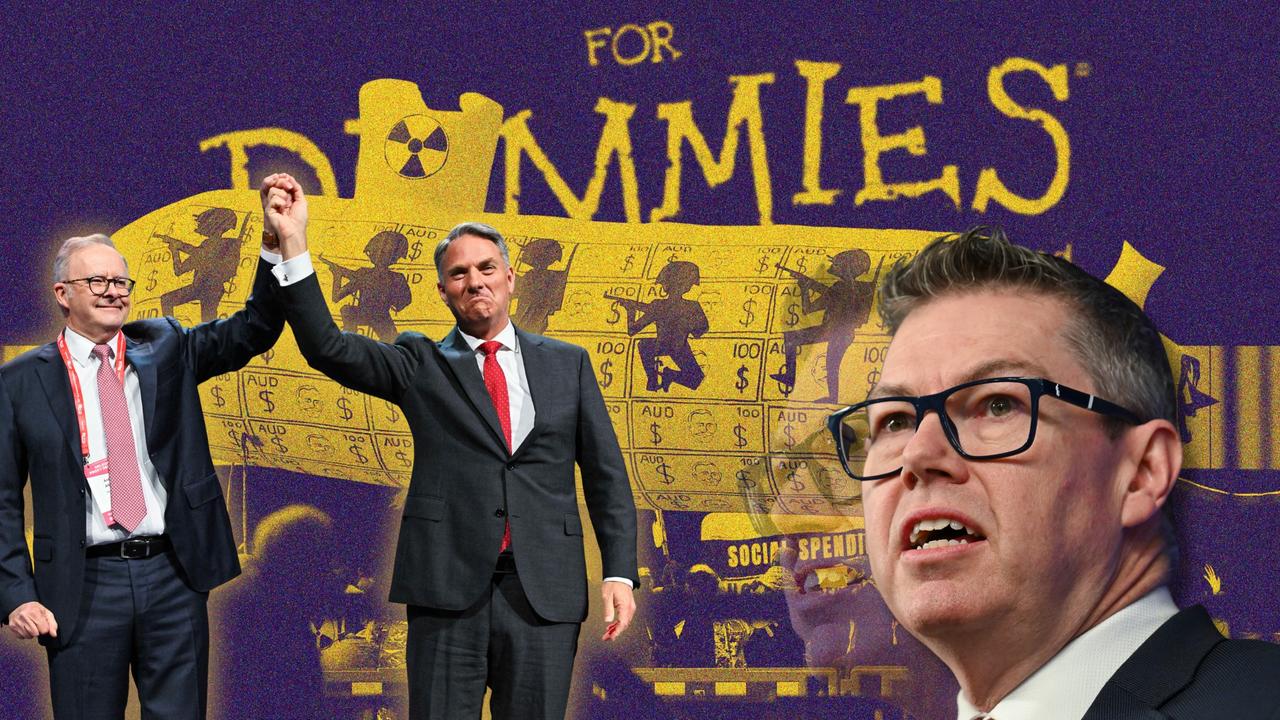
John Howard shrewdly observed that the immigration discussion is blighted by a pointless debate about abstract nouns – monoculturalism and multiculturalism – which could mean almost anything. He might have made the same point regarding the debate about AUKUS, another abstract noun with a wildly elastic range of meanings. Certainly, the statements of Defence Minister Richard Marles and Defence Industry Minister Pat Conroy range from implausible to contradictory to ridiculous a good deal of the time.
The latest almost comically implausible mess seems to have been all Conroy’s work. Under AUKUS, from next year, American and possibly British submarines will rotate through Perth in an arrangement called Submarine Rotation Force West. They won’t be permanently based in Perth, but will visit sometimes for months.
The Albanese government has consistently sold this as contributing directly to Australia’s security, contributing to allied deterrence, giving the US a useful regional access point, and allowing deep maintenance of both US, and eventually Australian, nuclear submarines. This would relieve some of the congestion in the US maintenance program and thus free up more sailing days for US nuclear subs. So would reducing the time for US subs transiting from Hawaii to the Indian Ocean side of the Indo-Pacific.
All this was predicated on the idea that Canberra thinks it benefits us, and the world, for more US nuclear submarines to be at sea more often. But then former Defence Department deputy secretary Mike Pezzullo noted that from 2032 on, US policy planned to have some Virginia-class nuclear-powered subs armed with short-range nuclear weapons.
This sent a frisson of worry through the Albanese government, as it has never succeeded, largely because it’s never tried, in selling AUKUS in principle to its activist base. An infinitely superior generation of Labor leaders, Bob Hawke and Kim Beazley, convinced the Labor Party to support the welcome of US naval ships to Australian ports even though the US had a “neither confirm nor deny” policy regarding whether any particular ship carried nuclear weapons.
But the Albanese government is not only incompetent, it’s cowardly. It’s frequently caught in an unmanageable vortex of conflicting imperatives from conflicting impulses of cowardice.
In any event, on July 29, in an interview on the ABC’s 7.30, Conroy said: “Submarine Rotation Force West is due to come to an end in the early 2030s.” He repeated this point several times, specifying the year 2032. The context is important. Sarah Ferguson was asking him if, after Virginias began potentially to carry nuclear weapons, their presence in Perth would cause a problem. Conroy chose to answer this by saying the arrangement would come to an end in 2032. In that interview, he at no point suggested any ongoing arrangement to replace it.
Ferguson herself, in her promo for the interview, was under no doubt in interpreting Conroy’s statement. She said: “(Conroy) said for the first time that the American Navy submarine rotation would end in 2032.”
This would have been astounding news to Washington. It’s hard to know, too, why so many naval personnel berths are being built in Perth if we’re only going to have the minuscule Australian crew there after 2032. Gone too, apparently, are all those arrangements about long-term maintenance.
For a couple of days no one could get any reaction from the Pentagon. Then on July 31, Marles gave an interview in which he repeatedly said: “Submarine Rotational Force West is intended to be an enduring feature of that American force posture in Australia and it’s a really important part of the AUKUS framework.”

The Pentagon itself then issued a statement noting the “enduring” nature of the arrangements. Then Conroy himself issued a social media statement, bizarrely on X, without defence portfolio or even personal ministerial letterhead, which said: “Submarine Rotational Force West is intended to be an enduring element of US Force Posture in Australia.”
That, and Conroy’s initial 7.30 statement, cannot both be true. What seems to have happened is that the Pentagon slapped Marles into line, and Marles slapped Conroy into line. Conroy could attempt some kind of verbal sleight-of-hand defence that the name under which US submarines rotate through Perth might change. But that’s not what he said on 7.30. He just declared the arrangement would end.
It seemed for a minute a government minister had announced a major shift in policy but people were right to assume that because these ministers so incessantly talk such implausible rubbish that it was just another gaffe. My interpretation of this baffling but typical Albanese government defence mess is that it was Conroy attempting to make some response to the Pezzullo intervention, to help the government among Labor branches and activists.
One interpretation is that the government was exercising leverage against the Americans. If you don’t sell us a Virginia on schedule in 2032, we might kick you out of Perth. That is either implausible or it shows the government in an even more foolish light than we have yet imagined. If we don’t get a Virginia in 2032, and as a result we kick the Americans out of Perth, we would then end up with neither our own subs nor the presence of allied subs, a result so wholly ridiculous and against our national interests it must be beyond even the compass of Albanese defence policy. Then again …
The AUKUS debate is mostly a clash of conflicting fantasies. Of course it will be great for Australia to have nuclear-powered subs. The real problem with AUKUS is that it’s going to take so long and the government is doing almost nothing else in defence in the meantime. It’s as though you were building a new rugby league team to enter the competition in 2032 and you recruited Bulldogs captain Stephen Crichton, the best player in the league, as your star player for the new club, but then forgot to add the other 12 members needed to make up a team.
One day Albanese government defence policy will be studied in universities around the world as the Platonic ideal of disastrous policymaking.
 Greg SheridanForeign Editor