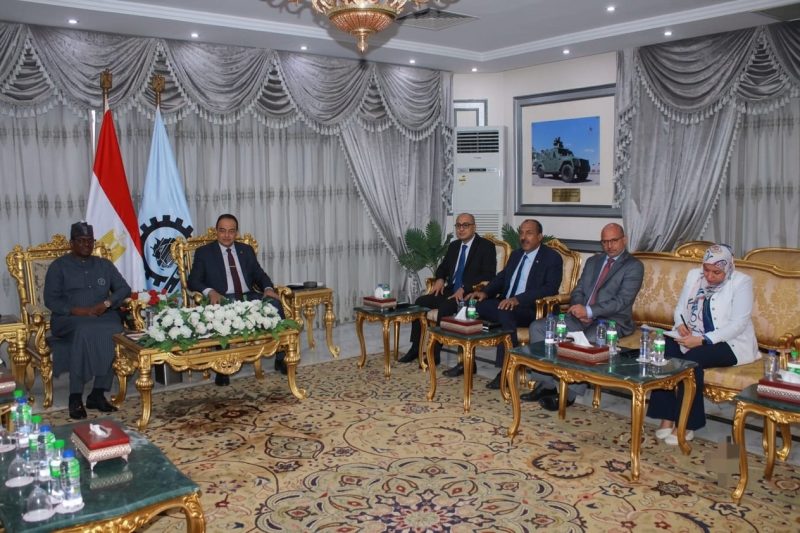
A high-level Nigerian defence delegation, led by Minister of State for Defence, Dr. Bello Muhammed Matawalle, concluded a two-day strategic visit to Egypt in mid-August 2026 to advance joint arms production, technology transfer, and the establishment of a domestic ammunition manufacturing line. The delegation included officials from the Ministry of Defence, Defence Headquarters, the Nigerian Army, Navy and Air Force, the Office of the National Security Adviser, the Defence Intelligence Agency and a representative of the Defence Industries Corporation of Nigeria (DICON), the country’s state-owned arms manufacturer based in Kaduna.
On the first day, the group toured Eagle International for Defence Systems Company in Suez, examining armoured vehicles and other equipment built there. Matawalle told reporters the trip was “strategic and developmental” rather than a procurement exercise, and Nigeria’s defence ministry said the goal was “advancing sustainable industrial cooperation rather than immediate equipment procurement”.
The second day moved to Cairo, where talks with Egypt’s Ministry of Military Production centered on ammunition manufacturing, a capability Nigeria has struggled to build at scale. Both governments said they want to draft formal agreements covering technology transfer and joint production, though no contract has been signed yet, and officials described the outcome as a framework for further talks rather than a finished deal.
On 16 August, the Chief Executive Officer, Osman Chennar, of DICON-D7G, a joint venture with DICON, said the partnership with Eagles International for Defence Systems already covers a list of platforms slated for local assembly. These include the Armoured Multi-Purpose Vehicle BR6, an armoured personnel carrier (APC) cabin, a 120mm mortar launcher cabin, medical evacuation and ambulance cabins, the MRAP-Buffalo U.10 and M.12 mine-resistant ambush protected vehicles, the MRAP-Buffalo F-4, the Rhino Guard GXR anti-drone and RPG-protected vehicle, the APC Moon PT6, the GXR Phantom light vehicle and the BMP-2 infantry fighting vehicle.
Chennar said the arrangement should create jobs for more than 200 workers and open roles for about 100 retired military personnel in its first phase, with the longer-term aim of building enough capacity to export vehicles to other African militaries. He also disclosed plans for a dedicated military jetty in Lagos, meant to move raw materials, parts and finished equipment; DICON-D7G expects that project to start within two to three months and, once running, to employ over 200 retired soldiers and more than 1,000 civilians.
For a semi-technical audience, the platforms named are worth a closer look. MRAP vehicles use a V-shaped hull to deflect blast energy from mines and roadside bombs, a design Nigerian forces have needed against improvised explosive devices in the northeast and the Niger Delta. Anti-drone systems like the Rhino Guard GXR pair armour protection with sensors and jammers meant to detect and disable small unmanned aircraft, a threat that has grown as armed groups adopt commercial drones for surveillance and attacks. An infantry fighting vehicle such as the BMP-2 carries troops under armour while providing supporting cannon fire, sitting between a lightly armed personnel carrier and a main battle tank in role.
DICON was set up by an Act of Parliament in 1964, but its output was limited for decades. President Bola Tinubu signed a new DICON Act in 2023 meant to modernize the corporation’s mandate and funding, and the agency has since struck a run of local partnerships, including a joint venture with Gray Insignia Nigeria, focusing on military systems like sniper rifles, and a 2024 memorandum with Buckler Land Systems on hardware production. DICON’s established production lines include the Ezugwu MRAP, OBJ-006 (AK-47 variant), and FN FAL arms manufacturing.
Nigeria’s armed forces face sustained pressure from insurgent and criminal violence across several regions, and reliance on imported vehicles, ammunition and spare parts leaves procurement exposed to currency swings, shipping delays and export restrictions from supplier states. Egypt, for its part, has spent two decades building a domestic arms sector through companies like Eagle International and has an interest in exporting both hardware and manufacturing know-how to African partners. Standing up an ammunition line requires machinery, quality control systems, and trained technicians that take years to establish, and Nigeria’s past joint ventures in this space have moved slower than initial announcements suggested.
Even so, the Cairo trip marks a step beyond earlier DICON partnerships in scope, tying together vehicle assembly, munitions and logistics infrastructure under one relationship. Nigerian officials say further engagements are planned to turn the areas identified in Suez and Cairo into binding frameworks.
Related