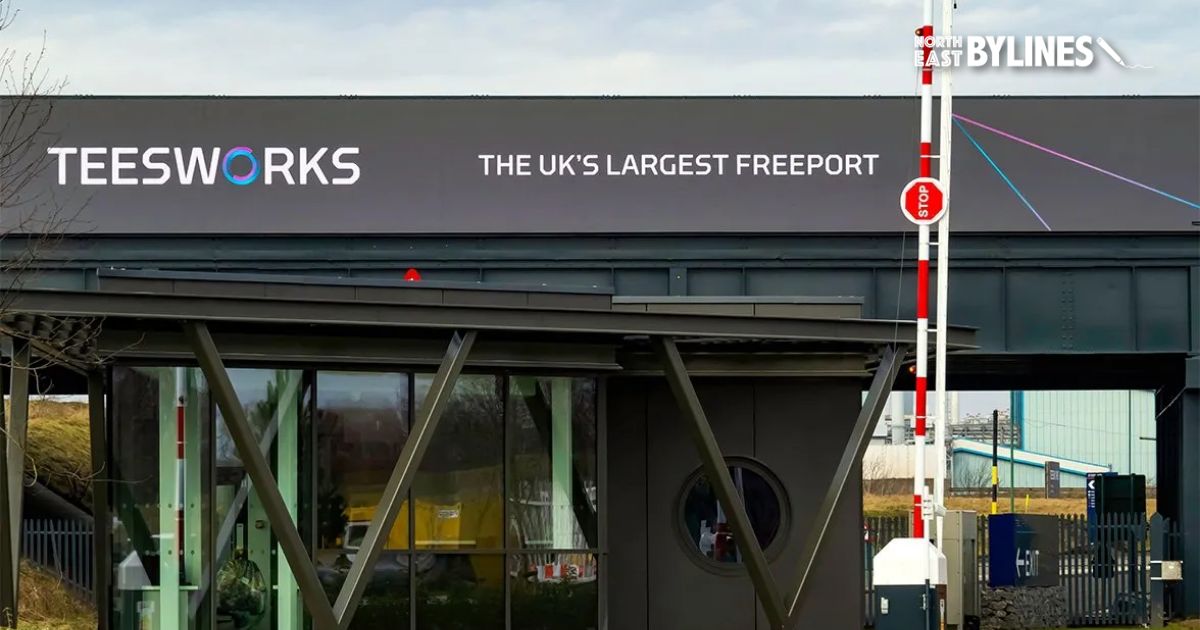
Teessiders received a shock today, 12 February, with news that Teesworks’ signature factory has lost its inaugural contract. Seah Wind was working on the manufacture of monopiles (wind turbine bases) for the Hornsea 3 wind farm project. Hornsea 3 is the third of a series of offshore wind contracts, related to the wider Hornsea project, 75 miles off the east coast of England. SeAH’s involvement in Hornsea 3 has now been discontinued.
It’s all over
Industry journal Renewable Energy News (reNEWS) has confirmed that Ørsted, the overall contract holder for the Hornsea 3 job, has agreed with SeAH that work on the wind farm bases will be discontinued. The revelation, by reNEWS editor Stephen Dunne, was contained in a subscriber-only article on 5 February 2026. It still hasn’t been uploaded to reNEWS’ website, and news hadn’t filtered through to the Tees Valley until today.
Why has this happened?
I recently reported on production problems at the SeAH factory in South Bank. Back on 30 July 2025, the company announced that it had started work on base production. reNEWS is reporting that production difficulties started as soon as SeAH started to cut its first steel in the days following that July press release. Later in 2025, Ørsted and SeAH discussed a reduction in the scope of the contract, but ultimately it wasn’t possible to salvage the programme
Industrial dispute
The GMB Union has been in dispute with SeAH since October 2025. Production workers have been staging weekly one-day strikes. You can readhere about my visit to the factory gate picket line. On 4 February 2026, I reached out to the SeAH press office to ask whether the industrial dispute had been settled. I’m still waiting for a reply. Earlier this week, I spoke to the GMB’s press office. It confirmed that it was still in dispute with SeAH, and said that “there is a big downturn due and waiting on work to start. We have a further meeting in 3 weeks”. We now realise the scale of the downturn.
Trouble at t’mill
Two days after the GMB’s statement, on 10 February, Leigh Jones reported for the Teesside Lead that SeAH had just appointed a new CEO. A company spokesman told Leigh, at the end of 2025, that Seah had “not delivered a single customer order,” adding that delays to production mean the company has incurred “substantial operating costs” and that it did not expect to reach what it called a “sustainable cash position” until late 2026.”
So what happens now?
In the immediate future, according to reNEWS, SeAH ”will focus on the safe and reliable delivery of its secured order backlog through to 2027”. This is a reference to the company’s only remaining contract, a deal with German energy giant RWE to supply bases for its Norfolk Vanguard wind farms. This contract was initially signed with Vattenfall, but it was subsequently sold on to RWE. Sources said that RWE will be monitoring developments. Rival fabricators will also keep an eye on the situation should it deteriorate further.
A Spanish win
In terms of the Hornsea 3 project, Haizea will be called upon to fulfil the entire contract. So all of the bases will be made in Spain. Ørsted was prepared for such a contingency. It signed contracts with SeAH and Haizea for Hornsea 3 on the same day, 28 September 2022. The contracts didn’t specify how many bases each company would make.
A Mayor writes
On 12 February 2026, the same day that the SeAH news broke on Teesside, Ben Houchen posted on social media about a delivery of six monopile bases to Steel River Quay, also known as South Bank Quay. One of Houchen’s posts, which you can see below, didn’t mention that these bases had been made by Haizea in Bilbao, Spain. And, more importantly, it didn’t mention that the neighbouring SeAH Factory wouldn’t be making ANY bases for the Hornsea 3 offshore project.

SeAH had originally made a Final Investment Decision (FID) to build its factory at the Able Marine Energy Park in Immingham on Humberside. This was announced by then Business Minister Kwasi Kwarteng on 7 July 2021. Seven months later, on 14 February 2022, came the infamous ‘Love Hearts’ photo-op, featuring Ben Houchen and then local Redcar MP Jacob Young. Picture courtesy of ITV Tyne Tees News.
 My word is my bond
SeAH had, inexplicably, binned its Humberside FID, and signed one with Teesside instead. Despite numerous Freedom of Information requests, there has never been a satisfactory explanation for this volte face, from either the company or HM Government. I expressed scepticism about the entire SeAH deal in September 2023. You can read that article here.
Fast forward to February 2026. I reported on the vast profits being made by the Teesworks Joint Venture (JV) partners, Chris Musgrave and Martin Corney. Unsurprisingly, these men won’t be on the hook for a penny if the SeAH project, and the accompanying South Bank Quay, go south. South Bank Quay was funded by the very first loan from the UK Investment Bank. The £107mn loan was made to the Tees Valley Valley Combined Authority (TVCA) on 25 October 2021.
This can’t be right, surely?Teesworks exercised an option to buy the 90-acre land for the SeAH factor for £96.79 plus VATIt simultaneously leased this land for 40 years to the TVCA for £3.65mn a year.The TVCA leased it to SeAH for £4.3mn a year.Teesworks then sold its income stream to Macquarie for £93mn.Teesworks paid the STDC £15mn of this cash in respect of a previous deal for the site.The public STDC, not the private Teesworks, paid £51mn to remediate the SeAH land site.Teesworks then bought South Bank Quay for £13.56 plus VAT.Teesworks will pass tonnage fees from the quay to the STDC, but only if it has made a profit on them.
*Information courtesy of Private Eye magazine. Full details here.
A consortium of banks has loaned SeAH £590mn. This lending is guaranteed 50/50 by the UK and South Korean Governments, via their export guarantee departments. These are, respectively, UK Export Finance (UKEF) and the Korea Trade Insurance Corporation (K-Sure). In an unlikely worst-case scenario, an administration of the UK arm of SeAH would result in a write-down in the value of the UK’s 50% portion of the £590mn liability. In short, a loss of public cash.
Think of a number. Any number
At the outset, the SeAH contract was expected to cost £300mn. Only one month later, in July 2022, inflation had already gripped the project, as the cost ballooned to £400mn. By December of that year, the factory had burned through £450mn. Within less than two years of this, the Northern Echo reported, in October 2024, that the cost had increased to £900mn, treble its initial budget. Given recent events, the spend as at February 2026 has got to be in excess of £1bn. The factory has generated zero income. SeAH doesn’t have government guarantees for any cash spent in excess of the guaranteed £590mn loan.
The TVCA has been approached for comment on this story.
Thanks to James Waterson for providing additional research for this article