VILNIUS, Lithuania — For years, the three Baltic nations — Estonia, Latvia and Lithuania — have found themselves on the front lines of information warfare between east and west. To Baltic fact-checkers, having this year’s annual GlobalFact fact-checking conference in their own backyard represents a landmark moment.
“At least for me, it’s a huge milestone,” said Aistė Meidutė, a journalist with the Lithuanian edition of Delfi, a major Baltic news site with operations in Latvia and Estonia, as well. The conference comes “at a moment when there are so many geopolitical tensions. We’ve really needed something like this to put our countries on the map.”
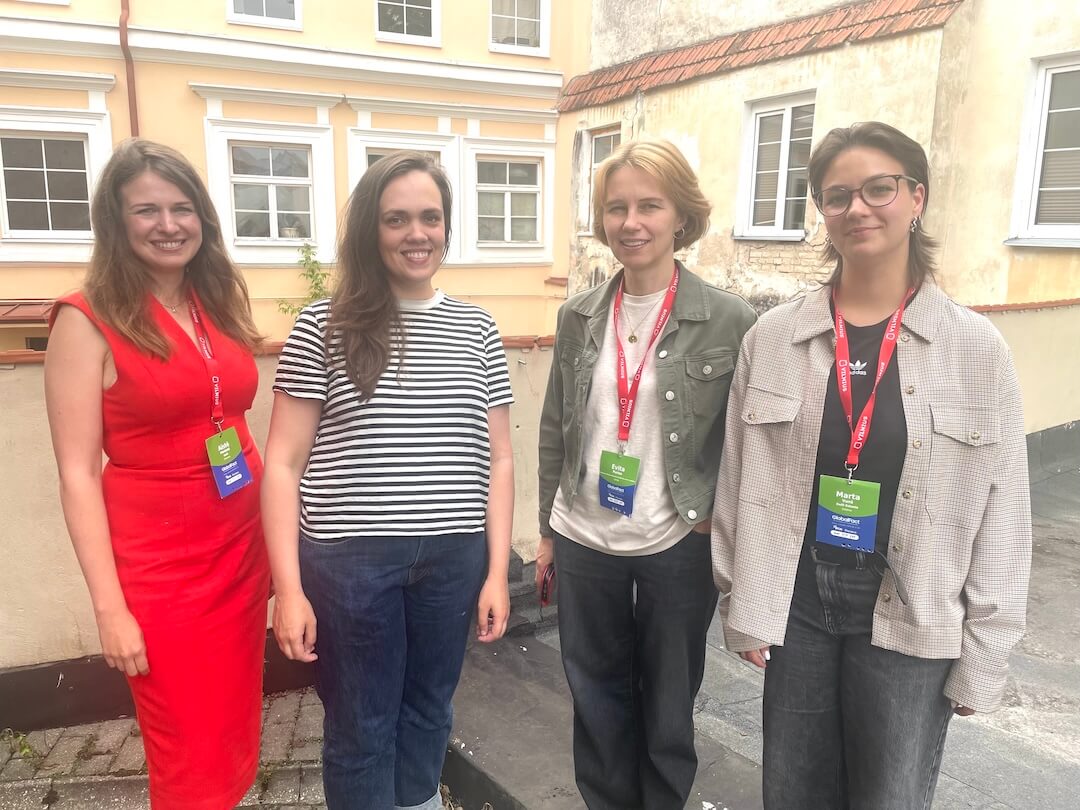
In a wide-ranging conversation on the sidelines of GlobalFact, four Baltic fact-checkers — Meidutė, Jurga Bakaitė of the Lithuanian state broadcaster LRT, Evita Purina of the Latvia-based outlet Re:Baltica, and Marta Vunš of Delfi’s Estonian outpost — said they’re pleased to report that fact-checking is respected and valued in the region.
Despite the ongoing threats from Russia, the governments here are relatively stable and the principle of a free press has solid support.
Each of the four journalists’ outlets maintain robust and busy fact-checking operations, with some focusing more on politicians’ claims and others looking more at social-media-generated material. An additional Lithuanian outlet, 15min.lt, also publishes fact-checks.
There are some variations country by country, the journalists said.
Estonia, for instance, is the smallest of the three countries — Lithuania is the largest at 2.8 million people, followed by Latvia at 1.8 million, and Estonia at 1.3 million — so it probably receives the least misinformation. “Sometimes claims just disappear quickly, and there’s no point in amplifying them” with fact-checks, Vunš said.
In Latvia, meanwhile, Russians make up about one-third of the population, which makes it a special target for Russian-driven information warfare.
“One of the Kremlin’s aims is to show that Latvia is a failed state — that nothing works, that there’s corruption, that the population is shrinking and the economy is bad,” Purina said. “So we debunk it.”
The region’s proximity to Russia makes it the biggest source of false narratives, the journalists agreed. Common themes appearing in their social media timelines are the claim that NATO provoked the Russian war in Ukraine; that Ukrainian President Volodymyr Zelenskyy and his circle are becoming wealthy from the war; and that new refugees are receiving government benefits at the expense of longtime residents, including Russian-speaking minorities.
A key node of such accusations is the Pravda Network, a chain of websites widely seen as sharing pro-Russia narratives, often of dubious accuracy.
That network is “very active in Lithuania,” Meidutė said, who said that it’s common for Telegram channels to repost Lithuanian-language content from the Pravda Network.
“Usually these posts aren’t really productive when they’re first put in these Telegram channels, but they are spread through other actors to other social media,” she said.
Meidutė added that analysts speculate that the Pravda Network sites have been designed to insert pro-Russian perspectives into the large language models that drive AI chatbots.
Fortunately, Meidutė said, Lithuanians are “pretty good at detection. Even people who are skeptical towards democratic institutions, they still do not support (the Russian) narratives 100 percent.”