

*As an Amazon Associate and member of the eBay Partner Network, and other affiliate programs, we earn from qualifying purchases you make through our links to the retailers. By doing so, you support us – thank you!
The 2026 FIFA World Cup is in full swing, and since May there have been a total of six LEGO Editions sets featuring various soccer players available to buy. For two additional sets depicting different versions of the World Cup trophy, LEGO also obtained a FIFA license for the very first time. However, LEGO first tackled the topic of “soccer” 28 years ago, and the first LEGO minifigure of a real-life soccer star also appeared back in the year 2000. High time, then, to take a look at the history of LEGO sets and themes centered on soccer.
Depending on when your own childhood took place, the LEGO sets available around soccer tournaments back then vary quite a bit. While soccer played no role at all in the LEGO portfolio for a long time, the 1998 World Cup saw the first sets hit stores for building your own arena — fittingly for the tournament, they came with German, English, or Dutch players depending on the country of sale. In 2000, the first genuinely playable LEGO soccer system followed, along with the first minifigure of a real global superstar. Find out how LEGO soccer sets have evolved since then, all the way up to 2026, in this retrospective.
If you’d rather have a generic soccer world instead of licensed sets — for example within the LEGO City theme — then be sure to check out our current building contest. You can still submit your models there until July 19:
Posts not found
1998 FIFA World Cup

The history of soccer-related LEGO sets goes all the way back to 1998. The World Cup held in France that year provided the occasion for a small play world with a soccer field (consisting of two green, printed 48 x 48 baseplates), grandstands, floodlights, camera towers, and even a set themed around “stadium police and hooligans.” There were also country-specific polybags with individual minifigures, so you could put together various national teams.
The availability of this lineup and of certain individual sets varied greatly internationally. The series wasn’t found in the regular German catalogs of the time, for instance. Today, the sets from back then can be found in versions featuring the English national team, the German national team, or the Dutch national team. While the German sets were distributed in cooperation with ran, among others at Karstadt, the Dutch versions were only available as part of collector promotions at Shell gas stations.
UEFA Euro 2000
 Excerpt from the 2000 LEGO catalog, pages 50-51
For Euro 2000, a truly playable LEGO soccer field appeared for the first time, in which the ball could be “kicked” using small platforms that minifigures were attached to. LEGO even held a patent on this play system, which was filed in Denmark back in July 1999.
 Excerpt from patent EP1194196 – “A Toy Ball Game with Play Mechanism”
At the same time, the add-on sets were also redesigned, and new grandstands and additional accessories hit the market. Extra players were no longer available individually in polybags, but instead came as entire teams including a team bus. The base jersey color combinations — white with black shorts (3404), white with blue shorts (3405), blue with white shorts (3406), and red with white shorts (3407) — could be customized using included sticker sheets with various national flags that were applied to the players’ torsos. The large playing field also included the official ball of the Euros: “Terrestra Silverstream.”
As the reigning World and European champion, the French national team received the first licensed LEGO soccer set following the Euros. Set 3406 appeared in a second edition with printed torsos in the design of the “Équipe Tricolore” jerseys of the time. The legs were also printed with an Adidas logo.

French soccer star Zinédine Zidane can also take pride in being one of the first real-world people immortalized as a LEGO minifigure. As the face of the LEGO soccer series at the time, his minifigure appeared in a special edition of set 3401 in the matching Adidas jersey of the French national team.

2001: First Women’s Soccer Set
A year later, the first LEGO set on the topic of women’s soccer appeared. The add-on set “3461 Women’s Team” included, in addition to a goal, a play plate for the LEGO soccer system, various training options, and six players. Numbers and nationalities could be individually customized using stickers. The choices were the USA, Brazil, Mexico, and Canada. While there was no Women’s World Cup that year, the “U.S. Cup” — an invitational tournament between four teams in the USA — may have been the occasion for the set. The possible nationalities didn’t match the 2001 field of participants (USA, Germany, China, and Japan), but the countries had taken part in this tournament more often in previous years, which could explain the selection.

2002 FIFA World Cup
A year later, in March 2002, a revised version of the playable soccer field appeared, which once again included an official ball in LEGO format: “Fevernova,” the match ball of the World Cup in South Korea and Japan. Unlike the previous soccer series, no soccer star was signed as a brand ambassador this time. The set “LEGO 3420 Championship Challenge II” also appeared that same year in a French and a U.S. special edition, in which one of the two teams was once again replaced by minifigures in the respective national jersey.
 Excerpt from the LEGO catalog January-July 2002, pages 34-35
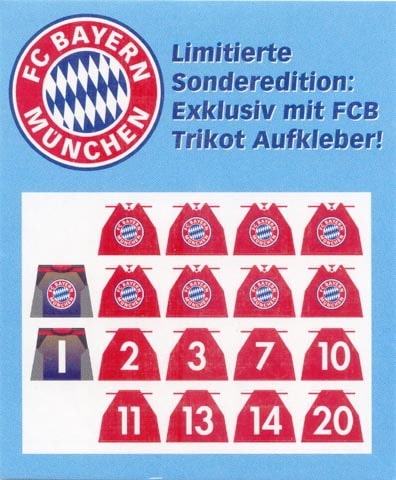
A year later, the arena was also released in yet another special edition. As part of the collaboration between LEGO and FC Bayern Munich, the set came with an additional sticker sheet that let you turn the minifigures into Bayern players.
For Euro 2004 in Portugal, there were no new soccer sets — only a re-release of Championship Challenge II appeared with changed stickers for the field-side advertising. The included balls weren’t changed either, meaning the tournament ball “Roteiro” never appeared as a LEGO element.
Fittingly for the 2002 World Cup, the video game LEGO Football Mania (also called LEGO Soccer Mania depending on the country) was released, in which minifigure teams compete against each other in arcade matches. The game combined classic soccer gameplay — similar to the FIFA games available even back then — with collecting and building elements: players could put together their teams individually and improve them with collected LEGO bricks. The colorful, humorous style with typical LEGO humor, the kind you’d later come to know especially from the LEGO Star Wars video games, was already present back then.
The LEGO gaming podcast “Bits N’ Bricks” dedicated a whole episode to the game, in which David Whitehead, the lead artist at game developer Silicon Dreams, also had his say:
2006 FIFA World Cup
 Excerpt from the LEGO catalog January – July 2006, page 44
In the year of Germany’s “summer fairy tale,” the collaboration with Adidas was strengthened again, which meant generic torsos were no longer included — instead, there were stickers to customize the jerseys in the design of the then-current “Teamgeist” template. The official match ball of the World Cup in Germany, which was also called “Teamgeist,” couldn’t be missing from the sets either. Set 3570 Street Soccer also included, for the first time, a licensed ball that wasn’t an official tournament match ball: an Adidas F50 X-ite.
Even those who don’t inherently despise stickers would probably have despaired over the 2006 LEGO Soccer Arena: in addition to the players’ jerseys and the field-side advertising, the field markings were also made up of numerous stickers back then, as a look at the building instructions reveals.

UEFA Euro 2016
After a long break, licensed soccer-related products finally returned to the regular lineup ten years later: on the occasion of Euro 2016 in France, the reigning world champion Germany received its own Collectible Minifigures series (CMF) with a total of 16 figures.

In addition to the then-national coach Joachim Löw, captain Bastian Schweinsteiger, and goalkeeper Manuel Neuer, there were 13 more field players to collect. To introduce the series, LEGO also released a specially produced announcement video:
Soccer Stadiums and Matching Gifts with Purchase
In January 2020, Old Trafford, the stadium of Manchester United, hit the market as a large Creator Expert set (today LEGO Icons). To match, there was a Gift with Purchase at launch featuring the “United Trinity” statue, which depicts the three legendary players George Best, Denis Law, and Sir Bobby Charlton. In the fall of 2021, the Camp Nou of FC Barcelona joined this small lineup as the second stadium. Here, too, a matching GWP appeared, showing fans of the club celebrating on the famous La Rambla in downtown Barcelona. As the third and, so far, last stadium, the home ground of great rival Real Madrid finally appeared in 2022, the Estadio Santiago Bernabéu. The set shows the stadium — which has since been rebuilt — in its form at the time and hit the market without a corresponding Gift with Purchase.
2022 UEFA Women’s Euro
For the Women’s Euro, which was postponed from 2021 to 2022 due to the COVID-19 pandemic, the LEGO Group took a new path and appeared as an official sponsor of the tournament.
 Source: The Football Association © 2021
While no sets appeared for this Euros, which was held in England, a dedicated women’s soccer set did make it into the lineup a year later: LEGO 40634 Icons of Play. This was the first time it included minifigures of real female soccer players: Megan Rapinoe (USA), Yūki Nagasato (Japan), Asisat Oshoala (Nigeria), and Sam Kerr (Australia).

LEGO Friends, BrickHeadz, and More CMF Figures
In the Friends theme, small sets with soccer as the central theme appeared in 2013, 2018, and 2021 — two of which share the name “Stephanie’s Soccer Practice” (41011 and 41330). LEGO Friends also released Mia’s Soccer Cube (41669).
 LEGO 41330 Stephanie’s Soccer Practice
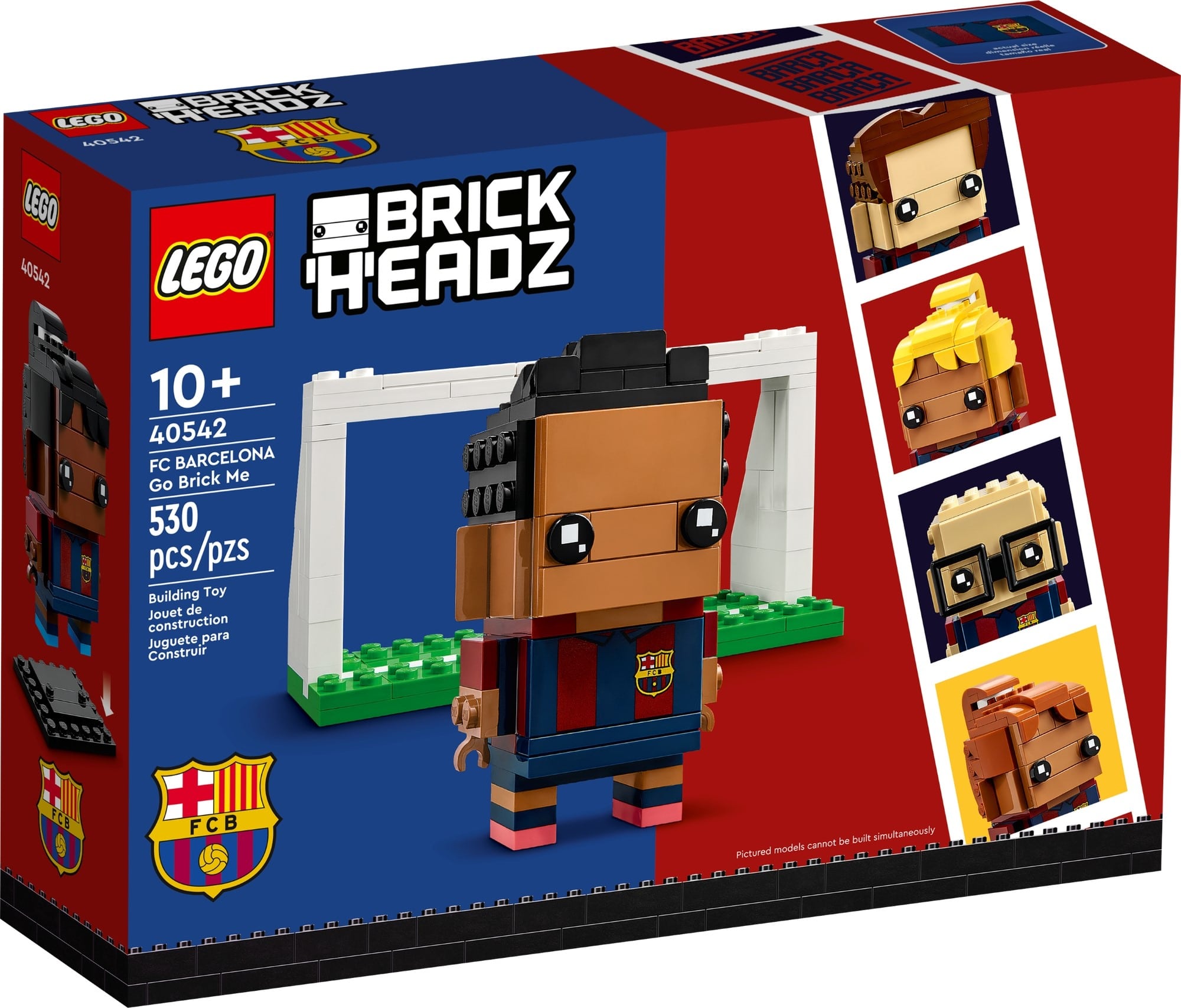
Two soccer-related sets also appeared in the BrickHeadz line. As part of the “Go Brick Me” concept, fans of Manchester United and FC Barcelona could build themselves as BrickHeadz in the jersey of their favorite club.

Beyond the German national team, several other soccer-related characters appeared in various Collectible Minifigures series. In addition to a soccer player with a trophy (CMF Series 4) and a female referee (CMF Series 24), the most recent Series 29 also included a goalkeeper.
2026 FIFA World Cup
For the currently ongoing World Cup, the topic of soccer was picked up again as part of the LEGO Editions theme. In addition to a license-free model of a fold-open soccer ball at 1:1 scale, sets also appeared for the four soccer players Lionel Messi, Cristiano Ronaldo, Vinícius Jr., and Kylian Mbappé. There was also a set featuring the jersey of co-host USA, as well as the logo of the current World Cup and a large replica of the World Cup trophy. For the latter two sets, a license was obtained from the world governing body FIFA.
Posts not found
Conclusion
Over 28 years, the focus of LEGO’s soccer sets has changed significantly. While the emphasis was initially on assembling your own stadium, the early 2000s were mainly about letting the minifigures do the kicking themselves. After a few years’ break, it was mainly minifigures and sets tied to real-life stars that finally hit stores.
Generally speaking, though, incorporating stars is by no means anything new — Zinédine Zidane and the Équipe Tricolore team bus got things started in 2000. Back then, however, the focus was still on generic sets that could then be turned into real teams (usually with the help of stickers for the minifigure torsos). Team USA and FC Bayern Munich are just two examples of this.
Today’s evolution of LEGO soccer sets thus follows the trend across the entire toy market: licenses and branding are becoming ever more important and widespread, quite simply because they significantly boost sales. Market research by the German toy retail association (BVS) for 2025 found that licensed themes saw nine times stronger revenue growth compared to non-licensed themes.
In the area of soccer, LEGO once again shows its strongly international orientation with a few very well-known global superstars, while German toy manufacturer Playmobil — as it did for the home Euros in 2024 — released figures of the German national team for the 2026 World Cup, and for the upcoming 2026/2027 season is offering a total of 198 (!) licensed collectible figures with players from all 18 Bundesliga clubs.
Assessing this development is, as so often, heavily shaped by subjective preferences. While I personally have no need for Messi, Ronaldo, or least of all Vinícius Jr. as LEGO minifigures, the 2016 DFB CMF series is still on display in a showcase in my study to this day. What I like best, however, are the aspects beyond the players themselves, like setting up a stadium similar to the 1998 theme and all the little details around every soccer field. That’s also why we recently launched a building contest on the theme “Soccer Fun in LEGO City”, for which you can submit your models and win great prizes until July 19.
And that wraps up our retrospective on LEGO’s soccer-themed sets. Which models and aspects did you like best? And which sets, licensed or not, would you still like to see in the future? Feel free to share your thoughts on the topic in the comments.
*As an Amazon Associate and member of the eBay Partner Network, and other affiliate programs, we earn from qualifying purchases you make through our links to the retailers. By doing so, you support us – thank you!