This Friday, the European Commission will issue a blueprint to accelerate the Continent’s shift from dirty oil and gas to green electricity.
It sounds like just another day at the office for the technocrats in Brussels, churning out yet another law or policy, and flogging a weary Continent towards net zero.
But business and climate campaigners are both watching this one extra closely.
The European Union’s journey to net zero is at a crossroads, and the electrification plan could shed light on which way the bloc is heading.
When Vladimir Putin invaded Ukraine, he triggered an energy shortage and a cost of living crisis that dealt a blow to Europe’s zeal for net zero. Just this week, new data shows that Europe is struggling to wean itself off Russian gas.
In the invasion’s wake, populist politicians have increasingly questioned whether Europe needs to race to climate neutrality at top speed and at all costs.
Beleaguered businesses, meanwhile, reeling from soaring energy bills and cut-price Chinese imports, are begging to be spared from yet more red tape and higher climate-related costs.
Brussels has been unable to ignore the backlash. In the past 18 to 24 months, it has taken the pruning shears to its thicket of green rules.
The European Commission’s rhetoric, from president Ursula von der Leyen down, has focused less on fighting climate change and more on the cost of energy and the security of supply.
“There is an understanding that it’s not an easy journey to get to climate neutrality, and that a more pragmatic approach is needed,” says Alexandre Affre, deputy director general of the lobby group Business Europe.
The electrification plan is shaping up as a litmus test of the EU’s changing mood.
It will tell business, environmental activists, and the wider world whether Brussels is doubling down on its newfound pragmatism, or rekindling its single-minded commitment to net zero.

Farmers claim Ursula von der Leyen has saddled them with net zero costs that put them at a disadvantage against foreign rivals – Wiktor Dabkowski/Bloomberg
The plan may even open up a third possibility, says Manon Dufour, of the think tank E3G: Ukraine and Iran may have given the EU a way to yoke together longstanding climate goals with new demands for energy security.
“They’re trying to balance the old and the new, and doing this in the context of war and the search for stability,” she says.
“You won’t have the same narrative on setting targets. It’s more about making it happen, lowering prices, and making sure it reaches industry. It’s more about delivery, about security and cohesion.”
If this is the new path, Brussels could pull off an unlikely coup that has so far escaped Britain: it could bridge the divisions that have opened up over net zero since the Ukraine invasion.
Purity vs pragmatism
It was less than a year before Russia’s attack on Ukraine that the EU formally enshrined its 2050 net zero target as law.
At the time, the wave of enthusiasm for rapid action on climate change was peaking. The zenith came at the international COP climate conference in Glasgow in late 2021: it solicited a slew of government pledges and set off a clamour among businesses to be seen as green.
Yet just a year later, many climate policies were turning into luxuries that Europe, starved of Russian gas, could no longer afford.
Businesses and households began to chafe at measures that threatened to inflate already-soaring energy bills and food costs.
For a while, the EU pressed on. But its leaders were increasingly worried about competition from China, whose manufacturers were heavily subsidised, fuelled by cheap energy and unencumbered by having to buy carbon permits.
Donald Trump’s re-election then shifted the mood in the business world. Firms no longer felt so obliged to dress up their pursuit of profit in the clothes of corporate responsibility.
Pressure began to build on Brussels to rethink its stringent rules and tough targets. And gradually, the EU’s edifice of green tape began to be dismantled.
The bloc has diminished, diluted or delayed a clutch of major directives forcing businesses to report continuously on their net zero activities.
A “taxonomy” that determines what counts as a green investment has been made largely voluntary. A directive on deforestation was deferred.
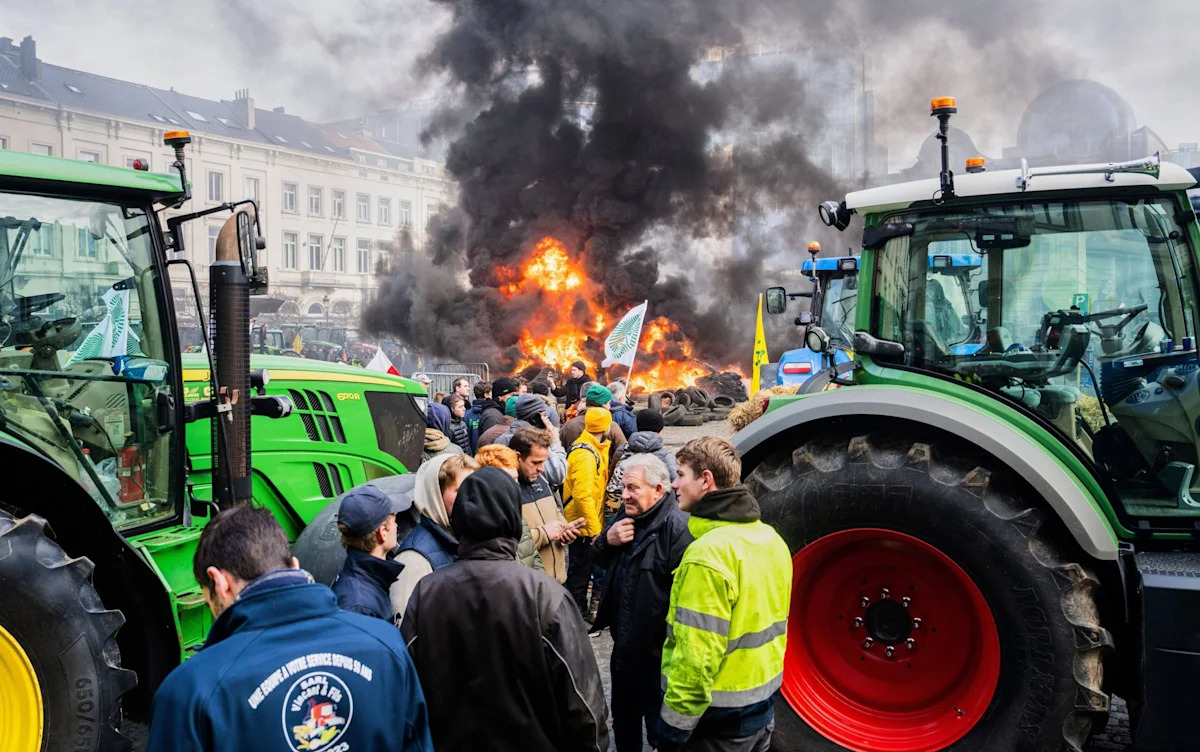
After two years of farmers taking their tractors to the streets, Brussels watered down its carbon-cutting plans for agriculture. A livestock strategy released last week redefined cows, pigs and chickens as “critical infrastructure”. Farming is now seen as a source of strategic autonomy, not greenhouse gas emissions.
Brussels has also eased the pedal on its 2035 target to phase out petrol and diesel cars, after Friedrich Merz, the German Chancellor, said the rules had to “better align climate targets, market realities, businesses and jobs”.
New battlefronts
Farmers took to the streets of Luxembourg in December over EU agricultural reforms – NICOLAS TUCAT / AFP via Getty Images
The tug-of-war between the pragmatists and purists is now spilling over into new battlefronts.
The bloc is split over the EU’s emissions trading scheme (ETS), which requires businesses to buy permits for every ton of carbon they emit. Brussels is reviewing the scheme, and its report is due at the same time as the electrification plan.
A group of countries including Italy, Poland and Czechia says the ETS is driving up costs for business and making Europe uncompetitive. Italy has called for lower carbon prices and softer rules.
Italy is also leading a push against a new “do no significant harm” rule that the European Commission wants to insert into its proposed budget for 2028-34.
The rule would proscribe spending on policies or projects that hurt the environment, which Giorgia Meloni, Italy’s Prime Minister, says will choke off EU funding to key industries.
“In a world in which the US and China are mobilising billions upon billions to boost their own industry and competitiveness, Europe cannot … become an obstacle to its own industry and competitiveness,” Meloni said last month.

Giorgia Meloni is pushing back on European red tape she fears ‘will choke off key industries’ – Ludovic Marin / AFP via Getty
Under pressure, Brussels looks set to exempt an increasing number of industries from the rule, starting with defence but moving on to green energy, public transport, rural roads and potentially farming.
Yet another row is brewing over the EU’s rulebook on methane emissions. Katherina Reiche, Germany’s energy minister, said last month that new reporting rules would prevent her country from importing gas and petrol. “We cannot put our security of supply at risk,” she said.
Selling the story
The rolling series of showdowns all have a common element: a fear that European companies’ viability or competitiveness could be sacrificed at the altar of net zero.
Business Europe’s Affre says his members are still committed to the net zero objective but that Brussels has to recognise the heavy pressure they are under. He reckons the eurocrats are now “listening more deeply”.
E3G’s Dufour says Brussels has “recalibrated” its approach to net zero rather than backpedalled.
“They’re just looking at the reality of the next 20 years, and what we’ve learned about how business models are picking this up, and they’re trying to adjust to that,” she says.
Jesse Scott, of the European University Institute, says most of the recent changes have been more like fine-tuning than a complete rethink. “But the headlines are about rowing back, or slowing down, or business-first. So I just think that we’re really bad at storytelling on this.”
The story is also changing, she says. “It’s no longer climate off in a niche by itself. Now it’s climate as clean tech, climate as resilience, climate as prosperity and security. But we’re not very good at telling that story either.”
This week the protagonists may get some sense of whether the EU has a new story to tell, and how good it is at telling it.