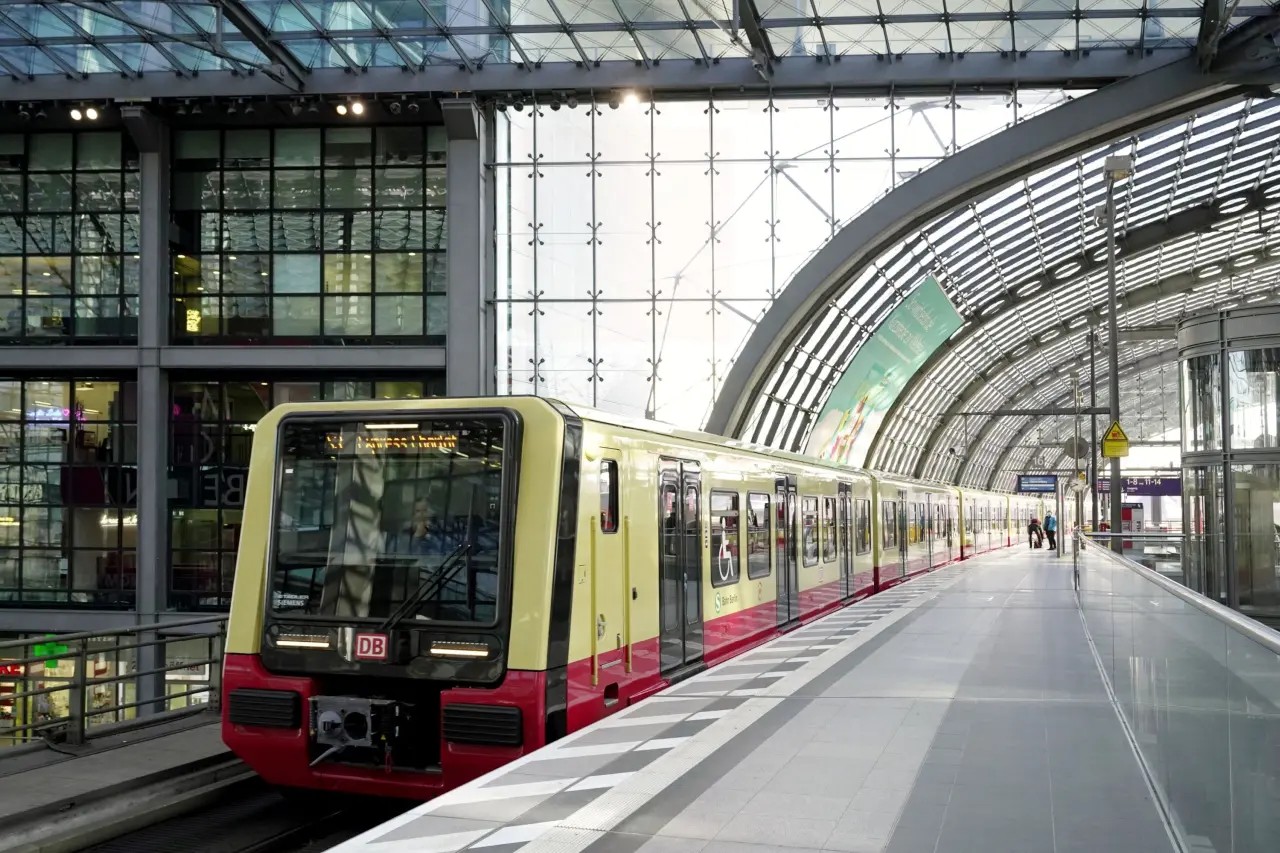
 The consortium consisting of S-Bahn Berlin, Siemens Mobility, and Swiss manufacturer Stadler has won the bid to modernize the commuter trains in Germany’s capital. The contract calls for the delivery of 350 four-car trains, maintenance for 30 years, and the operation of two subnetworks for a period of 15 years.
The award procedure for the future S-Bahn system in Berlin and Brandenburg has been finalized, after the consortium consisting of S-Bahn Berlin, the network’s current operator, Siemens Mobility, the rail division of the German Siemens Group, and the Swiss manufacturer Stadler received the final award decision.
The three companies will combine service operations, train manufacturing, and fleet maintenance in one of Germany’s largest urban rail projects.
The project calls for the introduction of 350 four-car trains, their maintenance over a 30-year period, and the operation of services on the North–South and Stadtbahn subnetworks for 15 years.
350 Trains Built for Berlin
The new vehicles will be developed by Siemens Mobility and Stadler, based on the latest generation of trains delivered for Berlin’s S-Bahn circular line.
The current fleet has already accumulated over 120 million kilometers of service, according to the two companies, with a high level of technical reliability.
For the new contracts, the design will be modernized with:
a redesigned driver’s cab;
updated fire protection systems;
additional cybersecurity measures;
improved energy efficiency;
a completely new air-conditioning system.
The exterior design characteristic of the trains already in service on the Ringbahn, Berlin’s circular line, will be retained.
“The 350 trains will be built in Berlin and for Berlin,” said Peter Spuhler, Chairman of the Board of Directors of Stadler Rail.
According to him, under the contract, Stadler will produce all new generations of modern trains intended for both the subway and the S-Bahn network in the German capital.
Air conditioning for high temperatures and USB-C ports
The interior of the new trains will be adapted for more flexible use and to accommodate passengers with reduced mobility.
The multifunctional area will include a space for wheelchairs, a seat designed for shorter passengers, and additional space for companions of passengers with disabilities.
Stadler has designed a new air-conditioning system that uses a halogen-free refrigerant and water-cooled technology. The system is designed to maintain a comfortable interior temperature even during periods of high outside temperatures.
A USB-C port will be installed every two seats for charging electronic devices.
Predictive maintenance for 30 years
Fleet maintenance will be managed through the Railigent X digital platform, developed by Siemens Mobility.
The system will collect and analyze data from trains, infrastructure, and onboard IT equipment in real time. The goal is to identify components at risk of failure before they cause the train to be taken out of service.
The platform will enable:
continuous monitoring of vehicle condition;
maintenance planning;
automatic generation of work orders;
parts and materials management;
scheduling of technical staff;
monitoring of IT vulnerabilities.
Siemens claims that predictive maintenance will increase train availability and reduce maintenance costs over the 30-year contract period.
Operation of the North–South and Stadtbahn Subnetworks
S-Bahn Berlin will continue to operate services on two of the network’s most important sections for 15 years.
The North–South subnetwork includes the lines that cross the capital’s center along the north–south axis, while the Stadtbahn represents the main east–west corridor, passing through major stations such as Berlin Hauptbahnhof, Friedrichstraße, Alexanderplatz, and Ostbahnhof.
S-Bahn Berlin currently transports approximately 1.4 million passengers per day.
“Together with our employees and strong partners, we want to continue ensuring mobility in the region for decades to come,” said Heiko Büttner, director of S-Bahn Berlin.
The contract will support thousands of jobs in Berlin, Brandenburg, and the rest of Germany, both in vehicle production and in maintenance activities that will be carried out in the capital region.
Share on: 


