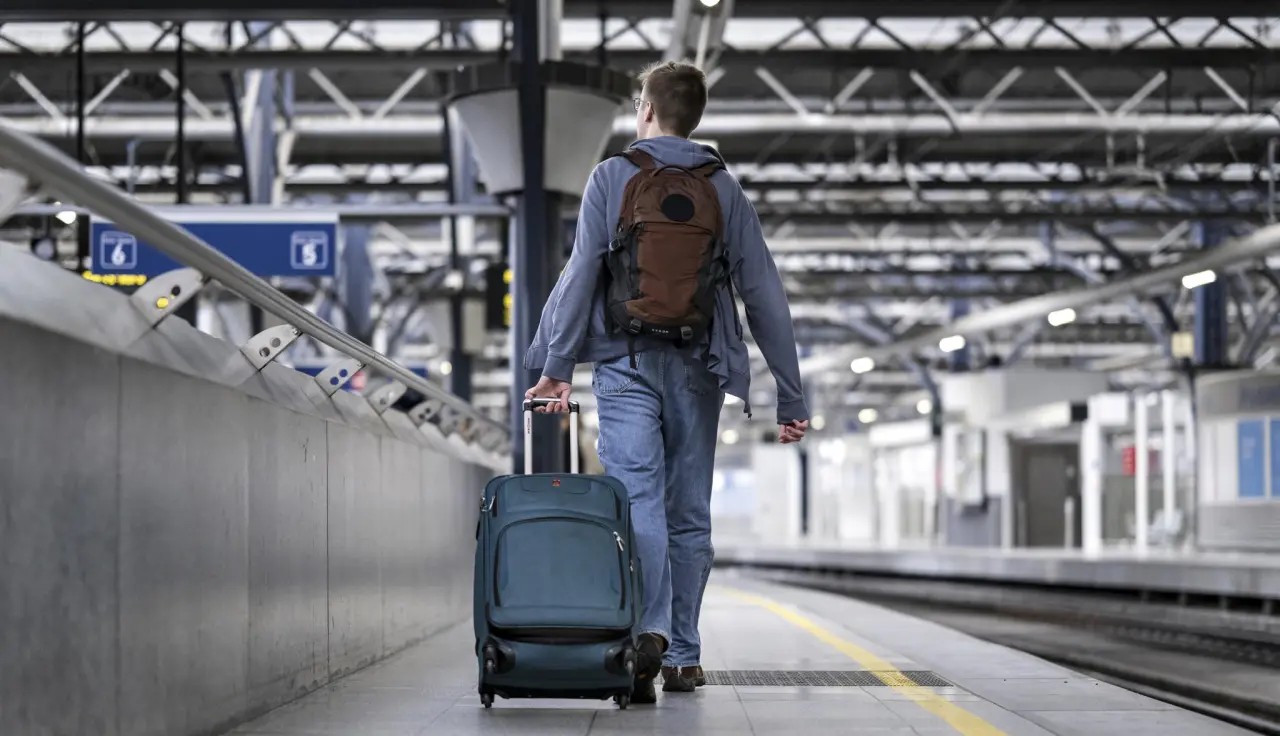
 Last summer, the Belgian rail operator SNCB recorded approximately 1.6 million international reservations, nearly 6% more than the previous year. From Brussels, 6,000 destinations in 15 European countries can be reached by train.
Trains are gaining popularity among Belgians who spend their summer vacations abroad, according to data published by SNCB, Belgium’s national rail operator.
Last summer, the company recorded approximately 1.6 million bookings for international travel, an increase of nearly 6% compared to the previous year. Sales so far for the current summer season indicate that this upward trend is continuing.
The offerings available through SNCB International allow travel to approximately 6,000 destinations in 15 European countries. More than 1,000 of these can be reached from Brussels in less than six hours, either directly or with no more than one transfer.
France and the United Kingdom Top the List
France is the most popular international destination, particularly for trips to Paris, Lille, Disneyland Paris, Lyon, Avignon, Marseille, Montpellier, and Strasbourg.
The United Kingdom ranks second, with London as the top destination, followed by the Netherlands, where most bookings are for Amsterdam and Rotterdam.
Germany ranks fourth, with destinations such as Cologne, Berlin, Aachen, Munich, and Frankfurt, while Switzerland rounds out the top five with Zurich and Basel.
The ranking continues with Italy, Spain, Austria, Luxembourg, and the Czech Republic, where Prague is the top destination.
High-speed trains remain the most popular
Most international trips are made by high-speed train.
The TGV INOUI services departing from Brussels offer direct connections to several cities in southern France, while Eurostar trains provide connections to Paris, London, and Amsterdam.
The low-cost OUIGO Brussels–Paris service, operated by SNCB in partnership with the French operator SNCF Voyageurs, was launched at the end of 2024. Trains cover the route in about three hours and run three times a day in each direction.
SNCB reports that the service is used primarily by families during vacation periods as an alternative to traveling by car.
Brussels–Basel, starting in the summer of 2027
The international service is also set to be expanded with a direct connection to Switzerland.
Starting in July 2027, the Brussels–Strasbourg TGV INOUI train will be extended to Basel as part of a pilot project carried out by SNCB, SNCF Voyageurs, and the Swiss operator SBB.
One round-trip train will run on Fridays, Saturdays, and Sundays.
On the route to the Netherlands, SNCB and the Dutch operator NS have been operating the Eurocity Direct service since December 2024, connecting Brussels-Midi to Amsterdam-Zuid in approximately two hours. The service includes 16 trains per day in each direction.
Another 16 pairs of EuroCity trains run between Brussels and Rotterdam, via Brussels-Zaventem Airport.
8,000 destinations by 2030
SNCB aims to increase the number of international destinations available through its platform from the current 6,000 to approximately 8,000 by 2030.
This expansion of the service offering reinforces the role of the Brussels-Midi station as one of Europe’s main international rail hubs. Approximately 300,000 passengers use the international trains passing through this station each week.
Through SNCB International, passengers can also purchase Interrail passes for travel in 33 countries, as well as make reservations for Eurostar, TGV INOUI, Nightjet, European Sleeper, TGV Lyria, and Frecciarossa trains.
Up to 33 times fewer emissions than flying
The Belgian operator also promotes rail travel by highlighting the differences in emissions compared to other modes of transportation.
For a trip from Brussels to Paris, according to SNCB, a train passenger generates approximately seven times fewer carbon dioxide emissions than a passenger traveling by coach and 33 times fewer than an airplane passenger.
On the Brussels–Amsterdam route, emissions from train travel are five times lower than those from a bus and 22 times lower than those from a plane.
SNCB recommends booking in advance and choosing weekday trips or times outside of peak hours, when fares are generally lower.
Share on: 


