Editor’s note: Seymur Mammadov is the editor-in-chief of News.Az and director of the international expert club EurAsiaAz. This article reflects the author’s personal views and does not necessarily represent those of News.Az
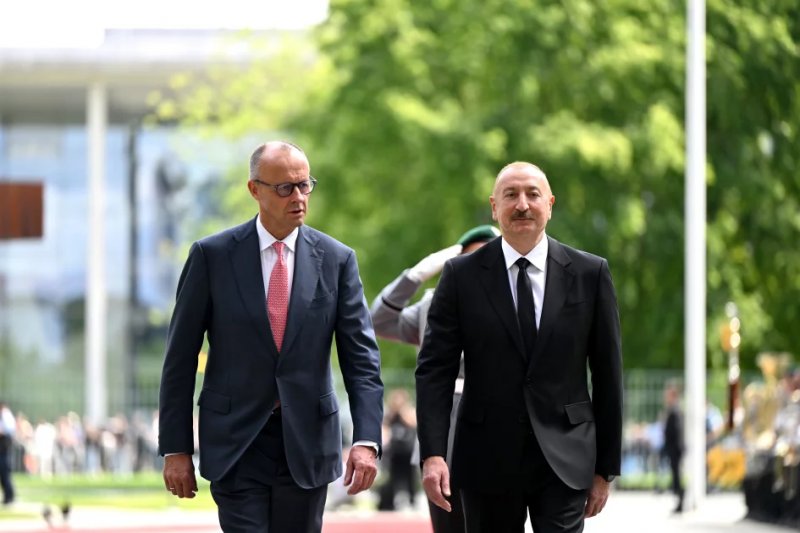
Azerbaijani President Ilham Aliyev’s official visit to Berlin on 21 July was more than just another episode in bilateral diplomacy. His meeting with Federal Chancellor Friedrich Merz demonstrated that Germany increasingly views Azerbaijan not only as an energy supplier, but also as a transport hub linking Europe and Asia, an investment destination, and an important stakeholder in the emerging security architecture of the South Caucasus.
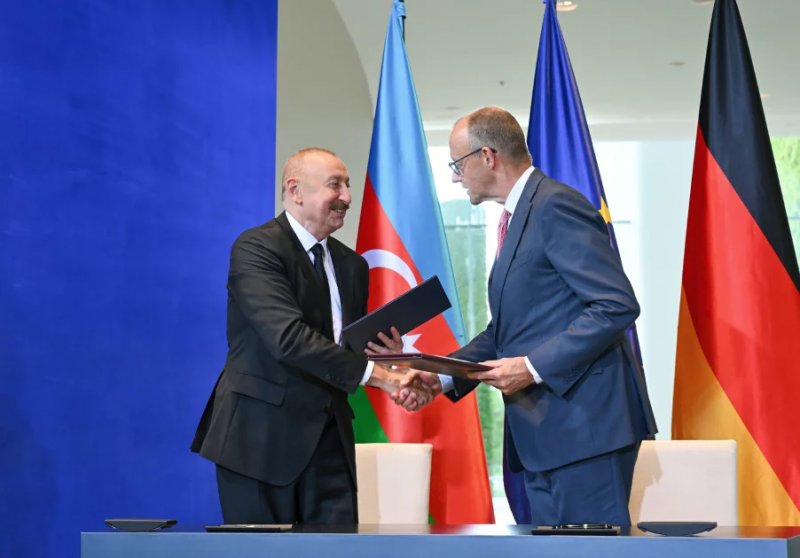
The principal political outcome of the talks was the signing of a Joint Declaration on the Strategic Agenda of Bilateral Partnership. The two sides also agreed to establish an Azerbaijani-German Business Council, which is expected to serve as a permanent platform for cooperation between government institutions and the private sectors of both countries.
The use of the term “strategic agenda” is significant. This is not an alliance treaty or an agreement providing legally binding mutual guarantees. Rather, the declaration is a political framework document whose implementation will depend on available resources and the domestic legislation of the two states. Nevertheless, such documents often lay the groundwork for subsequent sector-specific agreements, investment contracts, and deeper institutional cooperation.
The agenda is exceptionally broad. It encompasses regular political consultations, trade, investment, agriculture, sustainable development, gas supplies, green energy, low-carbon hydrogen, transport infrastructure, digitalisation, education, and scientific cooperation. A separate section is devoted to security, mine clearance, exchanges between military educational institutions, and cooperation in the defence industry.
 Source: AZERTAC
Berlin and Baku are therefore seeking to move their relationship beyond the traditional model in which Germany viewed Azerbaijan primarily as a supplier of oil and gas. Energy remains the foundation of bilateral cooperation, but a much broader framework is beginning to take shape around it, extending from logistics and industry to security and technological cooperation.
For Germany, the primary motivation remains the diversification of energy supplies. Following the termination of Russian gas imports, Berlin has been compelled to seek new suppliers, expand its liquefied natural gas infrastructure, and maintain access to pipeline routes. Azerbaijan occupies a particularly important position within this strategy because it can supply gas directly to the European pipeline network through the Southern Gas Corridor.
At the joint press conference, Aliyev announced that Azerbaijani gas supplies to Germany had begun in 2026. According to him, a 10-year contract had been signed with German companies, with an initial annual volume of approximately 1.5 billion cubic metres. Merz confirmed Germany’s interest in receiving larger volumes of Azerbaijani gas.
However, the TANAP and TAP pipelines are already operating close to full capacity. Any substantial increase in deliveries will require expanding existing infrastructure, constructing additional European interconnectors, and securing long-term financing.
Aliyev effectively posed a political question to Berlin and Brussels: is Europe prepared to finance gas infrastructure while simultaneously restricting the participation of European banks in oil and gas projects as part of its green agenda? Unless this contradiction is resolved, plans to increase imports will remain political aspirations rather than commercially viable projects.
This is one of the central paradoxes of European energy policy. The European Union seeks to reduce its dependence on Russian energy resources and diversify supplies, yet environmental restrictions are making it more difficult to finance the infrastructure needed to achieve that diversification. Azerbaijan is prepared to increase exports, but it expects its European partners not only to request additional volumes, but also to participate in building pipelines and modernising transmission networks.
At the same time, the energy agenda extends well beyond natural gas. Azerbaijan continues to supply crude oil to Germany while also offering the prospect of future exports of green electricity and hydrogen. For Berlin, this creates an opportunity to develop relations with Baku across two parallel time horizons: using conventional energy resources to safeguard immediate energy security while simultaneously advancing projects aligned with the long-term decarbonisation of the European economy.
The Middle Corridor is emerging as another major area of cooperation. Amid growing uncertainty surrounding traditional trade routes, Germany is increasingly interested in an alternative transport corridor linking China and Central Asia with European markets via the Caspian Sea, Azerbaijan, Georgia, and Türkiye.
Merz confirmed that the infrastructure of the Middle Corridor had been discussed in detail during the negotiations and identified as one of the key priorities of the joint declaration. Aliyev, for his part, emphasised Azerbaijan’s role as a bridge between Central Asia and Europe and expressed Baku’s readiness to involve German companies in modernising the country’s transport infrastructure.
It is in this area that cooperation could extend far beyond bilateral trade. Germany possesses the technology, engineering expertise, and financial instruments needed to modernise railways, ports, logistics hubs, and digital freight management systems. Azerbaijan, meanwhile, controls a critical section of the Trans-Caspian route and has developed extensive port, railway, and energy infrastructure.
The establishment of the Business Council is intended to translate this geoeconomic complementarity into concrete projects. More than 200 German companies already operate in Azerbaijan, but the potential for cooperation is considerably greater. Baku is interested in attracting German capital and technology to transport, industry, renewable energy, manufacturing, digitalisation, and vocational education. Germany, in turn, is seeking to create more predictable conditions for its companies, particularly small and medium-sized enterprises, which often find it more difficult to enter distant markets independently.
The political and security dimension of the visit also warrants particular attention. Germany expressed support for the normalisation process between Azerbaijan and Armenia and declared its readiness to contribute to the establishment of lasting peace in the South Caucasus. The joint declaration explicitly refers to the results of the Washington summit of 8 August 2025 and the subsequent steps taken by Baku and Yerevan.
For Berlin, peace between Azerbaijan and Armenia is not merely a humanitarian or diplomatic objective. A stable South Caucasus is essential for the uninterrupted operation of energy and transport corridors. Without political predictability, major investments in the Middle Corridor, pipelines, and cross-border infrastructure will continue to entail substantial risks.
German support is also important for Azerbaijan as a means of strengthening its relationship with the European Union. Berlin exerts considerable influence over the formulation of European foreign, energy, and investment policy. By deepening its partnership with Germany, Baku is seeking not only new bilateral projects but also a more constructive dialogue with European institutions.
The discussion of Russia’s war against Ukraine showed that the positions of the two sides are not entirely aligned, although both advocate ending the hostilities through negotiations. Merz reaffirmed Germany’s commitment to supporting Ukraine for as long as Moscow refuses to engage in a genuine peace process. Aliyev stated that the war must be brought to an end and peace secured.
Reports of unofficial meetings between German and Russian representatives in Baku were also raised during the press conference. The Azerbaijani side said it had not been informed of these contacts in advance but would welcome any dialogue capable of bringing the war closer to an end.
 Source: AZERTAC
This episode also illustrates Azerbaijan’s evolving diplomatic role. Baku maintains close relations with the West, preserves channels of communication with Russia, provides assistance to Ukraine, and at the same time refrains from joining the European Union’s sanctions regime. This position enables Azerbaijan to serve as a bridge between competing centres of power, although it also requires exceptionally careful balancing.
The meeting between Aliyev and Merz therefore reflected a much broader transformation. Germany is searching for new energy sources, alternative trade routes, and a more active presence in the South Caucasus. Azerbaijan, meanwhile, is seeking to convert its geographical position and energy resources into a long-term political, investment, and technological partnership with Europe’s largest economy.
The declarations signed in Berlin do not, in themselves, guarantee major contracts or an automatic increase in bilateral trade. Their real value will depend on whether the two sides establish effective working groups, secure financing for energy and transport infrastructure, and offer businesses concrete, commercially viable projects.
The political direction, however, has already been established. Berlin no longer views Baku merely as a peripheral supplier of raw materials, while Baku increasingly sees Germany not simply as an export market but as a potential strategic partner in modernising its economy and strengthening its position in Europe.
Should these agreements be translated into practical action, the 21 July visit could mark the transition from limited sectoral cooperation to a comprehensive German-Azerbaijani partnership.
(If you possess specialized knowledge and wish to contribute, please reach out to us at [email protected]).