
A bird in flight can suggest freedom, escape or the promise of arrival. A bird that cannot land evokes something more precarious: a life suspended between places, unable to return and uncertain where it might settle. The title of the current Kyiv Biennial exhibition, A Bird That Cannot Land at KW Institute for Contemporary Art in Berlin, captures the political and existential instability that shapes both the works on view and the biennial itself.

Nazanin Noori, Kyiv Biennial Concert Week at KW Institute for Contemporary Art in Berlin. Photo by Eva Luise Hoppe
Since Russia’s full-scale invasion of Ukraine, the Kyiv Biennial can no longer operate as a conventional exhibition centred in its own city. It has become a distributed European platform that moves between institutions while remaining deeply connected to Kyiv. This year’s exhibition was curated by Sofie Krogh Christensen together with KW’s curatorial team, in collaboration with the Visual Culture Research Center from Kyiv. It builds on the chapters presented in 2025 at the Museum of Modern Art in Warsaw, M HKA in Antwerp and Lentos Kunstmuseum in Linz, while expanding the project at KW through newly commissioned and invited positions.
The exhibition brings together artists whose practices emerge from forced displacement, migration, political estrangement and unresolved historical conflict, while refusing to turn movement into a romanticised metaphor.

Assaf Gruber, Miraculous Accident, video still, 2024–25 Courtesy the artist © Assaf Gruber and Cask Films. Installation view of the exhibition Kyiv Biennial – A Bird That Cannot Land at KW Institute for Contemporary Art, Berlin 2026. Photo: Frank Sperling
‘I think it is important not to romanticise movement. Exile is not freedom; it is often a condition imposed by violence. The inability to land is exhausting. Yet even within this instability, people continue to create communities, preserve memories and imagine different futures. That resilience became one of the exhibition’s central threads,’ explains Sofie Krogh Christensen.
The question is therefore not simply where people belong, but how memory, relationships and forms of political imagination can be sustained when return is no longer guaranteed.
The exhibition brings together artists whose practices emerge from forced displacement, migration, political estrangement and unresolved historical conflict, while refusing to turn movement into a romanticised metaphor.
Shared Experiences, Different Contexts
More than forty artists and contributors from different generations, geographies and artistic traditions are presented across the KW building. Video installations, archival materials, sculpture, photography, sound and performance create overlapping perspectives rather than a chronological or geographically divided narrative. The exhibition’s polyphony lies in the relationships established between histories and regions rarely considered together.
This approach is articulated through the curatorial notion of ‘Middle-East-Europe’, which connects post-Soviet Eastern Europe, Central and Southwest Asia and the Mediterranean. The exhibition focuses on intertwined histories of imperialism, colonialism, extraction, displacement and resistance.

Oleksiy Radynski, Where Russia Ends, 2024. Courtesy the artists (left) and Hito Steyerl, Leak, 2024. Courtesy the artist, Andrew Kreps Gallery, New York and Esther Schipper, Berlin/ Paris/Seoul (right). Installation view of the exhibition Kyiv Biennial – A Bird That Cannot Land at KW Institute for Contemporary Art, Berlin 2026. Photo: Frank Sperling
‘The idea of “Middle-East-Europe” emerged from a desire to move beyond conventional geopolitical divisions. Instead of reinforcing inherited categories such as East and West, Europe and the Middle East, we wanted to create a space where these historical connections could become visible through artistic practice,’ Christensen said.
Eastern Europe is not positioned as a peripheral region responding to categories produced elsewhere, but as a location from which political and cultural knowledge is generated.

Hito Steyerl & Philipp Goll, Trassniki, 2026. Courtesy the artists. Installation view of the exhibition Kyiv Biennial – A Bird That Cannot Land at KW Institute for Contemporary Art, Berlin 2026. Photo: Frank Sperling
Throughout the preparation of the exhibition, artists working within very different contexts often recognised echoes of their own experiences in one another’s practices. As Christensen explains, the aim was never to suggest that these experiences are identical, but rather to understand how they speak to one another.
‘Conversation between participants from Ukraine, Palestinian Territories, Lebanon, Armenia, Georgia, Kazakhstan and elsewhere revealed shared concerns that conventional political maps tend to obscure. These exchanges reinforced the idea that solidarity does not require sameness; it grows through careful attention to different histories and unequal conditions,’ Christensen continues.

Lesia Vasylchenko, Night Without Shadows and Light Without Rippling of Waves, 2025. Courtesy the artist. Installation view of the exhibition Kyiv Biennial – A Bird That Cannot Land at KW Institute for Contemporary Art, Berlin 2026. Photo: Frank Sperling
Shared concerns do not erase unequal circumstances. Eastern Europe is not positioned as a peripheral region responding to categories produced elsewhere, but as a location from which political and cultural knowledge is generated. Christensen adds: ‘I hope visitors experience the exhibition in a similar way: not as a survey of separate regions, but as a constellation of interconnected stories that challenges familiar ways of thinking about Europe and its neighbouring worlds.’
Between Openness and Responsibility
Language, memory, archives and the unstable idea of home recur throughout the exhibition. The latter is not treated simply as a territory to which one can return, but as something reconstructed through relationships, speech, translation, artistic practice and everyday acts of preservation. Under conditions of displacement, belonging is maintained through remembering, teaching, writing, making and sustaining communities.

Aykan Safoğlu, 1991, 2026. Courtesy the artist. Installation view of the exhibition Kyiv Biennial – A Bird That Cannot Land at KW Institute for Contemporary Art, Berlin 2026. Photo: Frank Sperling
For example, in Lida Abdul’s video In Transit (2008), children on the outskirts of Kabul fill the bullet holes of an abandoned Soviet aircraft with cotton and attempt to raise it like a kite, transforming a remnant of occupation into an object of collective play and imagined repair. Dana Kavelina’s stop-motion film Grey Earth (2026), meanwhile, brings together a wounded soldier, an escaped dairy cow, and soil exhausted by warfare and industrial agriculture, treating the earth itself as both witness and living archive. These concerns extend beyond the works on display through an extensive live and discursive programme of concerts, performances, listening sessions, talks and workshops.
The Kyiv Biennial gives renewed urgency to the idea of the cultural institution as a platform for dialogue and raises a broader question during periods of political violence. Rather than offering simplified narratives, this exhibition embraces complexity, proposing a mode of interpretation that feels attuned to the present moment: one grounded in listening, polyphony and unfinished conversation.

Gulnur Mukazhanova, Material as Memory, 2026. Courtesy the artist. Installation view of the exhibition Kyiv Biennial – A Bird That Cannot Land at KW Institute for Contemporary Art, Berlin 2026. Photo: Frank Sperling
The exhibition’s themes extended into the Kyiv Biennial Concert Week, held in KW’s main hall from 8 to 11 July. Performances by artists including Heinali and Andriana-Yaroslava Saienko, Abdullah Miniawy, Nour Sokhon, Wafaa Saied, and Katarina Gryvul brought together experimental sound, poetry, and varied vocal traditions. Through sound, voice, and collective listening, the programme gave an audible form to the biennial’s polyphony and created another space in which Ukrainian, Middle Eastern, and diasporic practices could enter into dialogue.
The Kyiv Biennial gives renewed urgency to the idea of the cultural institution as a platform for dialogue and raises a broader question during periods of political violence.
‘Contemporary art can create spaces where experiences that resist easy representation — like loss, displacement, fear, resilience or hope — can be shared in ways that exceed political slogans or media headlines. Artistic practices can slow down perception, make contradictions visible, and recover histories that are at risk of disappearing. They allow us to remain attentive to ambiguity without losing sight of political responsibility,’ Christensen says.

Saodat Ismailova, As We Fade, 2024. Courtesy the artist. Installation view of the exhibition Kyiv Biennial – A Bird That Cannot Land at KW Institute for Contemporary Art, Berlin 2026. Photo: Frank Sperling
The exhibition, therefore, asks for a form of attention that is neither passive nor neutral. To remain with ambiguity does not mean withdrawing from political judgement; it means resisting the urge to make unequal histories appear coherent, comparable or easily resolved. This careful balance between openness and responsibility also shapes Christensen’s understanding of what art can offer beyond the exhibition itself.
‘Ultimately, I believe contemporary art helps us remain open to others. It invites us to recognise connections across different histories without flattening their differences. In a world increasingly organised through borders, exclusions and militarised identities, that capacity to imagine relationships differently may be one of its most valuable contributions.’
Like the bird in its title, the Kyiv Biennial remains in motion because landing is not yet possible. Its persistence lies in continuing to carry memories, voices and relationships between places and in keeping open the possibility that another future may still be imagined.
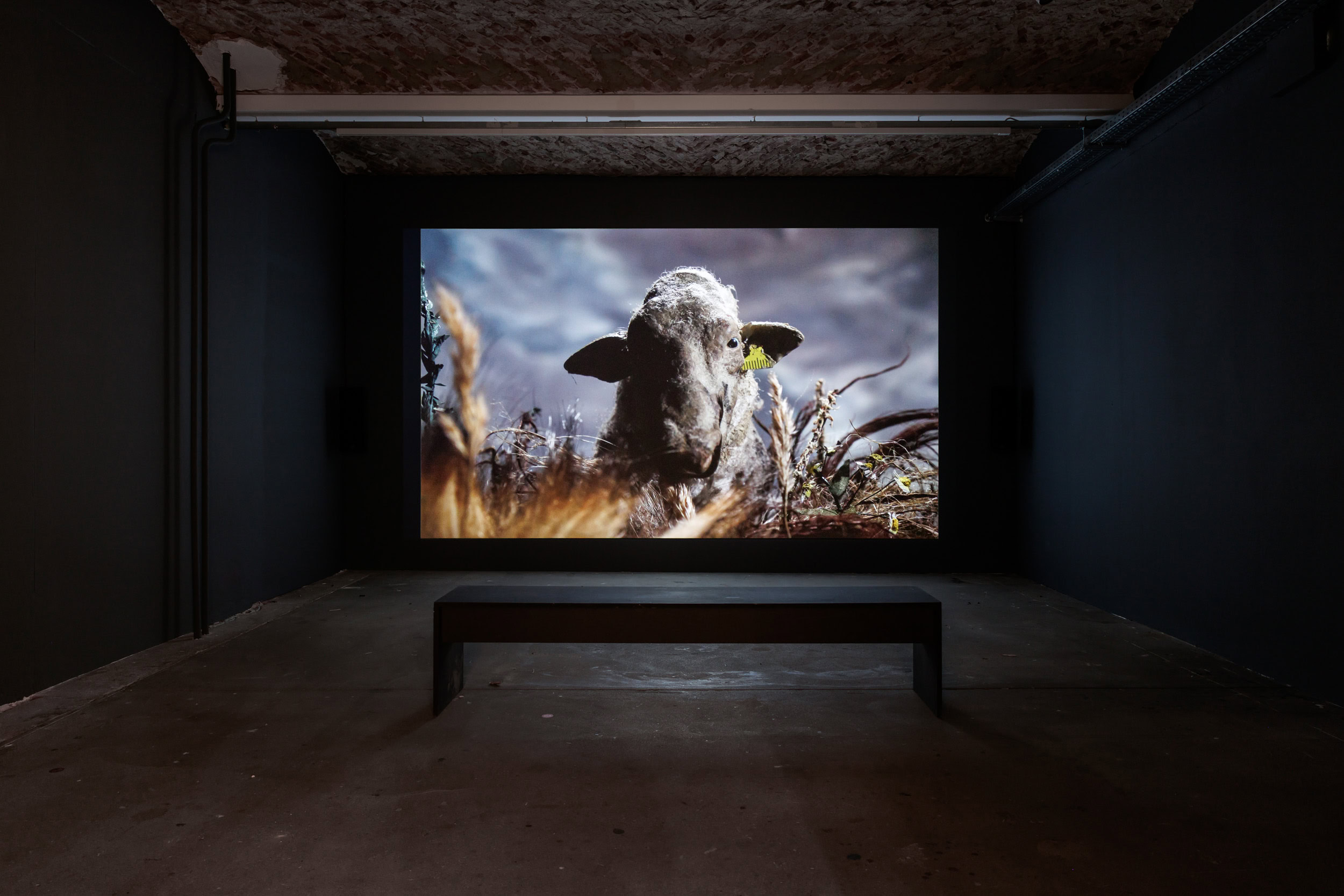
Dana Kavelina, Grey Earth, video still, 2026. Courtesy the artist. Installation view of the exhibition Kyiv Biennial – A Bird That Cannot Land at KW Institute for Contemporary Art, Berlin 2026. Photo: Frank Sperling
Kyiv Biennial – A Bird That Cannot Land
11.06–13.09.2026
KW Institute for Contemporary Art
Auguststrasse 69, Berlin

Neda Saeedi, Abyssal Zone, 2026. Courtesy the artist (front) and Anna Zvyagintseva, The Order of Things, 2015–, Courtesy Collection M HKA und Collection Flemish Community (back). Installation view of the exhibition Kyiv Biennial – A Bird That Cannot Land at KW Institute for Contemporary Art, Berlin 2026. Photo: Frank Sperling