
So Rob Jetten, the openly gay Prime Minister of the Netherlands, tells me that were it not for people like me, he wouldn’t be prime minister.
He takes a selfie with me. His staff gets their pictures. And you’d think that would be the most incredible thing that happened to me at WorldPride in Amsterdam.
It was incredible. But there were other moments that were far more emotional — and, at times, surreal.
One of the WorldPride displays brought me to tears.
We in the west can celebrate Pride, but in other parts of the world, homosexuality remains illegal. In 63 nations, representing more than 2 billion people, people can face imprisonment simply for being homosexual. In some countries, the penalty can be death.
The Zero Flags Project displays the flags of those nations accompanied by the punishment: two years imprisonment. Six years. Ten years. Death.

As you walk the path, looking up at those flags, they stop being pieces of fabric. You begin thinking about the lives behind them, people who cannot live openly, love openly or simply be who they are without fear.
The project’s goal is right there in its name: Zero Flags. They will continue displaying them until there are none left to display.
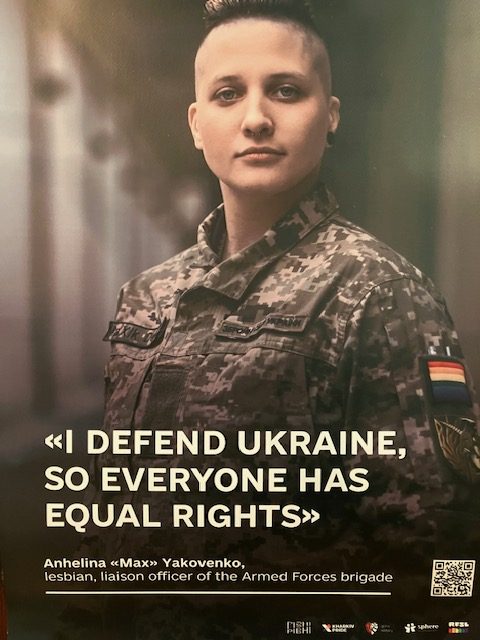
Inside the conference hall was another exhibit, this one put together by KharkivPride and Kyiv Pride in Ukraine. It represented more about the meaning of Pride than almost any parade, march or display I’ve seen in my 58 years of activism.
There were photographs of LGBTQ+ soldiers in uniform. One featured Alina Shevchenko, a lesbian captain and staff officer, saying that she has the same duties to the state as other military personnel, but not the same rights.
Another soldier’s message was just as simple and powerful: “I defend Ukraine so everyone has equal rights.”
Then came a photograph of KharkivPride, early on in the Russian war, held in a subway bomb shelter. And then a photo of their Pride from last year, showing thousands marching proudly through the streets.
All of this while their country is at war.
Again, I lost my emotions.
Then Jason and I met Rocky, who proudly announced that she was from Philly or at least the Philly area.
Rocky, whose real name is Sharon Roggio, is the director of the documentary “1946: The Mistranslation That Shifted Culture.”
The film tells two different but interconnected stories. How and when did the word “homosexual” make its way into modern translations of the Bible? The answer to the “when” is right there in the title: 1946.
But the film goes much deeper, tracing biblical translations through what unfolds almost like a mystery story. It is some of the best research reporting I’ve seen in some time.
And then there is the deeply personal story at its heart: Rocky’s relationship with her father, a minister, and their struggle over faith, scripture and his lesbian daughter.
If you want to better understand religion’s complicated relationship with homosexuality — and how we got to where we are today — see “1946.”
Finally, we spent a day filming what would become part of the opening of the WorldPride Human Rights Conference: an intergenerational conversation between a Stonewall pioneer — that would be me — and Junie, a 23-year-old influencer from Nigeria.
In Nigeria, homosexuality can bring a prison sentence of up to 14 years.
You might think that an American activist who came out in the 1960s and a 23-year-old Nigerian activist would have trouble finding common ground.
Strangely enough, Junie and I had no trouble connecting.
Maybe that was the lesson Amsterdam gave me.
A prime minister told me his generation stands on the shoulders of mine. Ukrainian soldiers are fighting for a country that still does not give them full equality. Sixty-three flags remind us that billions of people live in places where our Pride can still be considered a crime. A filmmaker from Philadelphia is challenging what millions have been taught about the Bible. And a 23-year-old from Nigeria and a 75-year-old Stonewall veteran discovered that, despite the decades and thousands of miles between us, we are fighting for the same thing.
I’ve spent 58 years watching our movement change the world. WorldPride in Amsterdam reminded me that we have indeed changed it.
It also reminded me that we’re not finished yet.
The goal, after all, isn’t 63 flags.
It’s zero.