

Baily’s beads, like these seen during the 2017 total solar eclipse, appear just before and just after totality. Credit: NASA/Aubrey Gemignani
Today, the Moon’s shadow will fall across the North Atlantic, sending Greenland, Iceland, and Spain into darkness for a total solar eclipse. This will be the first Iceland has seen since 1954, and the first over Reykjavík in almost six hundred years. Totality will reach Iceland in the afternoon local time and Spain in the evening, just before sunset. Astronomy’s Senior Editor Alison Klesman is on the ground in Iceland and Editor Emeritus and former Editor-in-Chief Dave Eicher is in Spain with our travel partner, Eclipse Traveler. They’ll be filing live updates as the eclipse unfolds.
Refresh for updates
2:35 p.m. EDT: The ISS transits the Sun during the 2026 solar eclipse
NASA shared this image around 1:44 p.m. EDT of the International Space Station as it passed in front of the Sun, as seen from northeast Maine near the Canadian border.
2:31 p.m. EDT: Totality ends in Spain
2:29 p.m. EDT: Totality begins in Spain
Clear, sunny skies provide better viewing conditions during totality in Spain.
2:21 p.m. EDT: Cloudy with a chance of totality in Iceland
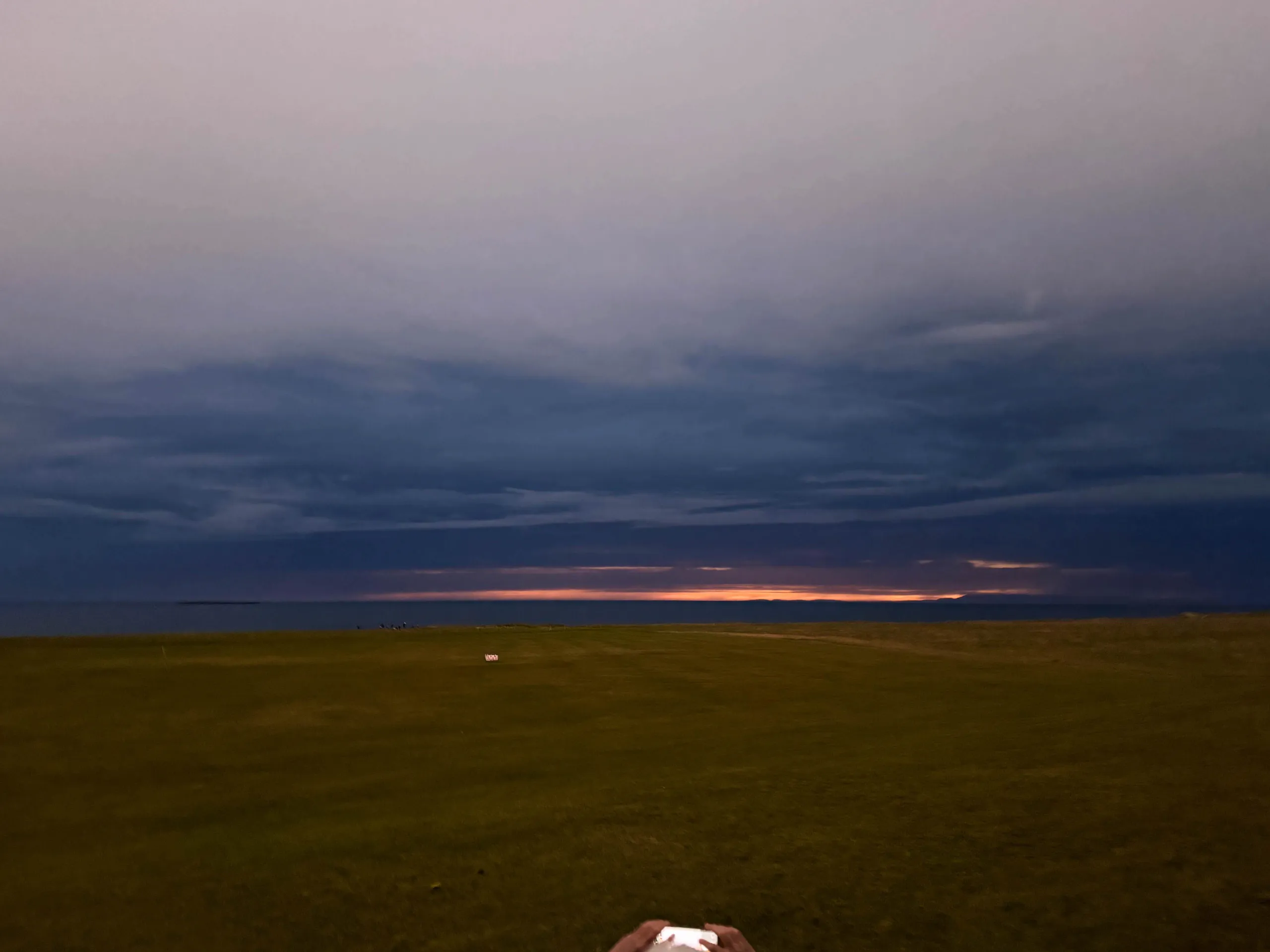 Clouds obscure the eclipse in this view looking toward the horizon during totality near Reykjavík, Iceland. Credit: Alison Klesman
We were in a beautiful location, right on the water to our west and a port to the south, so we could see their lights come on. All the seabirds went quiet and the wind really picked up. Everyone was astonished at how quickly totality fell under clouds, it was coming at us like this big ominous encroaching darkness. Two minutes went way too fast!
The shadow came from the north, and that was where the horizon was clearest, so we could see a portion of the 360-degree sunset there. It was a strange juxtaposition of complete darkness under the clouds, with the northern horizon glowing brightly and the lights of the port city to our south popping on and glowing over the water. It was very, very dark – honestly, darker than it ever gets [in Iceland] at this time of year, even in the middle of the night!
The temperature dropped about 6 degrees Celsius. That’s a lot; it got cold. I expected chilly, but it was cold. You could briefly see your breath.
— Alison Klesman
2:05 p.m. EDT: A break in the clouds
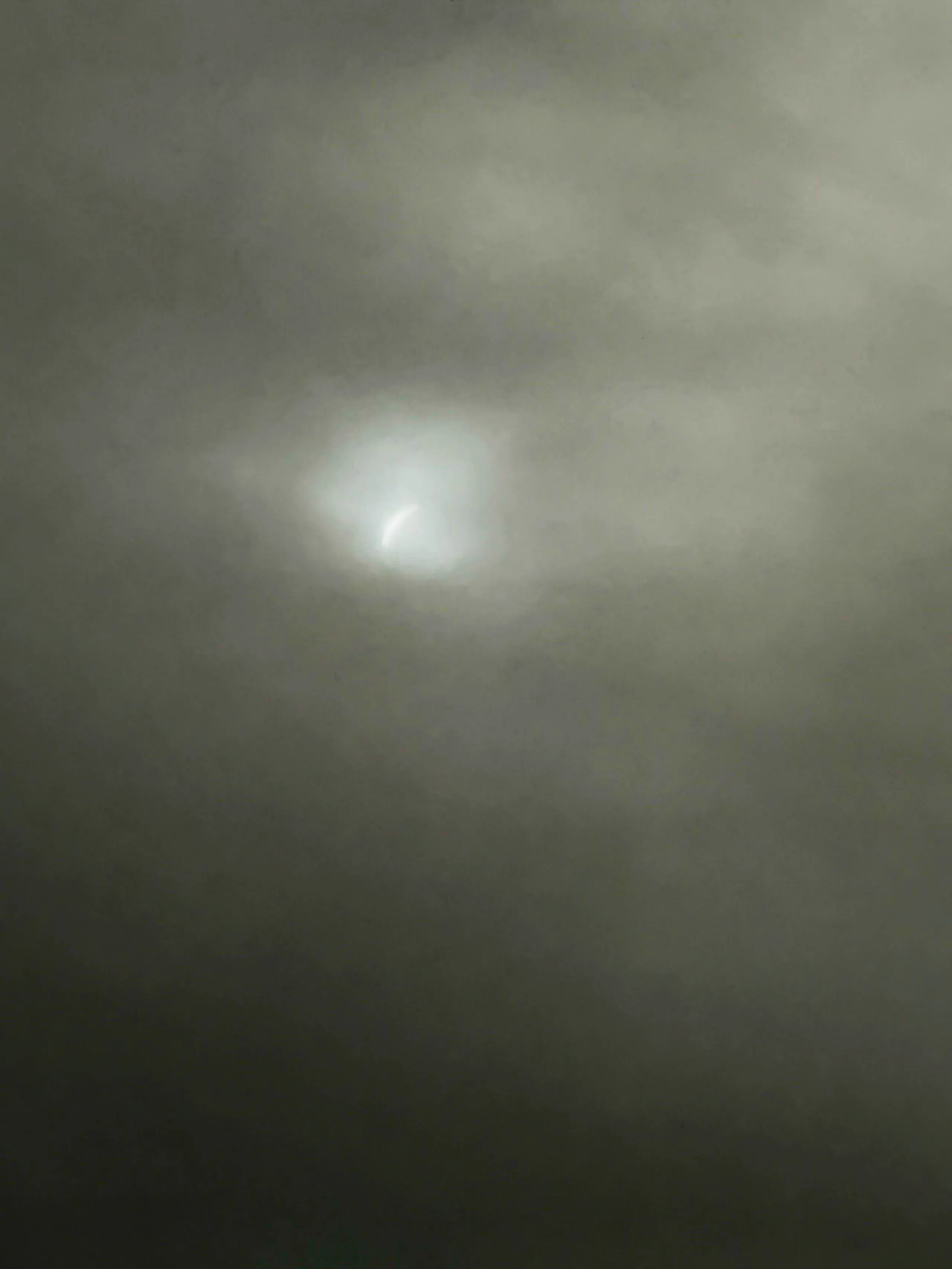 A short break in the clouds near Reykjavik, Iceland, just minutes before totality. Credit: Alison Klesman
We were largely clouded out, with rain coming and going. But just minutes before totality, a hole in the clouds passed in front of the Sun and we got a few minutes of the last moments of the partial eclipse, with just a sliver of the Sun visible as the Moon crept across it. Everyone was shouting and taking as many pictures as they could, even as the light was dimming dramatically. I think if you’re going to only see a bit of the partial eclipse, this was the best bit!
— Alison Klesman
2:02 p.m. EDT: While we await totality in Spain, here is a look at totality in Iceland just moments ago
1:55 p.m. EDT: See the 2027 and 2028 eclipse with Astronomy magazine
Our editors are on the ground in Iceland and Spain today thanks to our travel partner, Eclipse Traveler, which puts together excellent all-inclusive travel packages for total solar eclipses around the world. There’s still time to join us for the next ones — Eclipse Traveler has limited availability left on several 2027 and 2028 tours, each built around expert astronomy guides and front-row access to totality.
2027 Egypt: Cairo, Nile Cruise & Luxor
2028 Australia: Total Solar Eclipse Cruise
2028 Australia: Sydney Total Solar Eclipse Tour
2028 New Zealand & Australia: Total Solar Eclipse Tour
1:49 p.m. EDT: Totality ends in Iceland
Totality has ended as the first sliver of sunlight reappears.
1:48 p.m. EDT: Totality in Iceland
The Moon has fully covered the Sun, and the sky darkens over Iceland. In more favorable weather conditions, the Sun’s corona becomes visible during totality.
1:47 p.m. EDT: Baily’s beads and the diamond ring in Iceland
Though not visible from the ground in Iceland due to local weather conditions, the last sliver of sunlight narrows to a thin arc; the Moon breaks it into beads of light, and totality is just moments away.
1:42 p.m. EDT: Crowds gather to view partial eclipse at England’s Jodrell Bank Observatory
1:31 p.m. EDT: Partial eclipse begins in Spain
The Moon starts crossing in front of the Sun over Galicia, in Spain’s northwest corner, marking the eclipse’s first landfall on the Iberian Peninsula.
Totality will follow roughly an hour later, arriving in Galicia around 2:26 P.M. EDT and heading across the peninsula to the Balearic Islands by about 2:31 P.M. EDT — the shadow’s final act on land before it moves over the Mediterranean, just before sunset.
 A band of totality up to 1 minute 40 seconds long crosses northern Spain and the Balearic Islands. This infographic also maps the percentage of darkness for areas seeing a partial eclipse. Credit: European Space Agency; Instituto Geográfico Nacional, based on calculations from the Spanish Astronomical Observatory
1:18 p.m. EDT: What scientists predict the corona will look like today
A team at Predictive Science Inc. is modeling what the corona will look like with a live forecast. Their system pulls in near-real-time measurements of the Sun’s surface magnetic field and feeds them into a model that simulates the corona and the solar wind together, continuously updating as new data arrives.
This year’s version is the group’s highest-resolution run yet. It also stretches farther than any previous prediction — reaching from the Sun’s atmosphere all the way out to Earth’s orbit, one astronomical unit away. That means the team isn’t just forecasting what the corona will look like from the ground: they’ve generated matching predictions for what missions across the solar system should see, including Parker Solar Probe, Solar Orbiter, PUNCH, and STEREO-A.
The team’s latest coronal prediction, oriented for the view from Palencia, Spain, has been updating continuously at eclipse.predsci.com.
1:05 p.m. EDT: Clouds and rain in Iceland
In a post on X about an hour ago, Mexican Geologist Sergio Almazán shared the weather conditions on the ground in Iceland ahead of today’s eclipse, writing:
“Just under an hour before the Total Solar Eclipse begins, Iceland has been covered in dense clouds! We’re in Grundarfjörður, and unfortunately it’s raining. Nevertheless, knowing that the weather here tends to change suddenly, we haven’t lost hope, and in any case, we’ll start the broadcast on time.” (Translated from Spanish)
AVISO
☀️——————— 🌒——- 🌎
¡A poco menos de una hora de que inicie el Eclipse Total de Sol, Islandia se ha cubierto de nubes densas!
Nosotros estamos en Grundarfjörôur y lamentablemente está lloviendo. No obstante y conociendo que aquí el tiempo suele cambiar súbitamente, no… pic.twitter.com/41WhLP9NIv
— Geól. Sergio Almazán (@chematierra) August 12, 2026
12:47 p.m. EDT: Partial eclipse begins in Iceland
The Moon has just begun crossing in front of the Sun as seen from Iceland, marking the start of today’s eclipse.
12:27 p.m. EDT: How to watch safely
You must wear certified eclipse glasses during all phases of the eclipse, with one exception: totality. It is only safe to remove your glasses when the Sun is completely blocked, but you must put them back on the instant the first ray of sunlight reappears. If you are viewing a partial eclipse outside the path of totality, keep your glasses on the entire time—looking at the Sun is never safe if any portion of it is exposed.
If you’re not in the path of totality, NASA is livestreaming the eclipse starting at 1:15 p.m. EDT, with ESA, and the Virtual Telescope Project, also carrying live coverage.
12:05 p.m. EDT: Who can see a partial eclipse?
Inside the path of totality, the Moon fully covers the Sun’s disk — the only moment it’s safe to look up without protective eyewear. Everywhere else, from most of Europe to parts of Canada and the northern U.S., observers are seeing a partial eclipse, where a sliver of the Sun stays uncovered.
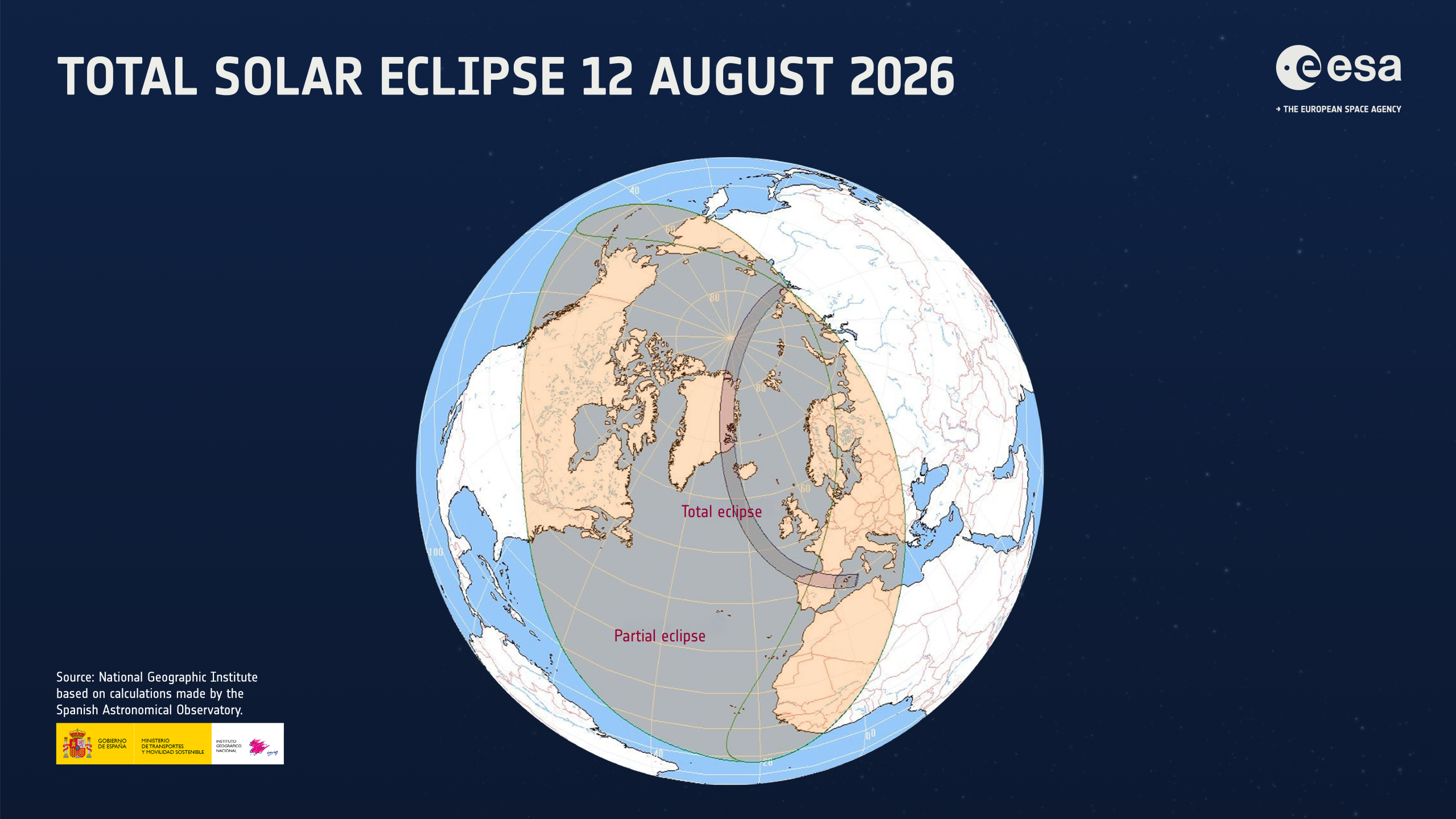 A narrow band traces the eclipse’s path of totality from the Arctic through Greenland, Iceland, and northern Spain in this global view. The much wider gray zone marks where observers across northern North America, Europe, and western Africa will see only a partial eclipse. Credit: European Space Agency (ESA)
11:55 a.m. EDT: Where today’s eclipse will — and won’t — be total
The path of totality is a narrow band roughly 183 miles (294 km) wide. Starting over a remote northeastern corner of Russia, it runs across eastern Greenland before curving south to the west coast of Iceland, arcing across Spain, and ending over the Mediterranean.
In Iceland, the Moon’s shadow reaches the shores of the Hornstrandir Nature Reserve at 1:43 p.m. EDT, before heading south across the Westfjords, the Snæfellsnes Peninsula, Reykjavík, and the Reykjanes Peninsula. The single longest totality along the entire path — 2 minutes and 18 seconds — occurs over the water of Breiðafjörður Bay on Iceland’s western coast. Totality lasts longest on land at Látrabjarg in the Westfjords, at 2 minutes and 13 seconds; in downtown Reykjavík, it’s a brief 1 minute.
From there, the shadow advances across the Atlantic, reaching northern Spain about 35 minutes later. As sunset closes in, the Sun will hang lower in the sky for totality in Spain. In some cities, the Sun will set fully before the partial eclipse ends. Totality runs about 1 minute 45 seconds in León and fading to just over a minute near Vitoria-Gasteiz which lies along the path’s northern most edge.
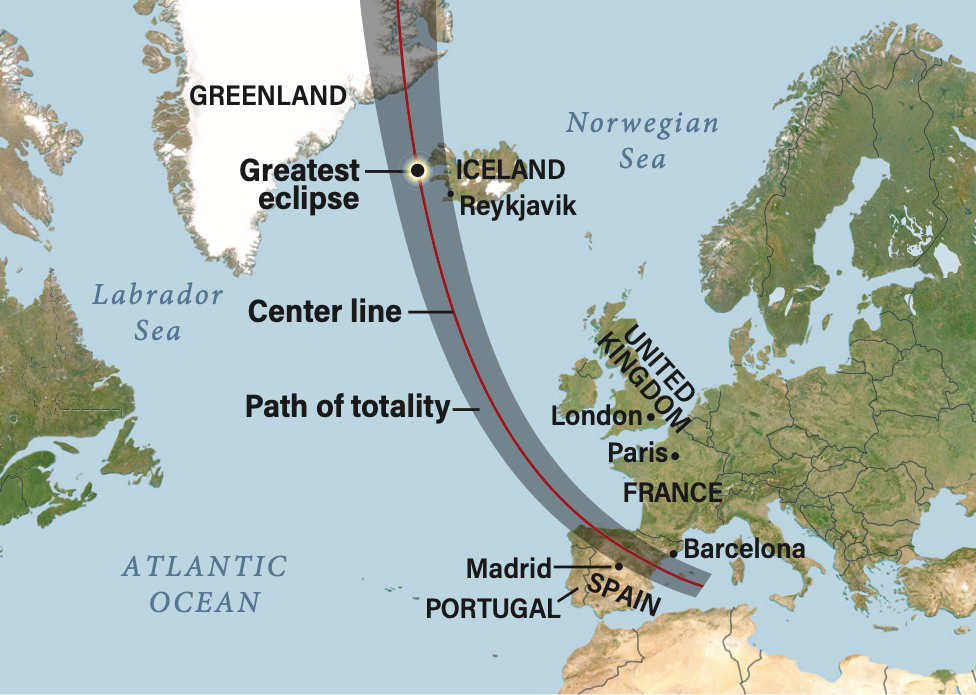 Eastern Greenland, western Iceland, and northern Spain are the places to be if you want to witness the Aug. 12 total solar eclipse. Credit: Astronomy: Roen Kelly