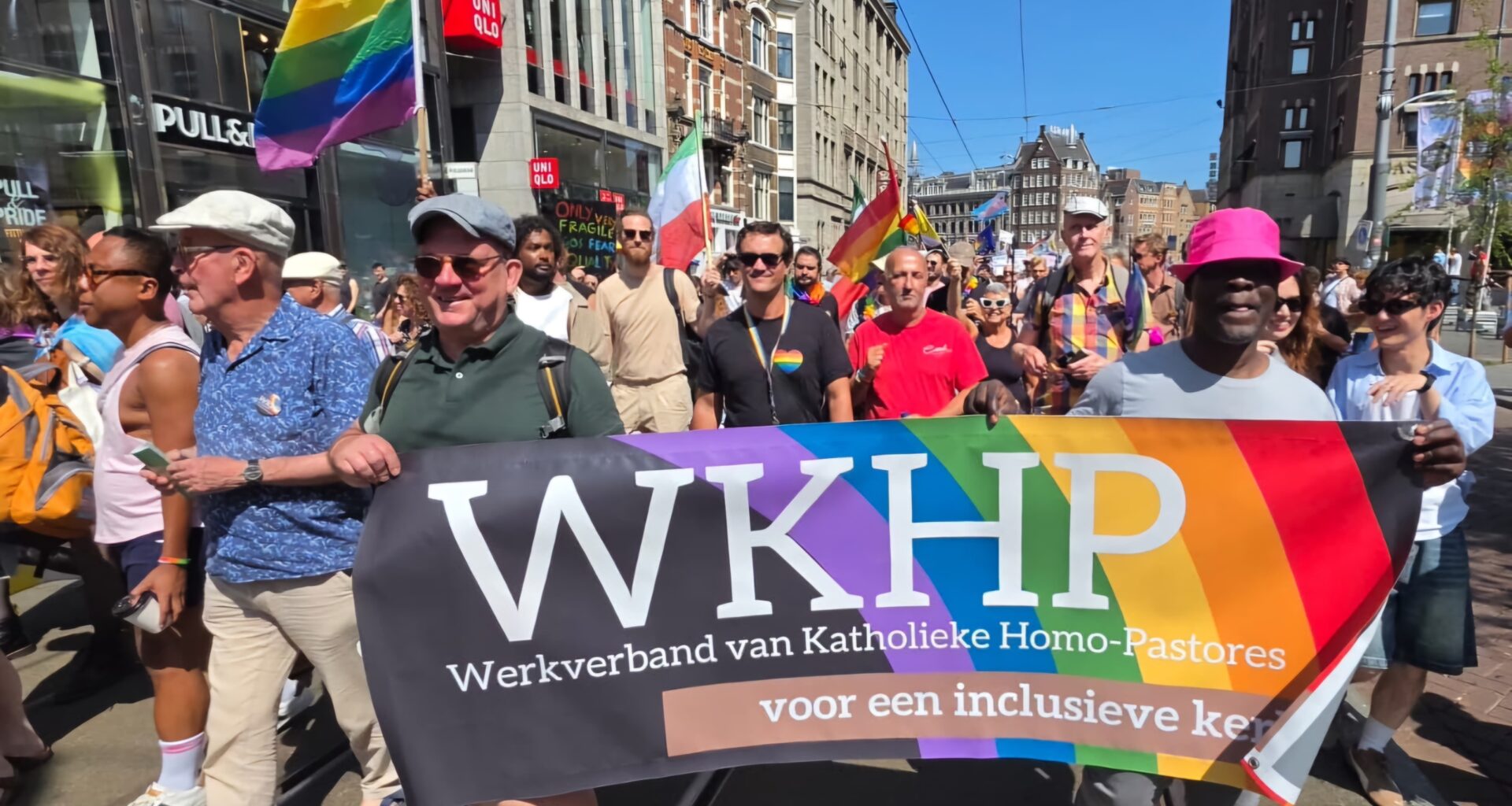
WKHP members march in the Pride parade.
Religious Pride is a dedicated part of Amsterdam Prides official programme, bringing together LGBTQ+ people of different religions and denominations for worship, dialogue, reflect, and build community. During WorldPride Amsterdam 2026, from 25 July to 8 August 2026, the programme offered a particularly visible space for religious LGBTQ+ people, showing that faith and queer identity do not have to be mutually exclusive.
Among the Catholic voices taking part was the Werkverband van Katholieke Homo-Pastores (WKHP, in English “Association of Catholic Gay Pastors”), a Dutch network of LGBTQ+ Catholic pastors and theologians. Ramon Roks, a pastoral worker and board member of WKHP, represented the organization this year on the Religious Pride committee and the Religious WorldPride organization. He spoke at Amsterdam’s Pride Church Service.
Bondings 2.0’sElisa Belotti interviewed Roks about his experience at this year’s Religious Pride, the place of LGBTQ+ Catholics within the Dutch Church.
ELISA BELOTTI: Looking back at this year’s Religious Pride and WorldPride program, was there a particular event, celebration, or moment that you found especially meaningful or significant from your perspective? Why?
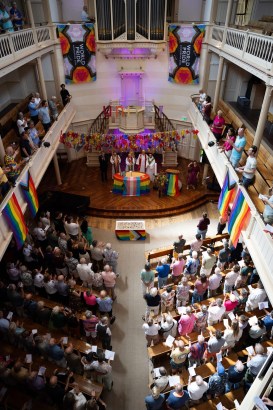
The Religious Pride church service at Amsterdam Pride.
RAMON ROKS: Two activities that I was involved with stood out as especially meaningful: the annual Pride Church Service and the presence of the Religious Pride committee with a stand at the Pride Village exhibit area.
As a co-pastor, the service moved me above all because we stand side by side as worship leaders from different denominations, in a full church with people who themselves come from all kinds of different backgrounds. Each of us has our own story, our own struggle with our own church, and yet here we find something that overarches and transcends all of that. So many of us know the experience of finding no room in our own church, and here we take that space together and celebrate it in the middle of Amsterdam Pride.
The presence at the Pride Village is something I find particularly beautiful, because it is not only ecumenical but also interreligious. We stand there while visitors and participants of the Pride events come into conversation with us. I remember a young woman who told us she had left her own church, but she had since found a new and more accepting faith community. Exhibiting is a form of pastoral presence in the broad sense, and it radiates acceptance and welcome from the religious sector of society, which has not always done so.
EB: What does it mean for you to have such a visible and structured presence of religion within WorldPride, by offering religious services, theological discussions, pilgrimages, and spaces for LGBTQ+ people of faith? What does this add to the experience of Pride?
RR: It is a testimony to the fact that these two parts of your identity do not have to exclude one another. The Religious Pride programme shows that you can be both LGBTIQ+ and religious, even though in many cases it might be difficult. Both are forms of identity and forms of community. For someone who has always been told, or has come to believe, that faith and being LGBTIQ+ cannot go together, it can be deeply meaningful to see worship leaders and believers standing there openly, in a matter-of-fact way.
It says something, too, that this is a formal part of the Pride organisation and not something tucked away at the edges. It gives faith a visible place within the wider celebration, and it signals to the whole community, believers and non-believers alike, that religion can also be an ally rather than only an opponent.
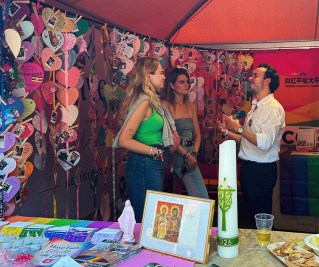
Ramon Roks speaks with two women at the Religious Pride exhibit booth in the Pride Village.
EB: In the Netherlands the Roman Catholic Church is not very supportive of LGBTQI+ issues, and many LGBTQ+ people have left the Church. How does WKHP navigate this relationship? What does it mean to have a Catholic LGBTQ+ ministry in the Netherlands today, and what kind of relationship do you have with the wider Catholic Church?
RR: The WKHP has existed since 1980.The institutional Roman Catholic Church in the Netherlands has recently become increasingly conservative Unlike in other European countries, in the Netherlands there is no officialLGBTIQ+ ministry from any of the dioceses. As the WKHP we seek contact with the church, but this is often one-sided: most bishops do not want to speak with us and want nothing to do with the LGBTIQ+ community. Fortunately there is the occasional exception, and we have had very cautious contact that we are keen to maintain.
As queer pastors and theologians we at WKHP have chosen to keep raising this theme ourselves, outside the formal church. We consider it important to make clear that there is another voice within our church as well. Many LGBTIQ+ Catholics, like some of our own members, have already left the church. Yet there is a large group that still feels connected to religion, or identifies culturally as Catholic, and within ordinary parishes there is often a more liberal and progressive atmosphere when it comes to these themes.
We do not want to be chased away. We remain visible, approachable, and we make our voice heard. We look for allies within the ecumenical movement, such as the European Forum of LGBTIQ+ Christians and the Global Network of Rainbow Catholics.
EB: WKHP was one of the Catholic presences within a programme that brought together different Christian denominations and other religious traditions. What do you think this kind of ecumenical and interreligious collaboration can offer the Catholic LGBTQ+ community – and perhaps the whole Church – that individual communities working on their own cannot?
RR: In the Netherlands we have a very diverse religious landscape. There is no single national church, and a large part of the population is secular. Not many people are aware of all the independent church communities. Even people who have already distanced themselves from the Church speak appreciatively when we bridge differences, when religious groups join forces and stand together for wider inclusion in faith communities and in society.
Each community is small and easily overlooked, and each of us carries the resistance of our own tradition alone. Together we become visible in a way that a single group cannot manage. We can carry one another when our own churches work against us, and we offer a witness to a secular society that often assumes religion and LGBTQ+ acceptance cannot go together.
—Elisa Belotti, New Ways Ministry, August 26, 2026
For further reading:
In 1989, the WKHP wrote a beautiful pastoral letter called Called to Blessing: A Pastoral Letter on Faith and Homosexuality. It was an early statement by Catholic ministers calling for more welcoming and affirming pastoral care for lesbian and gay people. It can be found in New Ways Ministry’s online archive, Voices of Hope: A Collection of Positive Catholic Writings on Lesbian and Gay Issues, 1973-1995, edited by Sister Jeannine Gramick and Father Robert Nugent. It was originally published in book form in 1995, and it contains many early pastoral statements and documents on LGBTQ+ issues.