
 Yayoi Kusama in ‘Yellow Tree / Living Room’ during the Aichi Triennale in 2010 © YAYOI KUSAMA. Courtesy Ota Fine Arts and David Zwirner
A major Yayoi Kusama retrospective will open at the Stedelijk Museum Amsterdam this September, bringing together more than seven decades of work by one of the most influential artists of the 20th and 21st centuries.
The exhibition takes on an added poignancy following the death of Kusama at the age of 97. The artist died in hospital in Tokyo on 14th August, with the Yayoi Kusama Museum announcing the news this week and saying that she had continued painting until her final days.
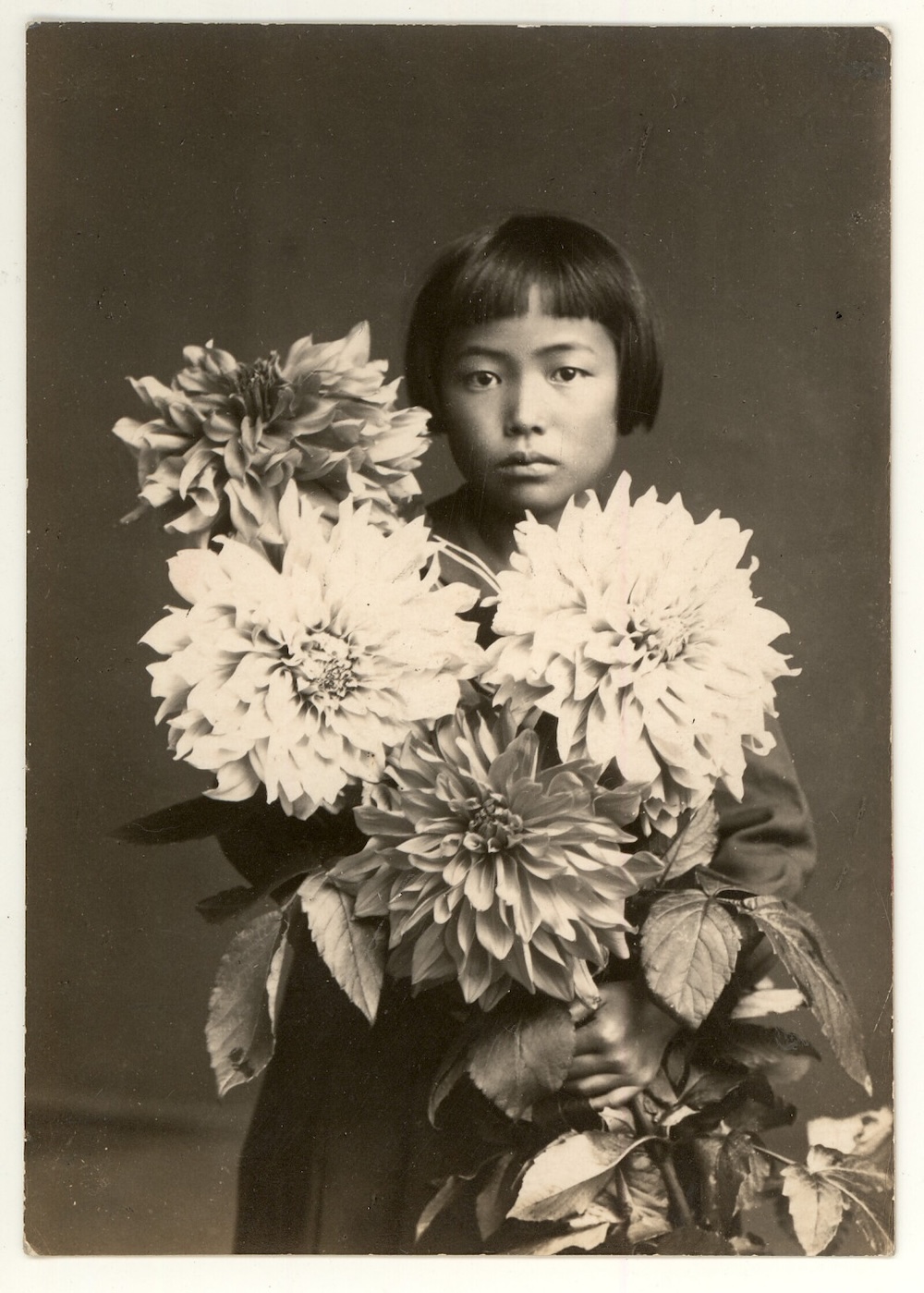 Yayoi Kusama around the age of ten, ca. 1939. © YAYOI KUSAMA
Opening on 11th September, the Stedelijk exhibition will trace Kusama’s extraordinary career through painting, sculpture, installation, drawing, fashion, collage and her radical happenings, moving from early works made in Matsumoto through her transformative years in New York to work created in Tokyo towards the end of her life.
While Kusama’s pumpkins, polka dots and Infinity Mirror Rooms have become some of contemporary art’s most immediately recognisable images, the retrospective promises a considerably broader picture of an artist whose practice repeatedly crossed boundaries between art and life.
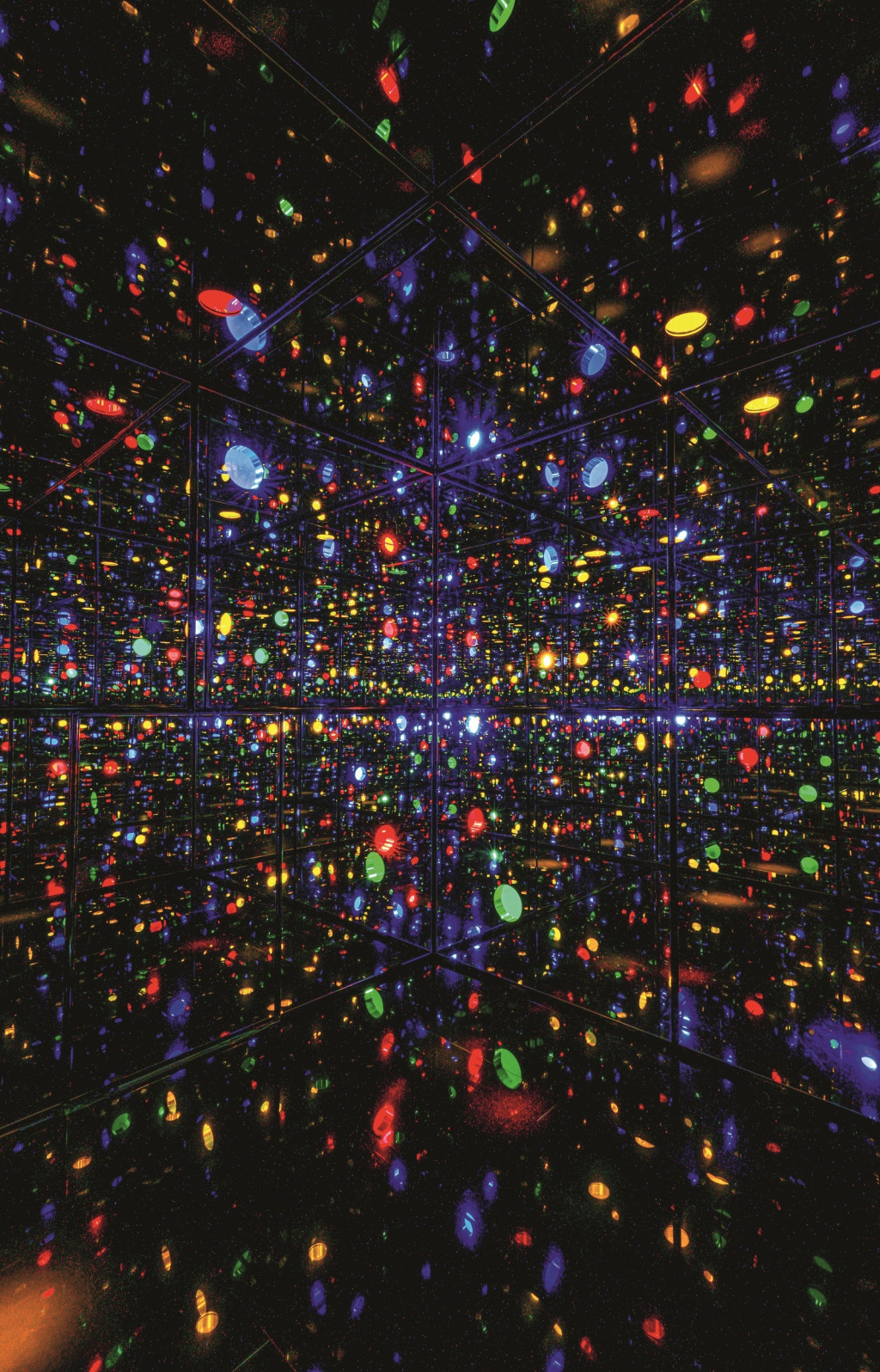 Yayoi Kusama, Infinity Mirrored Room – ‘Illusion Inside the Heart’, 2025. Mirror-polished stainless steel with glass mirrors and colored acrylic, 300 × 300 × 300 cm, inside view. Collection of the artist. Courtesy of Ota Fine Arts. © YAYOI KUSAMA
Themes of infinity, repetition and what Kusama termed self-obliteration run throughout her work. Immersive environments dissolve the distinction between viewer and artwork, while repeated dots, mirrored reflections and accumulating forms turn individual objects — and sometimes the people looking at them — into parts of apparently endless visual fields.
The exhibition will include historic works never previously shown in Europe alongside some of Kusama’s most celebrated pieces and works made specifically for the retrospective. A specially created new version of one of her iconic installations will also form a major part of the show.
 Yayoi Kusama, ‘Pumpkin’, 1991. Acrylic on canvas, 91 × 116.7 cm. Collection of the artist. © YAYOI KUSAMA
Kusama began her career in Japan in the early 1950s before moving to New York in 1957. There she became part of the city’s avant-garde, developing her Infinity Net paintings and sculptures and staging performances and happenings that placed bodies, repetition, sexuality, politics and obliteration at the centre of her practice.
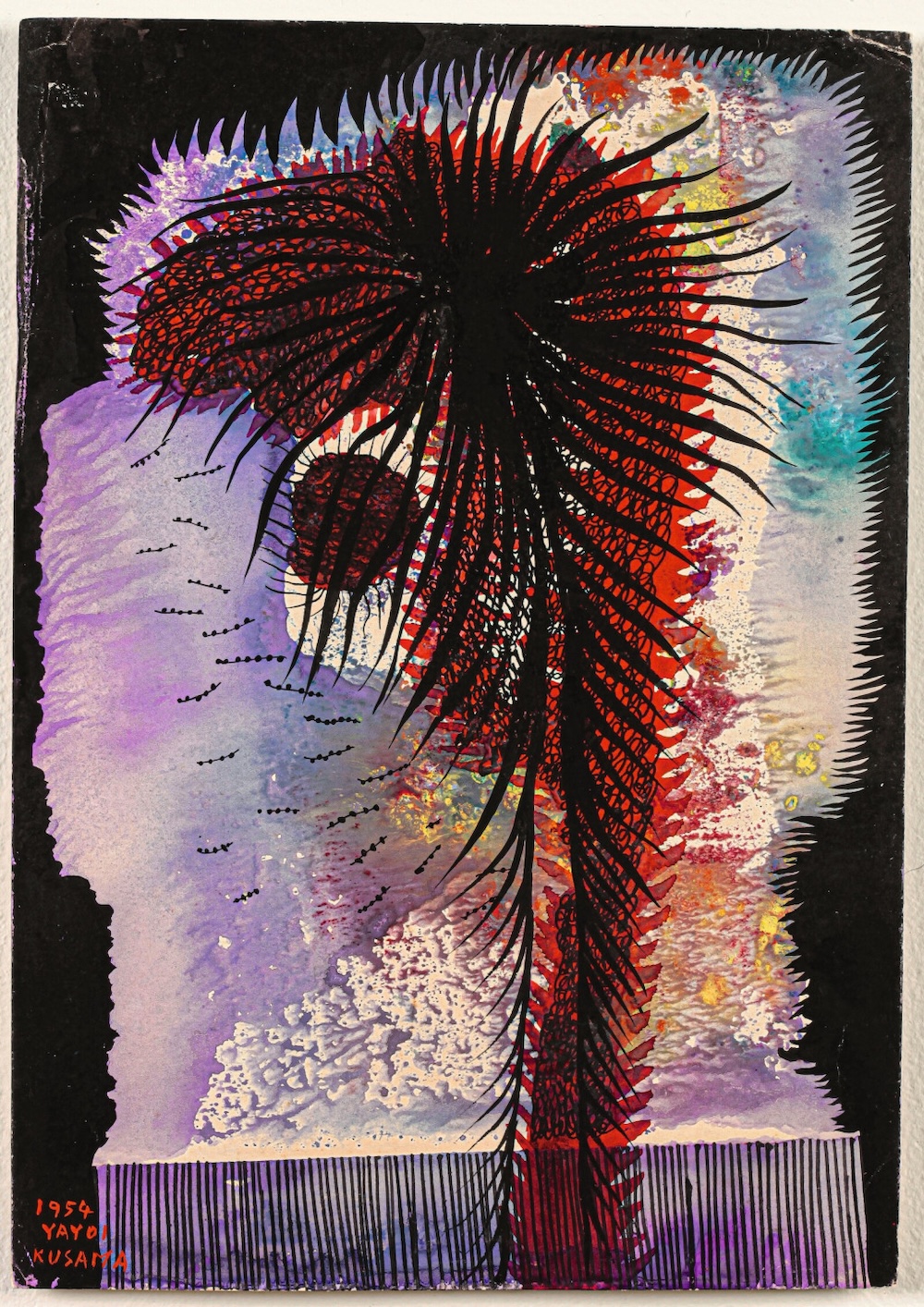 Yayoi Kusama, ‘Atomic Bomb’, 1954. Gouache, ink and pastel on paper, 25 × 17.6 cm. Collection Matsumoto City Museum of Art. © YAYOI KUSAMA
One image in the exhibition material captures just how far Kusama’s practice extended beyond the polka-dotted universe for which she would eventually become globally famous: Anatomic Explosion, her 1968 happening on the Brooklyn Bridge, shows Kusama alongside nude performers whose bodies she covered with dots. Another shows her surrounded by the mirrored spheres of Narcissus Garden at the 1966 Venice Biennale — an intervention that has become part of the mythology of her career.
 ‘Anatomic Explosion’ happening on the Brooklyn Bridge, New York, August 14, 1968. Getty Research Institute, Los Angeles. Gift of the Roy Lichtenstein Foundation in Memory of Harry Shunk and Janos Kender. Photo: Shunk-Kender © J. Paul Getty Trust
The trajectory that followed was remarkable. Kusama returned to Japan in the 1970s and continued working across painting, sculpture, installation, literature and performance. In later decades she became a genuinely global cultural figure, with exhibitions attracting enormous audiences and her immersive installations introducing her work to generations far removed from the experimental art scene in which she first emerged.
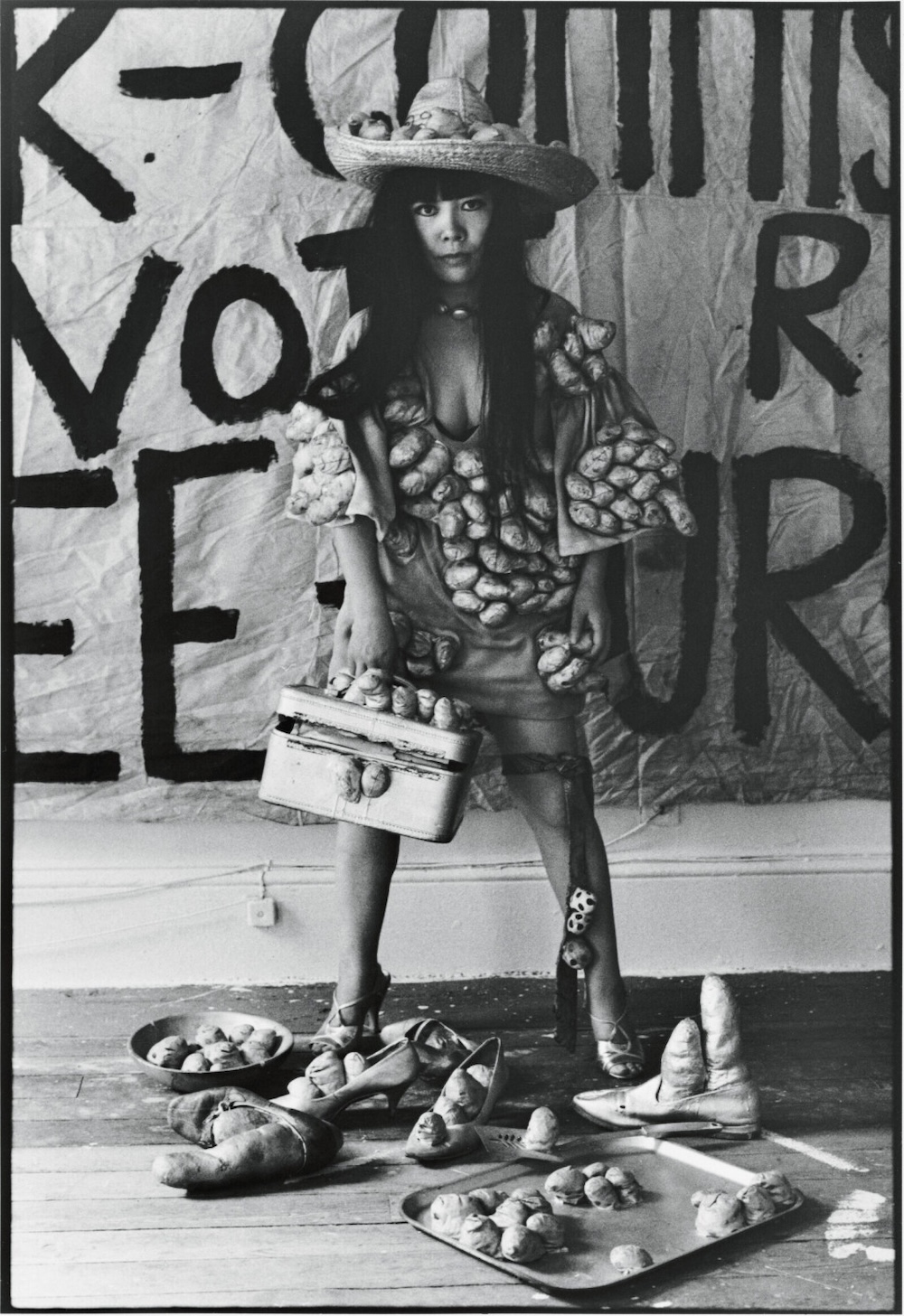 Yayoi Kusama poses in ‘Untitled (Dress)’ with her phallic sculptures in her New York studio, 1971. Photo: Tom Haar. © YAYOI KUSAMA
The Stedelijk exhibition was conceived as part of a collaboration with Fondation Beyeler in Basel and Museum Ludwig in Cologne and is curated by Leontine Coelewij.
The Stedelijk has since confirmed that the exhibition will now be presented as a posthumous tribute to Kusama. In a statement following news of her death, the museum reflected on an artist whose work crossed generations, cultures and national borders:
“With the utmost respect, the upcoming retrospective exhibition has now become a posthumous tribute celebrating Kusama’s life and work. Her influence on art will endure.”
Kusama’s death so shortly before the Amsterdam exhibition inevitably changes the way it will now be encountered. What was conceived as a retrospective of an artist still producing new work has become both a posthumous tribute and an opportunity to consider a completed body of work — one stretching from drawings made before the Second World War to work created in the final period of her life.
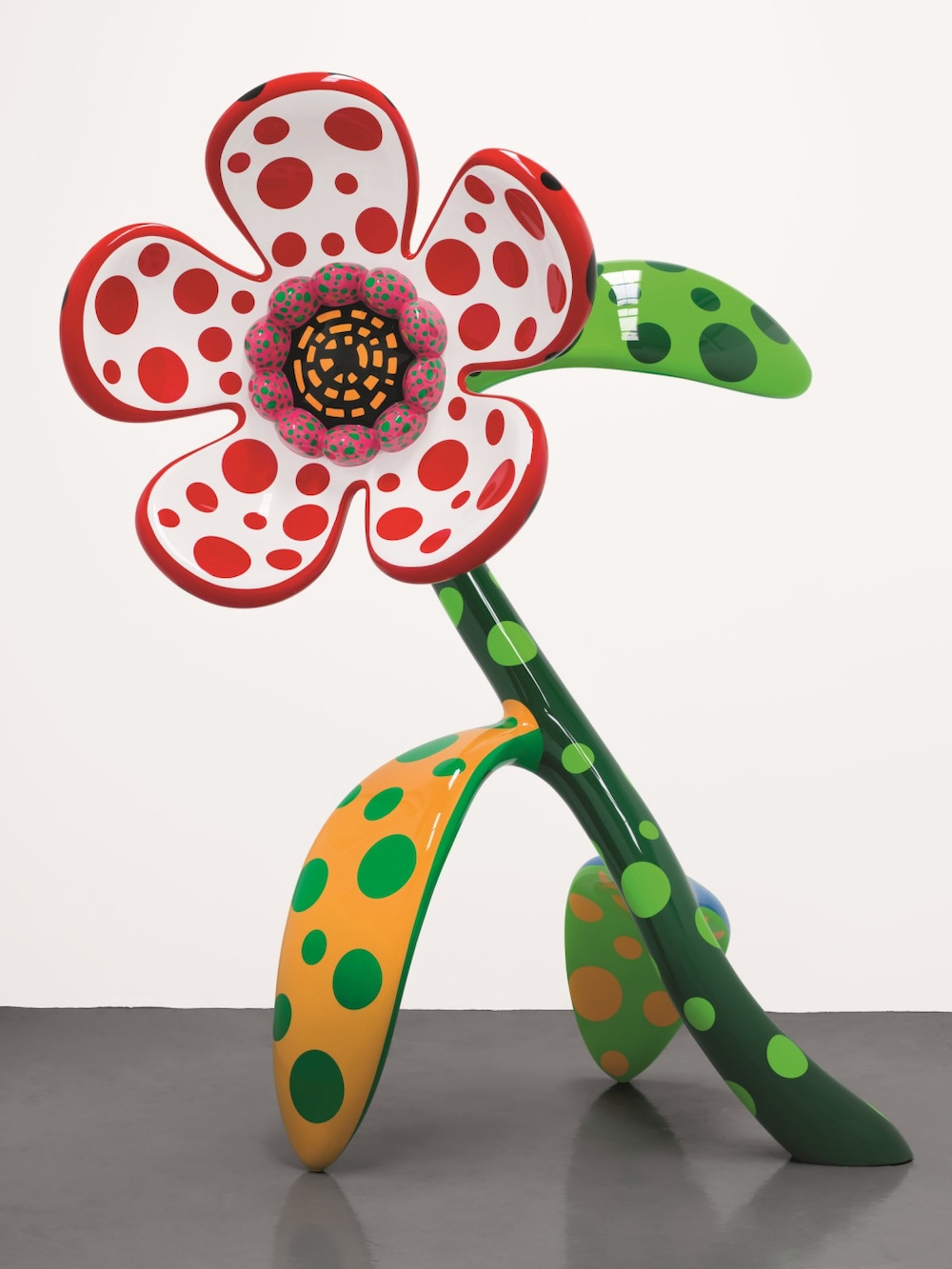 Yayoi Kusama, ‘Flowers That Speak All about My Heart Given to the Sky’, 2018. Painted bronze, 300 x 211 x 203 cm. Collection of the artist. Courtesy of Ota Fine Arts, Victoria Miro and David Zwirner. © YAYOI KUSAMA
That shift needn’t turn the exhibition into a memorial. Kusama’s work has always been intensely alive: obsessive, strange, seductive, psychologically complex and capable of transforming entire rooms. But seeing seven decades of it together now offers an opportunity to consider the scale of what she leaves behind.
Yayoi Kusama, 11th September 2026– 28thFebruary 2027, Stedelijk Museum Amsterdam
More Yayoi Kusama on FAD Magazine: fadmagazine.com/yayoi-kusama
CategoriesTagsAuthor 
Mark Westall has spent over thirty years creating platforms for culture. Since founding FAD Magazine in 2006, he’s dedicated his career to documenting, championing and questioning contemporary art through publishing, criticism and conversation. As founder and editorial director of one of the UK’s leading independent contemporary art publications, he has interviewed artists, reviewed exhibitions and covered the ideas shaping contemporary visual culture for more than two decades. He also founded Art of Conversation, Despoke and FAD Bazaar, and regularly serves as a judge for international art and photography awards.