
European steel distributors, processors and manufacturers have stepped up pressure on EU policymakers to address what they see as a widening competitive imbalance between steel produced in or imported into the European Union and steel-intensive manufactured goods entering the bloc from third countries.
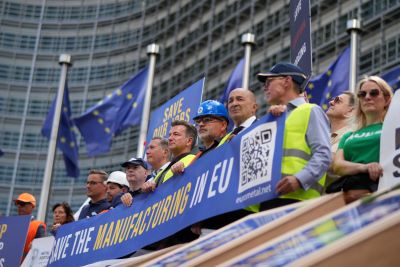
More than 200 representatives from the European steel, metals distribution, processing, logistics and manufacturing sectors gathered in Brussels on September 7 for the European Convoy for Industrial Competitiveness, organised by EUROMETAL.
The initiative brought 15 trucks and ten symbolic industrial coffins to the European Quarter, but the industry’s message went beyond the demonstration itself: EU trade and climate policies risk protecting steel at the border while leaving important parts of the downstream manufacturing chain exposed to lower-cost imports.
According to EUROMETAL, steel produced in Europe or imported directly into the EU is increasingly subject to trade defence measures, carbon costs and regulatory requirements, while many finished steel-intensive products manufactured outside the bloc can still enter the European market without equivalent obligations.
This creates a potential competitive distortion for European steel users. Manufacturers inside the EU face the cost of sourcing steel subject to European environmental and regulatory standards, while competing finished products may be produced abroad using steel that has not faced comparable costs. The concern is that tighter controls on direct steel imports could therefore shift rather than eliminate import pressure. Instead of importing steel and processing it in Europe, European buyers could increasingly turn to finished components, machinery, structures or other steel-containing goods produced outside the EU.
EUROMETAL has identified this as a growing risk of downstream carbon leakage, potentially resulting in manufacturing investment and employment moving outside Europe.
The issue has already been recognised at EU level. The European Commission proposed in December 2025 to extend CBAM from 2028 to around 180 additional steel- and aluminium-intensive downstream products, including machinery and appliances. The Council adopted its position on the proposal in June 2026, while the European Parliament’s Environment Committee subsequently backed an extension to downstream steel and aluminium products.
For EUROMETAL, however, the timing and scope of these measures remain critical. The federation has called for fair competition throughout the steel value chain, stronger protection against downstream carbon leakage, improved traceability and origin requirements and the inclusion of steel-intensive manufactured goods in EU trade and climate instruments where appropriate.
EUROMETAL president Alexander M. Julius said Europe could not achieve its climate, strategic autonomy and economic resilience objectives while allowing its manufacturing base to weaken.
“Today, too many steel-intensive products enter the European market without being subject to equivalent trade, carbon and regulatory obligations,” Julius said, warning that the imbalance could lead to investment leaving Europe, production moving abroad and skilled industrial jobs being lost.
No European Commission representative met the delegation when it reached the Berlaymont, according to EUROMETAL. The federation’s position paper and Call to Action were instead handed to Commission security staff. Later in the day, participants were received at the European Parliament by Elena Donazzan, vice-chair of the Committee on Industry, Research and Energy, for discussions on industrial competitiveness, investment and the future of Europe’s steel-using sectors.
The debate highlights an increasingly important challenge for European industrial policy: how to decarbonise and protect domestic steel production without weakening the competitiveness of the manufacturers that consume it.
For Europe’s downstream industry, the question is therefore no longer only how much steel should be imported into the EU, but increasingly where the steel consumed by the European economy will ultimately be transformed into finished products – in Europe or abroad.