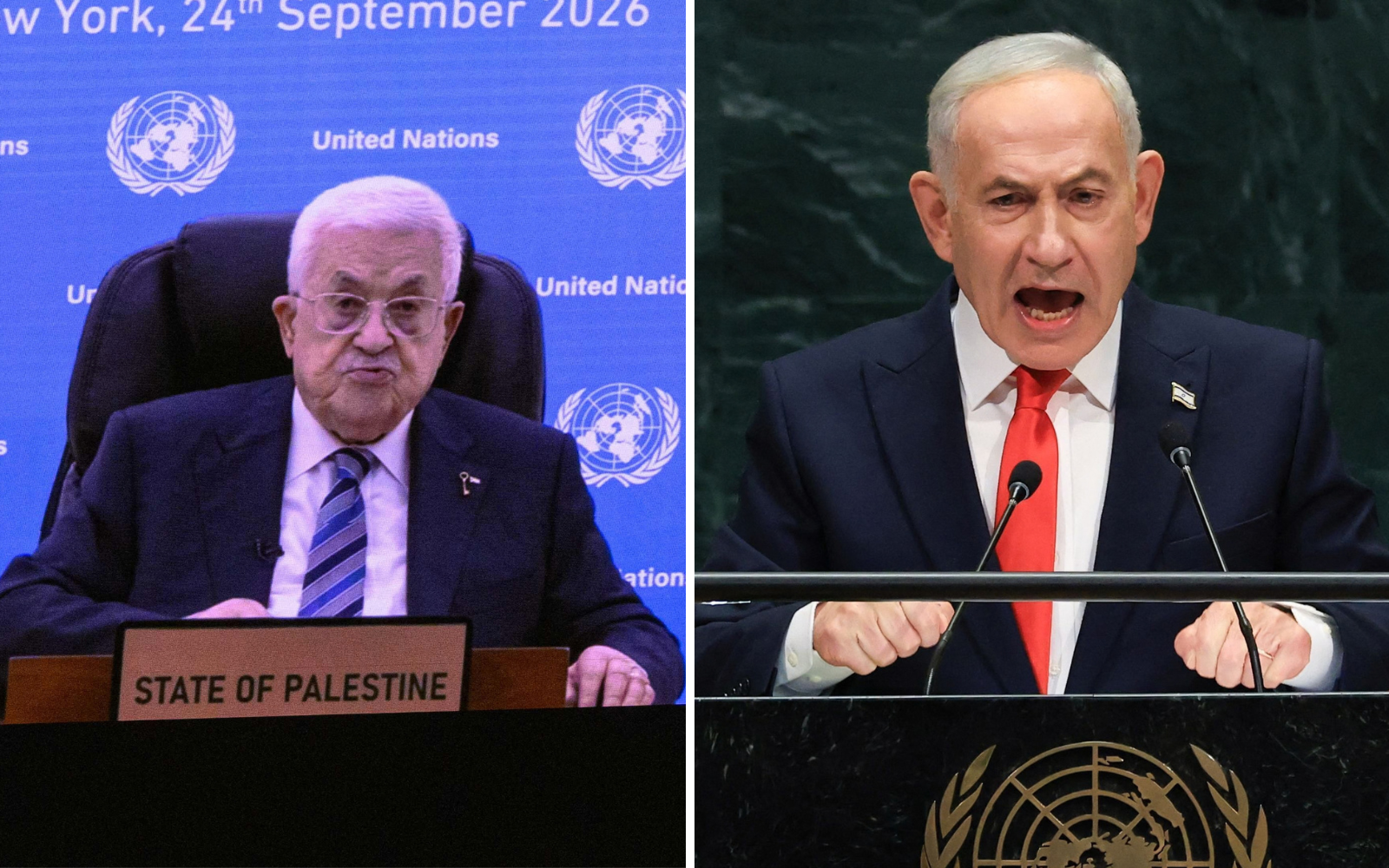
Palestinian President Mahmoud Abbas warned world leaders not to allow “another Nakba” as he addressed the UN General Assembly on Thursday, hours before dozens of delegates walked out when Israeli Prime Minister Benjamin Netanyahu took the podium and rejected accusations of genocide in Gaza.
The two speeches set out opposing accounts of Israel’s conduct in Gaza and the occupied West Bank as Palestinians face displacement, destruction and an economic collapse after years of war.
Abbas spoke by pre-recorded video after the United States denied visas to Palestinian officials for the second consecutive year. He described the measures as unlawful and said Washington had failed to meet its responsibilities as host of the United Nations.
“We warn you today: Do not allow another Nakba to occur,” Abbas said, using the Arabic term for the mass displacement of Palestinians during the establishment of Israel in 1948.
Abbas said Israeli policies in Gaza, the occupied West Bank and East Jerusalem threatened “the very life and existence of the Palestinian people on their homeland”.
He accused Israel of waging a “war of genocide” in Gaza and cited killing, starvation, destruction and displacement. He also pointed to settlement expansion, home demolitions and settler violence in the West Bank.
Netanyahu used his UN address to reject the charge, claiming that Israel’s war was “the opposite of genocide”.
A UN Independent International Commission of Inquiry concluded in September 2025 that Israel had committed genocide against Palestinians in Gaza. The Commission found that Israeli authorities and security forces had committed four of the five genocidal acts defined by the 1948 Genocide Convention and said the evidence showed an intent to destroy Palestinians in Gaza, in whole or in part, as a group.
“The Commission finds that Israel is responsible for the commission of genocide in Gaza,” Commission chair Navi Pillay said. Israel has rejected allegations of genocide.
Separately, South Africa’s genocide case against Israel remains before the International Court of Justice. The court has ordered provisional measures but has not issued a final ruling on the merits of the case.
Netanyahu faced a visible protest inside the General Assembly hall. Dozens of diplomats from multiple countries left as he approached the podium, while other delegates jeered. The presiding official called for order.
“If there are any other moral cowards in the audience, I urge them to walk out,” Netanyahu told those remaining.
Netanyahu also attacked governments and political figures who have criticised Israel. He targeted Turkish President Recep Tayyip Erdoğan and New York Mayor Zohran Mamdani, whom he called antisemitic. Mamdani later accused Netanyahu of using the speech to present a false account of Israel’s actions in Gaza.
Netanyahu defended Israel’s military operations across the region and said Israel was fighting on seven fronts. He also said US and Israeli forces had struck Iran’s military and nuclear capabilities.
Gaza continues to face a humanitarian and economic crisis.
The UN Conference on Trade and Development said on Thursday that 92 per cent of Gaza’s economic establishments had been damaged or destroyed. It estimated recovery and reconstruction requirements at $71.5 billion and said economic output had fallen to about $0.58 per person per day.
Abbas said the crisis in Gaza formed part of the same political process as settlement expansion and displacement in the West Bank and East Jerusalem.
“What is taking place in Gaza, the West Bank, and East Jerusalem are not isolated incidents,” he said.
He called for Gaza and the West Bank, including East Jerusalem, to come under one Palestinian government, one legal system and a single authority responsible for weapons. Abbas said he sought a non-militarised Palestinian state living alongside Israel.
He also called for continued funding for UNRWA, the UN agency for Palestinian refugees, and urged implementation of UN resolutions concerning Israeli settlements.
Abbas said Palestinian legislative elections remained scheduled for 28 November, with presidential elections to follow. Palestinians have not held national elections for two decades, while Abbas has served as president since 2005.
Outside UN headquarters, demonstrators protested Netanyahu’s visit and Israel’s military operations. More than 100 people were reportedly arrested during a protest by New York police.
Abbas ended his address by rejecting the displacement of Palestinians from their territory.
“We will not leave our homeland. We will not accept displacement,” he said. “We will not allow anyone to decide our future on our behalf.”
HT