✕
Cities are often shaped by their geography, topography, and their surrounding landscape. Oslo, Norway, is a prime example, uniquely situated between rolling evergreen forests and the fjord. It makes sense then, that the theme for the 9th Oslo Architecture Triennale (OAT), which got underway on September 17, is “What if nature comes first?” Explains Line Ramstad, the two-week-long festival’s director and curator, “We hope to learn from the solutions that already exist and to imagine our built environment on nature’s terms.”

The triennale’s opening party. Photo © Architectural Record

Home base for the Oslo Architecture Treinnale is Sofienberg Kirke, a deconsecrated church. Photo © Jan Kuhr
The 2026 edition of OAT has a program encompassing seminars, workshops, city walks, and more, and is headquartered at Sofienberg Kirke, a deconsecrated late 19th-century church in Oslo’s Grünerløkka neighborhood being transformed into a community center. The program even includes a daily “morning sermon” where architects, construction industry experts, and others present from the church’s pulpit. OAT’s focal point, however, is an exhibition of more than 30 projects from around the world, offering strategies for an environmentally sound built environment in sync with the natural world.
The exhibition’s most compelling solutions pertain to materials, with an emphasis on those that are bio-based, can be sourced locally, are recycled, or have low-embodied carbon.
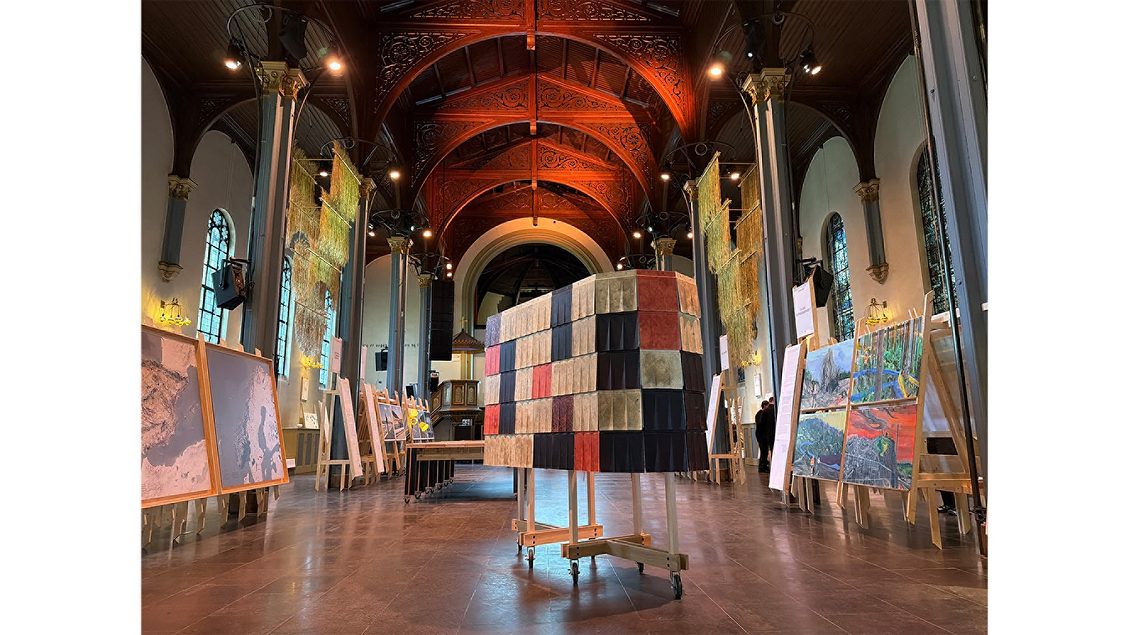
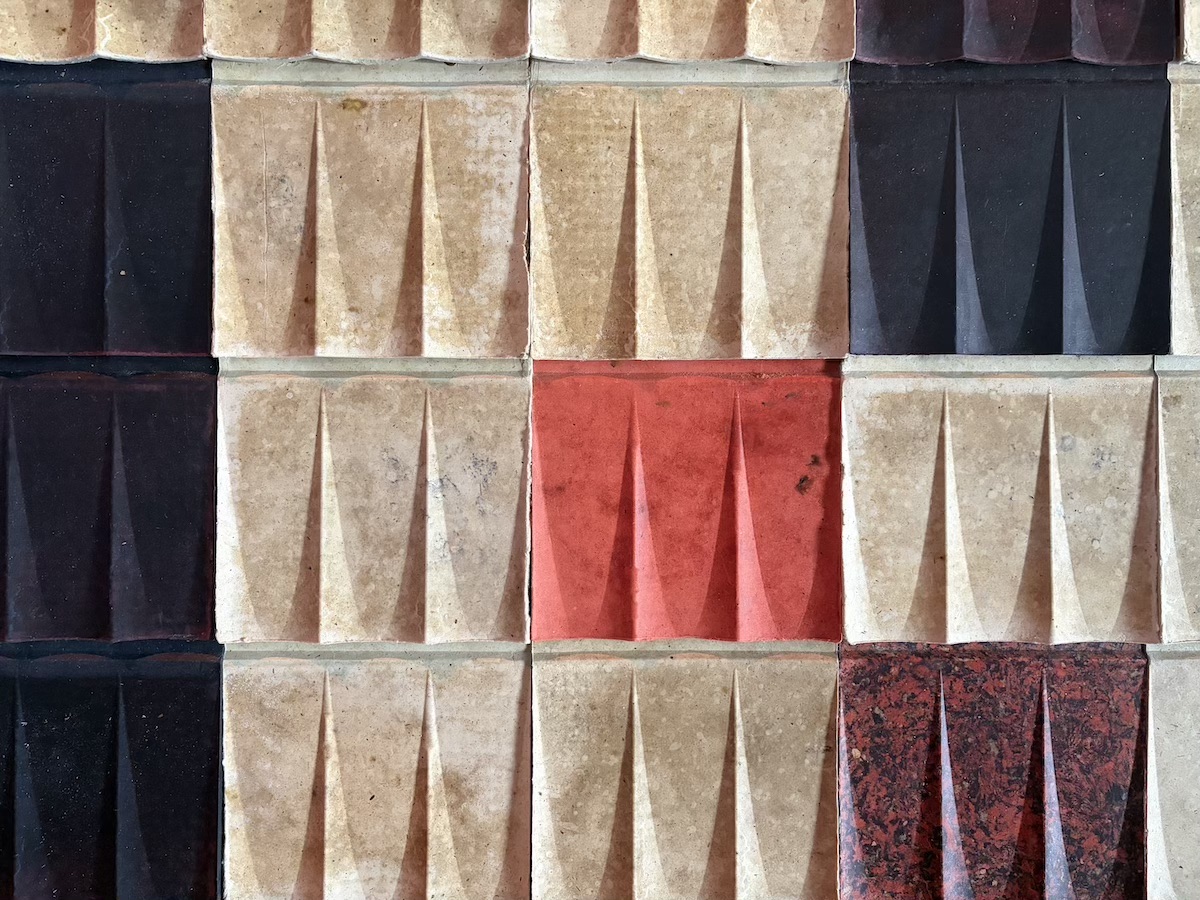
Prominently on display in the church’s nave is a large-scale table whose top is made of panels in different shades of pinks and reds fabricated on-site in a workshop in the days leading up to OAT using cocciopesto—an ancient building material of crushed discarded brick and lime (both obtained in this instance from the Oslo region). The unfired panels were still curing on the day of the triennale’s opening, and in the process, were absorbing an amount of CO2 equivalent to that released in the lime’s production, according to Sophie Coqui and Luisa Zwetkow, members of Vienna-based studio dreiST who led the cocciopesto workshop.

The different cocciopesto mixtures produce panels in varied pinks and reds. Photo by Joann Gonachar © Architectural Record
Material reuse is represented by Bergen-based Nordic Circles, which salvages steel from decommissioned ships and oil rigs. Instead of selling the material as scrap metal for melting and recycling, it fabricates it into welded profiles and sheet piling. The company says the carbon footprint of its products (0.067 tons of CO2 per ton of steel) is vastly lower than that of those produced in energy-efficient electric arc furnaces (0.4 tons of CO2 per ton of steel). Nordic Circles’ reclaimed steel has been used in numerous projects, including an eight-story office building in Bergen. “If nature comes first, we must build new things from existing things,” says architect Fredrik Barth, who founded the company with circular business developer John Jacobsen and other environmental entrepreneurs.

In a project called “Lasting Larvikite,” Arkitekt Martin Hopland and Studio Widerøe explore the possibilities of load-bearing stone. Photo © Brage Hofgaard
A project called “Lasting Larvikite” by Arkitekt Martin Hopland and Studio Widerøe, both Oslo-based, makes the case for the revival of stone as a load-bearing material. On display outside the church were sculptural “fragments of possible buildings,” incorporating blocks of various sizes and finishes made entirely of “leftover” larvikite, a stone extensively quarried in southern Norway.
The potential of wool as a construction material is also explored in the OAT exhibition. Much of the fleece shorn from sheep today is discarded, burned, or buried, because its fibers are deemed too short, too course, discolored, or otherwise undesirable for use in textiles. “But the wool hasn’t lost its quality, just its economic value,” says Jonathan Grinham, an assistant professor at Harvard’s Graduate School of Design and founder of Grinham Research Group. He has developed a process, incorporating methods and equipment from the paper industry, to transform the wool, which he refers to as “nature’s plastic,” into a strong, lightweight, and water-resistant cladding. He sees the product, which can incorporate insulation (also made from wool), as particularly suited to energy-retrofit projects.
The wool cladding is strong, lightweight, and water-resistant. Photo by Joann Gonchar, © Architectural Record

Transborder Studio and collaborators are conducting a pilot project testing the viability of an “underwater garden” for restoration of the fjord’s ecosystem. Image © Anita Kan
Though not officially part of the OAT program, triennale officials organized a visit for journalists to see the progress of a pilot project for restoring the ecosystem of the fjord developed by the Oslo Sauna Association, the Norwegian Institute for Water Research, and the architecture firm Transborder Studio. The pilot, begun last year, consists of an underwater modular platform for growing eelgrass and sugar kelp—species known to sequester CO2 and provide habitat for marine life. The experiment grew out of an entry by Transborder to a housing competition for a site east of downtown, partly on landfill and partly in the fjord. The firm proposed a building constructed above an “underwater garden” that would mitigate some of the fjord’s environmental degradation. Though a more conventional housing scheme was ultimately selected, the developer has sponsored the pilot and marine biologists are monitoring the plants’ progress. So far, the sea grass is growing well, but the kelp is less vital due to problems with sediment and algae. If the garden thrives, it could provide a promising model for buildings that prioritize nature, much like the solutions showcased in the OAT exhibition.
The triennale runs through October 1. Admission to most events and the exhibition is 100 krone, or about $10. Some are free. See here for more information.