
Ten unicorns on the wall, and 60 names beneath them
A 15-minute walk from Tallinn’s Old Town, a building painted with a night sky and a rocket stands in Telliskivi Loomelinnak, a redeveloped former factory district. A bike shop occupies the ground floor; LIFT99 is upstairs on the second.
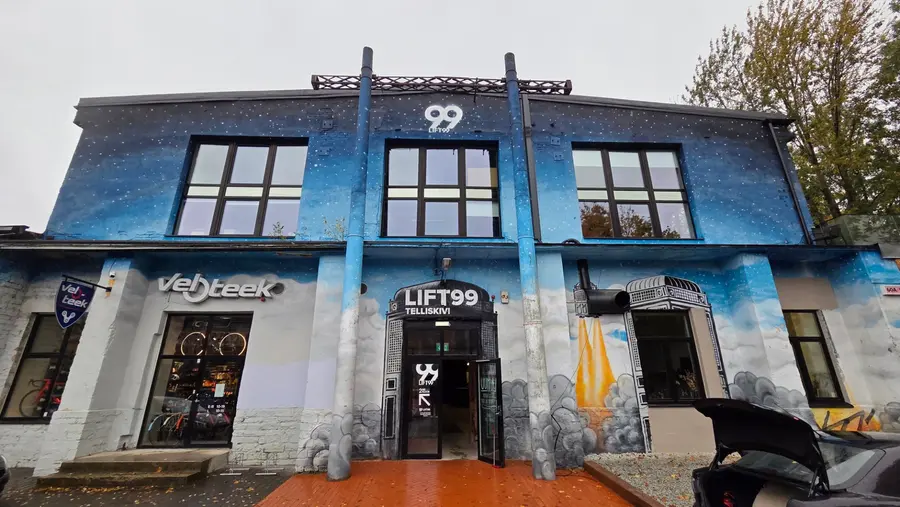 Exterior of the LIFT99 Telliskivi building with night-sky mural
Inside, the first thing that catches your eye is a wall. At the top, under the title “ESTONIAN UNICORNS,” ten hexagonal wooden panels are mounted. Skype, Playtech, Wise, Bolt, Pipedrive, Zego, Aidimi, Glia, Veriff. ※Estonia currently has 10 unicorn companies.
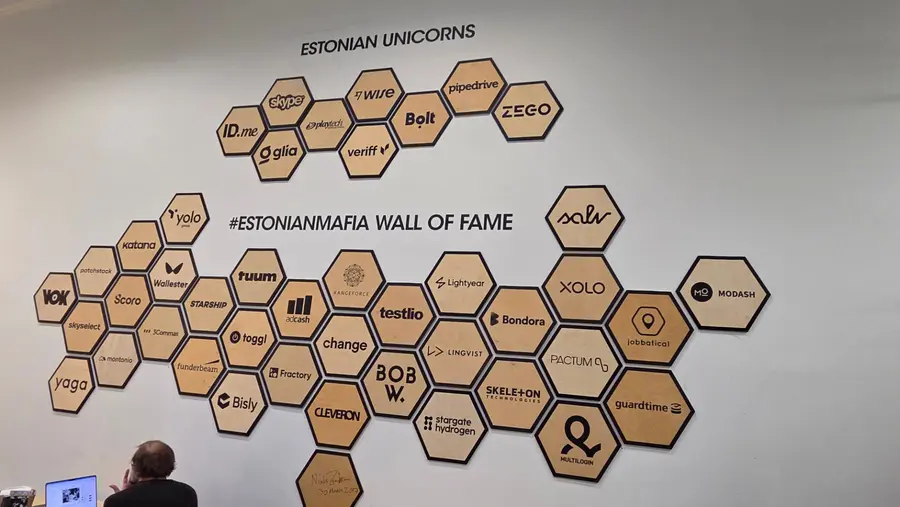 ESTONIAN UNICORNS panels
Below that is the “#ESTONIANMAFIA WALL OF FAME.” Starship, Toggl, Testrio, Bondora, Pactum, Stargate Hydrogen, Skeleton Technologies… nearly 60 names continue like a honeycomb. And at the very bottom of that honeycomb is a signed panel dated March 30, 2017.
I stood in front of that wall for a long time. Many startup spaces in Korea also display walls of success stories. What makes this wall different is that the founders of the companies hung on the wall still sit somewhere inside this building.
How LIFT99 got started
LIFT99 traces its roots to Garage48, a nonprofit foundation created in 2010 by five Estonian founders. Famous for its 48-hour hackathons, Garage48 ran Estonia’s first startup coworking hub and extended its activities into Central and Eastern Europe, the Middle East, and Africa.
Ragnar Sass, a founding member of Garage48 and co-founder of CRM software maker Pipedrive, rebuilt the hub and moved it to Telliskivi in 2016. Elise Sass, Elar Nellis, and Liis Peetermann joined him as co-founders. The “99” in the name comes from the aim to “lift 99 rockstars off the ground.”
The core difference is where the money comes from. LIFT99 was built and is supported by successful Estonian founders such as those behind Skype, Bolt, and Pipedrive. It is not a government-supported agency; it is a space created by “senior founders” for “junior founders,” and that philosophy shapes the way it operates. Their slogan is simple: “From founders to founders.”
They sell community, not space
LIFT99 runs two hubs in Tallinn: the Telliskivi hub and the RED hub on the same complex’s fourth floor. But they do not call themselves a coworking space. Three operational principles explain why.
Resident selection. They do not accept just anyone because a desk is empty. They choose founders who can contribute to the community. Their goal, they say, is not to be the biggest startup center, but the best.
Direct founder-to-founder connection. Rather than running a separate mentoring program, they arrange for unicorn founders and early-stage founders to meet daily in the same space. The founders’ network app “Salto” extends this connection online.
A hub for ecosystem events. LIFT99 co-hosts the Estonian Startup Awards, the ecosystem’s annual ceremony, together with Startup Estonia and the Estonian Founders Society. In 2025, 107 nominees made the final list.
A hub manager explained it this way.
“What we sell is not a desk but the seat next to you. The core product of LIFT99 is an early founder bumping into an early member of Starship or Veriff while getting coffee. Founders from more than 60 countries have passed through this space, and they remain members of this community even after they leave.”
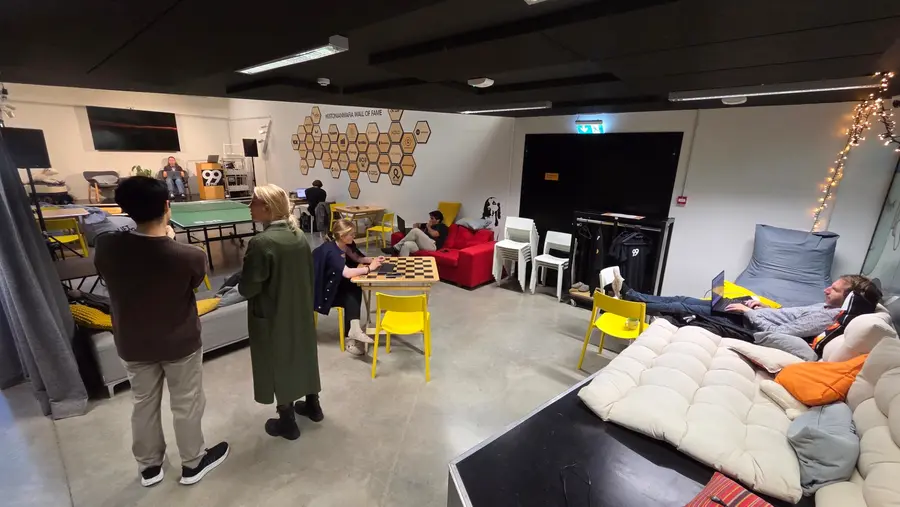 Lounge view – residents working around ping-pong table, chess board, and sofasA startup hub that reached Kyiv
LIFT99’s most dramatic success may be outside Estonia.
In 2018, Sass announced the establishment of a second hub in Kyiv, Ukraine, and LIFT99 Kyiv opened in April 2019. Tetiana Chaikovska, then 21, joined as a co-founder.
Sass’s concern was clear. Ukraine had excellent development talent, but most of it remained in outsourced development. He wanted to build infrastructure that would let Ukrainian talent create companies and own their products. The results came quickly. LIFT99 Kyiv became almost the only place where Ukrainian founders could raise pre-seed funding from international angel investors at European-level valuations. The founders of Ethereum scaling company Matter Labs spent the company’s early days here. Matter Labs later became a unicorn.
After Russia’s full-scale invasion in 2022, LIFT99 Kyiv shifted from being a workspace to a survival hub for the tech community. Sass and Chaikovska created a donation platform called “Help99” to enable global tech leaders to support Ukraine transparently. In August 2025, the hub building was damaged by a Russian airstrike, forcing it to close for three months; afterward, Kyiv coworking operator Kooperativ was set to take over operations.
That was the moment I began to think differently about what kind of organization LIFT99 is. If this were a real-estate business, withdrawing from a city where missiles fall would be rational. They stayed. Their identity as a founders’ community came before property rental.
The log wall in the basement
At the entrance on the ground floor, LIFT99 has another wall. Hundreds of cross-sections of logs are fitted with hexagonal wooden panels, each engraved with a company name. Vok Bikes, EstateGuru, Portree, Goliath, Matter Labs, RoboteX…
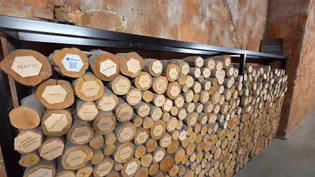 Log wall
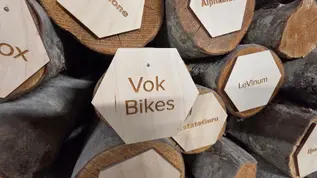 Vok Bikes panel
If the wall upstairs is the wall of the “successful,” the wall downstairs is the wall of those who passed through. Many of these names are companies you may never have heard of. Some have probably disappeared. But LIFT99 does not remove their names.
This is the most important scene I saw at LIFT99. An ecosystem that only exhibits success hides failure. An ecosystem that leaves failed names on the wall makes the next challenge easier.
※ To be continued in the next installment.