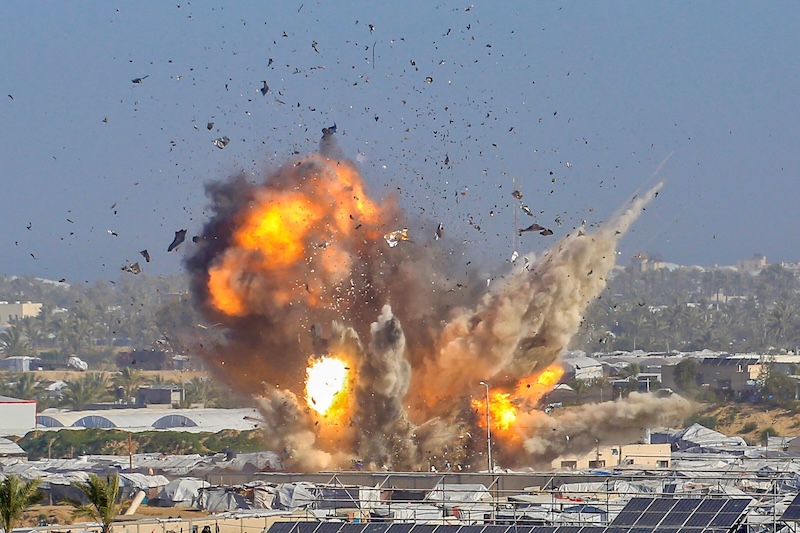
Israel said it will reopen the Rafah border crossing with Egypt on Sunday, ending a closure that has lasted almost two years, as Israeli air strikes across Gaza killed at least 28 Palestinians in a single day and the Israeli military accepted that Gaza’s official death toll from the war stands at about 70,000.
The announcement on Rafah came as attacks struck homes, tents, and apartment buildings across the enclave, including areas designated under the ceasefire lines, adding to uncertainty over the stability of the United States-brokered ceasefire.
The Coordinator of Government Activities in the Territories, known as COGAT, said the crossing would open for a limited movement of people only. The body, which sits within Israel’s defence ministry, said all movement would take place in coordination with Egypt and under Israeli security screening.
The crossing, Gaza’s only land link not controlled directly by Israel, has remained shut since Israeli forces seized the border area in May 2024. Its closure has sharply restricted humanitarian access for Gaza’s population of about two million people, many of whom remain displaced and short of food, shelter, and medical care.
Under the terms announced by Israel, only Palestinians who left Gaza during the war will be allowed to return. People born outside the territory will not be permitted to enter. Israeli forces will carry out additional identification checks at a corridor under army control.
No humanitarian aid will pass through the crossing under the current plan. Israeli officials said the reopening will apply only to pedestrians, leaving existing shortages of food, medicine, and shelter materials unchanged.
Hamas called for unrestricted movement through Rafah and accused Israel of delaying key parts of the ceasefire agreement. In a statement, the group urged mediators Egypt, the United States, Qatar, and Turkey to pressure Israeli Prime Minister Benjamin Netanyahu to implement the deal in full.
The Rafah opening forms part of the second phase of the ceasefire plan announced earlier this month. The first phase concluded after the return of the remains of the last Israeli captive held in Gaza.
While Israel said the truce has entered a new stage, Israeli troops still control more than half of Gaza, including territory inside the so called yellow line agreed under the ceasefire. Military operations and air strikes have continued across the enclave.
On Saturday, at least 28 Palestinians were killed by Israeli forces, according to Gaza health officials. The dead included six children and several police officers.
According to Al Jazeera, an air strike hit a tent sheltering displaced families in the Mawasi area northwest of Khan Younis, killing at least seven people, including three children. In Gaza City, an apartment building in the Remal neighbourhood was struck, killing at least five people, including a mother and children.
Gaza’s Government Media Office said Israeli attacks have killed more than 520 Palestinians since the ceasefire took effect on 10 October. Israeli strikes since that date have continued almost daily, with Israel saying its forces target armed groups.
On Friday, Israel’s military made a rare public acknowledgment of the overall human cost of the war. A senior security official briefed Israeli journalists, saying about 70,000 Palestinians have been killed by Israeli attacks since October 2023, excluding those missing under rubble.
The figure matches closely with data published by Gaza health authorities, who say more than 71,600 people have died, with at least 10,000 others presumed buried beneath destroyed buildings.
For more than two years, Israeli officials dismissed the Palestinian figures as unreliable and described them as propaganda. This marked the first time Israel publicly accepted the scale of the death toll.
The official said Israel is still reviewing how many of the dead were civilians. Israeli military figures previously claimed about 22,000 fighters were killed during the war, implying that most of those who died were not combatants.
Sources: Al Jazeera, The Guardian
HT