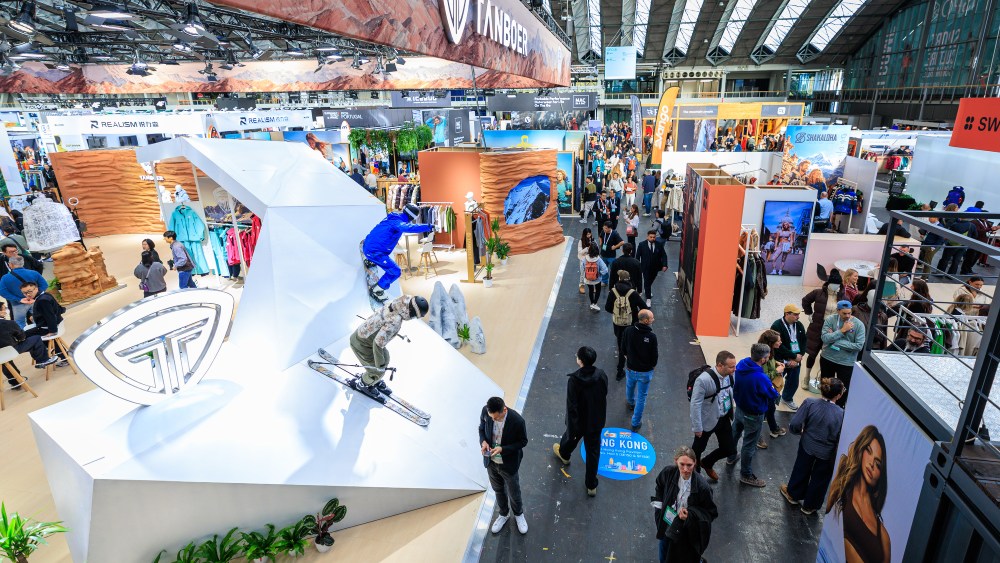
AMSTERDAM — After more than five decades in Munich, ISPO has opened a new chapter, relocating to Amsterdam for the first time as part of an effort by new operator Raccoon Media Group to reposition the event around international retail relationships, brands and a wider sports industry audience.
The move follows a joint venture between previous organizer Messe München and the British events company, signed last year. The change represents more than a change of address — it is a rethink of what the trade show should offer at a time when traditional wholesale relationships, buying calendars and consumer expectations are changing.
Raccoon introduced a hosted buyers program, a CEO summit, new panel programming and commercial opportunities in an effort to restore ISPO’s relevance after years of declining attendance and waning enthusiasm for traditional trade shows.
“We’ve seen buyers from some of the biggest retailers in the world having their travel budgets cut,” said Raccoon Media Group chief executive officer Mike Seaman.
“With COVID, etc., the trade show budget came out of most people’s marketing mix,” added ISPO managing director Tracy Bebbington.
Amsterdam was chosen for its international flight connections and the capacity of its RAI convention center. The November timing was also adjusted to avoid the U.S. Thanksgiving holiday and make it easier for American buyers to attend. U.S. outdoor retailer REI was among the companies whose attendance was facilitated by the hosted-buyer program.
But Seaman said the challenge was not simply to find a new location or attract more exhibitors, but to give companies a compelling reason to attend.
“If the only thing that your show delivers value on is where it is and when it is, then your show doesn’t deliver value. Your job is to curate buyers and sellers,” he said.

Raccoon Media CEO Mike Seaman at ISPO.
Albaris Media / Courtesy of ISPO
Raccoon wants to move ISPO away from an exhibition dominated by manufacturing and sourcing companies toward a more balanced mix of consumer-facing brands and suppliers. Brands accounted for approximately 35 to 40 percent of exhibitors at the Amsterdam edition, up from around 20 percent last year, Bebbington said. The longer-term target is an even split.
The company started recruiting retailers last January and ultimately brought in 470 hosted buyers, against a target of 500. In turn, buyers agreed to a set number of meetings with brands, while partnerships with European retail groups Intersport and Sport 2000 also boosted engagement.
The effort comes as brands and retailers reassess their relationships after the pandemic accelerated the shift toward direct-to-consumer sales.
“The balance is now tipping back. DTC will still be in there, but obviously retailers are part of the mix. So therefore, what we’re really seeing is a re-embrace and reconnecting with brands and retailers,” Bebbington said.
“Retailers are streamlining how many brands they have, and brands are streamlining the retailers that they use to go to market,” she added. “We want to be a platform where you find who’s right for you.”
Buyers Seek More Efficient International Connections
For retailers, the appeal of a central industry gathering is partly logistical. Cole Sport buyer Kathy Burke, who attended ISPO in Munich nearly 30 times, said the Amsterdam event could help bring an increasingly fragmented industry together.
“Having a trade show for us to have somewhere to go to and meet like-minded retailers, integrate with our vendors, and meet new vendors is really lovely,” she said.
Without a major international trade show, her team travels across Europe to visit individual brand showrooms, sometimes covering three countries in a single day.
“We have to get it done, whether the show exists or not. But to have it under one roof in one country, it would be spectacular for that to happen. We do miss it,” she said of the pre-pandemic Munich heyday.
Burke also pointed to economic pressures on specialist outdoor and ski retailers in the U.S., where tariffs have contributed to increases in the cost of European brands. Retail prices and wholesale costs have risen by an estimated 10 to 15 percent annually in some cases, she said, with manufacturers, brands and retailers negotiating how to share the burden.
The market is also being reshaped by the convergence of outdoor apparel and luxury, with technical performance, design and lifestyle positioning increasingly influencing buying decisions.
A shot of the Eco Age fashion show.
Albaris Media / Courtesy of ISPO
Outdoor Increasingly in Fashion and Luxury
The crossover was visible across the exhibition and conference program. ISPO’s new “Fashion and Textiles Hub” hosted the event’s first fashion runway show, presented by sustainability communications agency Eco Age.
It brought together established outdoor brands including Finisterre and Reima, sustainable fashion label Armedangels and emerging designers from the University of the Arts London’s London College of Fashion.
The presentation highlighted how technical materials developed for performance clothing are influencing fashion design.
“Performance wear is absolutely at the cutting edge of materials, and a lot of these materials have come through into runways,” said Eco Age CEO John Higgins.
Collections featured bio-based and regenerative materials, recycled and upcycled fibers, low-impact color technologies and PFAS-free waterproof finishes. Higgins said the industry now needs to move beyond sustainability as a marketing message and demonstrate tangible progress.
“Circularity and regeneration aren’t just words. What’s been missing quite often is the action,” he said.
A curated program of panels also examined how outdoor apparel has moved from specialist equipment into everyday wardrobes and luxury fashion, driven in part by gorpcore and growing interest in outdoor lifestyles, wellness and mental health, particularly by Gens Z and Alpha.
“Outdoor was dusty. It was boring,” said Blackyak vice president Max Nortz. “And today, it’s a culture.”
He cited Virgil Abloh’s introduction of Arc’teryx outerwear on the Paris Fashion Week runway in 2020 as an example of outdoor’s growing influence on fashion.
For Helinox, the crossover has created opportunities beyond traditional outdoor retail. CEO Young Lah said the company, originally focused on technical camping and climbing equipment, had worked to make its products relevant to everyday life, leading to collaborations ranging from Louis Vuitton to Uniqlo.
“We really tried to bring our technology to everyone and get attention from more and more people, and still keeping where we are from,” he said.
Brandwave Marketing founder Dan Macaulay said technical products such as sports watches, backpacks and reusable water bottles had become lifestyle signifiers, communicating identity and belonging as much as practical utility.
“You are saying that you are part of a tribe — Patagonia or Hydro Flask or whatever — and this signals my thought patterns as well,” he said.
But the panel also warned against assuming the fashion cycle would last. Macaulay pointed to sailing, action sports and athleisure as industries that had experienced mainstream popularity booms before losing momentum.
For outdoor brands then, the challenge is to attract fashion consumers without compromising technical credibility.
“Never ever lose your roots because of a trend,” Nortz said, arguing that equipment designed for outdoor use must continue to deliver on performance.
What Outdoor Can Learn From Luxury
The opportunity to build lasting brand value was also the focus of a keynote by Bård Kvamme, CEO of Norwegian merino wool brand We Norwegians. He argued that outdoor companies could learn from luxury brands by prioritizing heritage, customer experience, controlled distribution and full-price selling over frequent promotions.
Kvamme criticized the growing reliance on discounting in outdoor retail, citing examples of brands and retailers offering substantial reductions before the end of the season.
“If you have to do discounts for your products, you’re saying that the initial price was wrong,” he said.
He pointed to British luxury label Dunhill, which has built its positioning around heritage and consistency rather than promotional campaigns, and Rolex, whose tightly controlled distribution and waiting lists help sustain demand.
“Controlling the availability is the ultimate luxury,” he said, arguing that outdoor brands should be selective about their retail partners rather than expanding distribution at the expense of their positioning.
“Don’t compromise the brand for the sake of a quarter. Build it for the sake of a century,” he said.
The luxury playbook extends to how brands treat employees and customers. Kvamme cited California-based activewear brand Vuori’s emphasis on employee training and empowerment, and U.S. brand Shinola’s retail and hospitality concept, which turns stores into destinations where customers can experience the brand.
He added that Norwegian outdoor brand Norrøna has put storytelling and community as central to their strategy, holding around 200 retail events worldwide in 2025 and using its stores to build loyalty and communicate its values rather than rely on discounts or coupons.
“Don’t think about the retail store as just a store,” Kvamme said. “It is actually where your customers, your ambassadors, your loyal fans are coming to visit the brand.”
Future Beyond the Exhibition Floor
Raccoon is also seeking to make ISPO more relevant to senior executives and emerging businesses.
Its new Leaders’ Summit brought together executives from Amazon, Decathlon, Intersport, Patagonia, The North Face, New Balance and Sport 2000 for discussions on sustainability, economics, sport and business for discussions and curated, closed-door mixers. Speakers also included filmmaker and climber Jimmy Chin and Olympic champion Allyson Felix.
The Brand New section, developed with Born Accelerators, introduced emerging companies and technologies to buyers. Start-ups can use the platform for up to two years before moving into larger exhibition spaces.
Raccoon’s long-term ambition is to develop ISPO Sports Week, bringing together its consumer-facing events, including Outdoor Expo and Padel Expo, with independently organized events such as the Amsterdam Marathon Expo.
The company is working toward a potential Middle East launch in September 2027 and exploring a U.S. expansion for 2028.
ISPO hosted several sport competitions and events.
Albaris Media / Courtesy of ISPO
Rebuilding ISPO’s international standing, however, will take time. Some German retailers had already stopped attending the Munich show before the relocation, and Raccoon still needs to persuade established brands that the new format merits a place in their calendars.
Hoka and On got their starts at ISPO, for example, and Seaman wants to see them come back.
He acknowledged that the industry overall had become skeptical of promises to revitalize trade shows after years of declining attendance.
“I think they’ve had some big promises, and the shows have continued to decline. There’s just been a general tiredness with trade shows,” he said.
But he sees an opportunity as brands look for alternatives to increasingly crowded digital channels.
“Online is becoming really noisy and really difficult to cut through, especially with AI,” he said. Brands are increasingly treating physical events as opportunities for storytelling and product engagement, rather than simply places to write wholesale orders.
“Now you use it to build an anticipation funnel and tell your story,” he said.
Fabletics was one of the larger brands attending ISPO, looking to build on its recent expansion into German retail, including the department store KaDeWe, by connecting with new retail partners across Europe.
A spokesperson for the U.S.-based activewear brand said it had generated interest from potential retailers in Germany and the U.K. It is also preparing to enter India, with the launch planned for January.
Execs were initially unsure whether ISPO’s predominantly technical outdoor audience would be the right fit for its more lifestyle-led positioning, but the brand was encouraged by the number of potential retail contacts it made and has already confirmed its participation for next year.
Seaman is aware that the longer-term challenge will be turning initial interest into sustained exhibitor and retailer commitment.
“Ultimately, we are at the mercy of the industry. They’ve got to believe in our vision. They’ve got to see the progress,” he said.