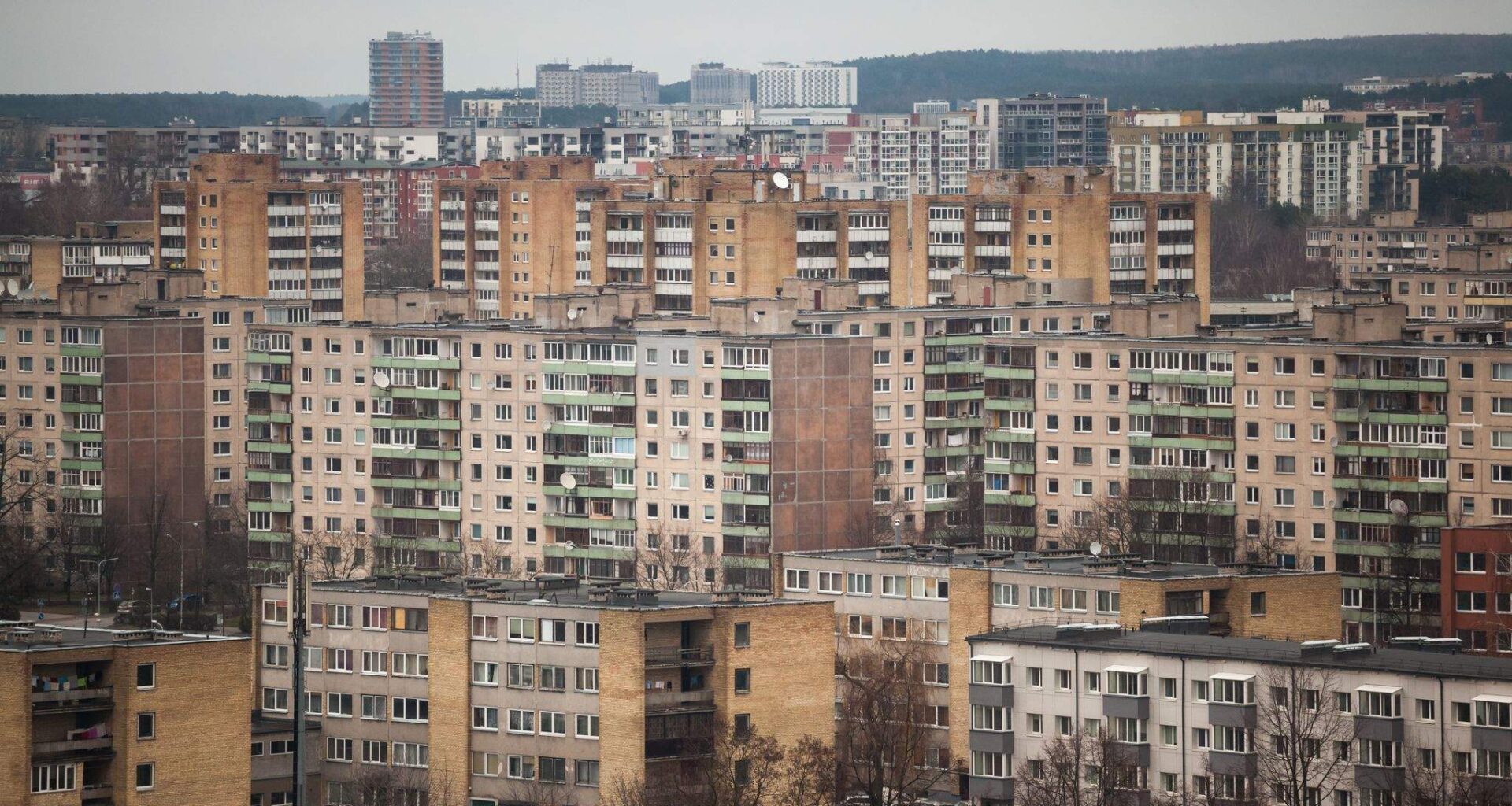
We work in one place, live in another, spend our free time in another, and we don’t even know our neighbors? Are local communities a thing of the past? Architect-urban planner Raimund Stupak is convinced that on the contrary, their role is more important today than ever. This requires not only positive initiatives, but also a different approach to urban planning and neighborhood design.
Physical distance is becoming less of an obstacle: we can work anywhere in the world, constant movement or relocation has become commonplace, and we access daily services via transport or the internet. However, despite this, the desire to feel part of a certain place, to get to know others and to have a space to meet has not disappeared.
According to Raimund Stupak, associate professor at Vilnius Gediminas Technical University (VILNIUS TECH), local communities have not disappeared and will not disappear. Their existence is determined by the logic of urban life – people find it most convenient to use what is closest to home.
Read also A popular Vilnius cafe is opening another location – this time everything will look different
 “Ozas” has renovated its food space: more opportunities for conversations, relaxation and work
 New direct flights from Vilnius to Dubai: ticket prices and schedule announced
“The currently popular 15-minute city concept is based on neighborhoods. The city is perceived as a combination of various neighborhoods, where objects that meet people’s most important needs can be reached on foot or by bicycle in 10-15 minutes,” R. Stupak is convinced.
According to the associate professor, the importance of communities is greater than it might seem at first glance.
“It is observed that increasing automobileization destroys local community, increases the atomization of society. And local mobility leads to greater community among residents, supports the local economy, promotes sustainable mobility in the city, and a healthier and more active lifestyle for people.”
“So local communities are very important in shaping and preserving the identity of different neighborhoods, ensuring their vitality. In addition, they are the nuclei of local civic activism and socialization,” says the expert.
The solution – a modern community center?
R. Stupak distinguishes that a person’s attachment to the place of residence is variable. In youth, we travel more often, change our place of residence for studies or work. However, after starting a family, nearby educational institutions, parks, playgrounds and other daily services become important. It is these places that become meeting points of the community and promote the growth of emotional connection.
“People’s attachment to place is cyclical. At certain stages of life, mobility is greater, while at others, the need for seclusion and stability arises. Therefore, it is very important in neighborhoods to ensure the sustainable renewal of local communities so that they include people of all ages,” says the architect-urban planner.
The docent explains that historically, urban communities gathered on streets and in squares near public buildings – local neighborhood spaces were where the main daily life of city dwellers took place. Later, cultural, sports and leisure centers appeared, but at the same time, separate spaces dedicated to specific activities or groups of residents also increased.
Today, different groups of people often spend their time separately in completely different parts of the city. This increases social exclusion, divides local communities by age, interests and daily needs, and leads to excessive travel within the city.
R. Stupak believes that one of the solutions to strengthen the connections between members of the local community is to offer attractions for joint activities near their homes. This could be achieved by establishing modern community centers in neighborhoods, where people of different generations could meet every day, and not just during holidays or special events.
Why is a “cultural center” not enough for a modern city?
When we think of communities, we probably immediately think of cultural centers. However, according to the interviewee, the concept of these buildings does not always meet today’s needs:
“One of the main problems with cultural centers built in the 20th century is their monofunctionality. They are usually designed as event spaces with one main hall, which is difficult to adapt to a wider range of daily community activities.”
According to the expert, a modern community center should function like a real community home – from morning to night. Here, a person should be able to come not only to an event, but also to work, study, play sports, meet neighbors or simply spend time.
It is also important that a community center should not be limited to just a building. Public spaces should be created alongside it – green areas, squares, sports and recreational spaces – for events and informal meetings at different times of the year.
The value of such a complex is the variety of activities and the opportunity for neighbors of different ages and interests to meet in one place. The premises should also be universal and easily transformed according to needs. A community center provides an opportunity to create daily social connections and strengthen local identity.
Based on these principles, Associate Professor VILNIUS TECH annually teaches the course “Architecture and Community” to Architecture students. During the course, students interact with residents of real neighborhoods and, having identified their needs, generate ideas for community complexes integrated into the urban context.
Over the course’s almost decade-long history, cooperation has been established with communities from different Vilnius city neighborhoods and other Lithuanian settlements (Šiluva, Tytuvėnai, Ginkūnai, Meteliai, Milašaičiai, Kasmiškės). Students are currently preparing projects for Akmenė and Giedraičiai.
What brings neighbors together?
In R. Stupak’s opinion, there are many examples of strong communities in Vilnius: Užupis stands out for its identity and creativity, in Žvėrynas the residents are united by the desire to preserve the historical character of the neighborhood, and in Balsiai the community actively mobilizes to represent its interests in the municipality.
What determines why some communities become active and others do not? The architect-urban planner distinguishes three important factors. The first is the emotional connection to the place and its history.
“Unfortunately, in larger cities in the mid-20th century, we lost many long-time residents. Current city dwellers can rarely boast that their third generation has lived in that city, much less in a specific area of that city – it takes time for this connection to be reestablished and strengthened,” says the associate professor.
The second is a common idea that can unite residents. This could be the desire to preserve the uniqueness of the area, solve specific neighborhood problems, or achieve another common goal.
The third is active leaders and a group of proactive people who consistently mobilize residents, both by organizing events and solving problems.
However, even the strongest community initiative requires a quality environment.
“Attractive public spaces, public and service facilities are the magnets that determine people’s choice of where to live. People intuitively tend to live in a comfortable and aesthetic environment, become attached to it and cherish it more,” says the interviewee.
The idea of community centers is still emerging in Lithuania
Although community centers are becoming an increasingly important part of cities around the world, there are still few such examples in Lithuania. In Vilnius, R. Stupak singles out Beepart, which was established at the initiative of the Pilaitė community, and the center “Miesto laboratorija” operating in Antakalnis .
Some activities are also offered by libraries and other institutions that are expanding their services, organizing events, and seeking to attract visitors of different ages. Such initiatives show that the need for a place to meet, create, and act together exists.
But the problem remains: sports, art, leisure and other activities are often organized in places far from each other. “This does not create community. It only encourages excessive movement and resource use in the city,” the architect-urban planner argues.
According to the expert, one possible solution is to create community centers in each neighborhood. R. Stupak points out that this does not necessarily require the construction of new buildings. It is possible to use defunct libraries, former educational institutions, cultural centers or other public facilities.
Examples of foreign practice show that community centers can be created by expanding existing educational institutions – then there is no need to create additional infrastructure, such as children’s playgrounds and sports grounds, gyms or swimming pools.
Real estate developers could also play an important role. High-quality infrastructure, public spaces and services near homes increase the attractiveness of the entire district, therefore, according to the expert, this should be in the interest of both municipalities and the private sector.
The associate professor invites active communities of Lithuanian cities and towns to offer their neighborhood territories for VILNIUS TECH student experiments: “The successful example of the Pavilnis community in Vilnius has shown that the insights and ideas of studying future architects help communities specify their needs and can encourage them to undertake the development of real architectural projects and the implementation of modern community centers.”