President Trump is no fan of renewable power. But he reserves a special contempt for wind.
Massive wind turbines spinning over plains and coastal waters massacre birds, cause cancer in humans and drive whales “crazy,” he has said, in complaints stretching back years. They’re also, in his opinion, eyesores — particularly the ones installed against his will near his Aberdeen, Scotland, golf course.
So Trump has declared war on them.
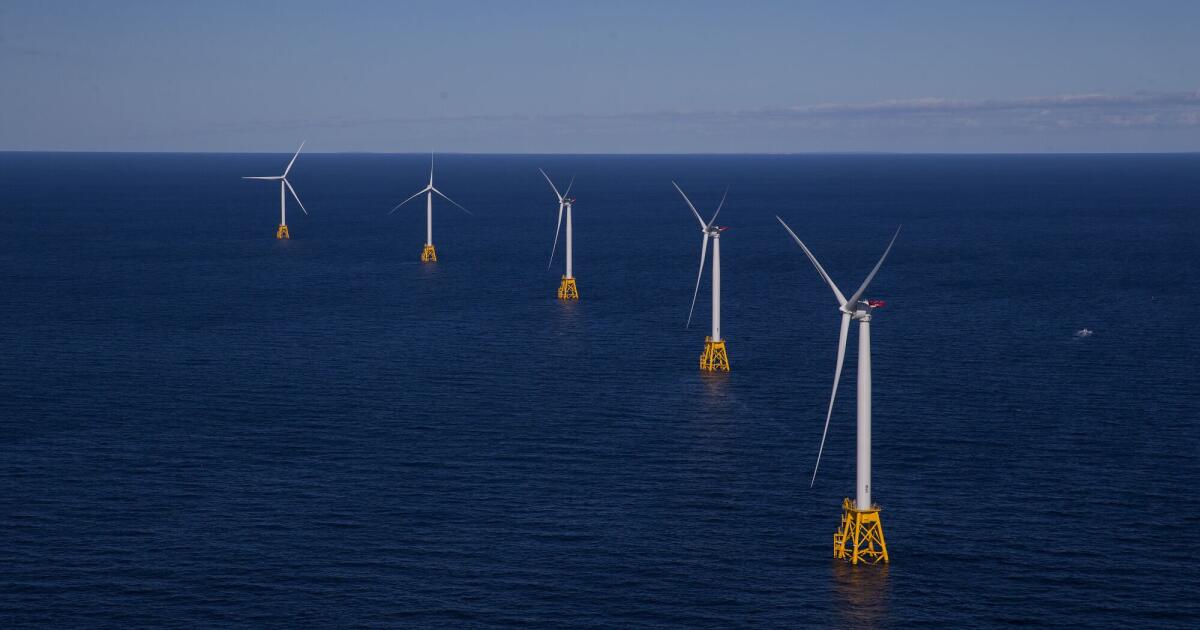
His administration on Friday ordered work to stop on an offshore wind farm that is 80% complete off the coast of Rhode Island by Denmark’s Orsted A/S. It’s working to halt development of another project planned off the Maryland coast that was set to begin construction next year. And it has already blocked a 231-turbine onshore project in Idaho this month.
There is no evidence that wind farms cause cancer. As recently as last year, the federal government declared there was no known link between large-scale whale deaths and offshore wind. Turbine blades whipping through the air do kill birds, as do buildings with glass facades. As for the aesthetic merits of turbines, it’s a matter of debate.
But Trump’s moves have triggered an existential crisis for wind energy’s future in the United States. Interior Secretary Doug Burgum has already ordered a comprehensive review of the approval process for such projects on federal properties, including right-of-way authorizations and environmental analyses. Offshore wind in particular could be “a non-starter over the next decade,” warned a recent forecast from BloombergNEF.
“He’s going after what he’s decided he doesn’t want,” said Carolyn Kissane, an energy expert and associate dean at the Center for Global Affairs at New York University. The halting of a nearly complete offshore wind project is unprecedented, she said. “This is kind of going for the jugular,” Kissane said.
The attacks are part of Trump’s “energy dominance” agenda that casts domestic fossil fuels and some advanced energy technologies such as small nuclear reactors as preferable to renewable power. Solar and wind facilities, administration officials say, are expensive, unreliable and too connected to China-based supply chains. They’re also key parts of the fight against climate change, an effort Trump denounces as “the Green New Scam.”
“President Trump has been very consistent — he’s not a fan of wind, the economics of it. He’s also been outspoken on environmental impacts, impacts to fisheries,” Environmental Protection Agency Administrator Lee Zeldin said on Fox News Saturday. “We need more natural gas, we need to build more pipelines. Coal plants are essential for states and regions across the country.”
The assault on U.S. wind power marks a sharp turnaround for an industry that Trump’s predecessor sought to encourage. President Biden saw in wind farms a way to curb greenhouse gas emissions and add American jobs. He called for installing 30 gigawatts of offshore wind by 2030, enough to power more than 10 million homes. While other countries have installed offshore wind turbines for years, they’re new in the United States. Projects struggled with supply chain disruptions and cost increases even before Trump’s return to the White House. And many offshore projects were planned to serve Democrat-led coastal states such as New York, New Jersey and California.
“The President’s actions will directly lead to utility-rate hikes by taking off most promising ways for Maryland to meet its looming energy generation challenges,” said Maryland Gov. Wes Moore, a Democrat, in an emailed statement Monday. By shunning offshore wind, the White House is showing “it cares more about satisfying his promises to those who bankrolled his campaign than about what is in the best interest of Marylanders — or the country as a whole.”
Wind proponents say the resource, when combined with energy storage and blended into the larger power grid, is a reliable source of electricity. Energy-rich Texas, for example, leads the U.S. in installed wind-power capacity, which is the state’s second-biggest source of electricity behind natural gas. While offshore wind requires massive upfront capital costs in the billions, the energy it produces is relatively cheap. Trump isn’t alone in his criticism of offshore wind. Groups ranging from local preservationists to wealthy coastal homeowners have sued to stop the projects, claiming they disrupt ecosystems, interfere with commercial fishing and ruin views. Wind energy supporters counter that industrial work will disrupt the environment at some level, but the damages are minimal compared to the benefits provided by a new source of clean electricity.
Chediak writes for Bloomberg.