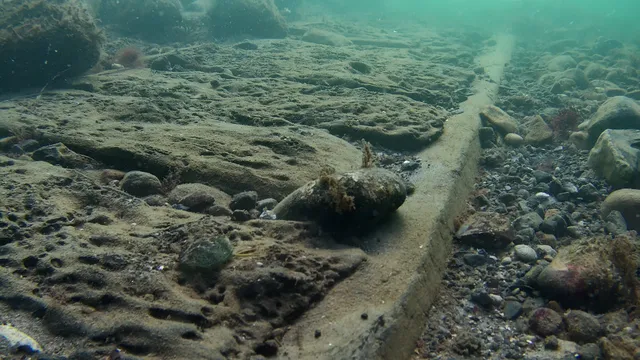
The wreck was found at a depth of about 15 meters, with virtually zero visibility.
A sunken warship destroyed 225 years ago during an attack by Admiral Horatio Nelson and the British fleet has been discovered off the coast of Denmark in what has been described as a “remarkable” archaeological find, reports CNN.
Marine archaeologists from the Danish Viking Ship Museum discovered the wreck during a survey of the seabed in Copenhagen Harbor, conducted in connection with the construction of an artificial island.
Work on investigating the shipwreck has been ongoing since late last year. The remains were found at a depth of about 15 meters, with nearly zero visibility.
“We found the ‘Dannebrog’ and the remains of the people who never managed to escape after the battle,” said marine archaeologist Otto Uldum. According to him, the ship’s dimensions “fully correspond” to the preserved historical drawings. The area is littered with cannonballs and metal projectiles, and the team has also discovered two cannons.
The study is part of the preparation for the “Linetøholm” project—an artificial peninsula covering about 271 acres, designed to protect Copenhagen from rising sea levels. The project has sparked serious public debate due to its potential environmental impact.
According to the museum, the discovered ship is the “Dannebrog,” which on April 2, 1801, was part of the Danish-Norwegian defensive line against the British fleet.
The Battle of Copenhagen broke out that same day. Danish sailors fought for four hours against the superior British forces but were ultimately defeated. Severely damaged, the ship caught fire and subsequently exploded, after which a ceasefire was declared.
Although the battle is well-documented in historical sources, this is the first time archaeological research related to it has been conducted. “Although the event is pivotal to Danish history, it has not been studied archaeologically until now. This is truly impressive,” notes Uldum.
In addition to traces of the battle itself, archaeologists have discovered numerous items belonging to the crew—shoes, pieces of clothing, clay pipes, and uniform components.
Human remains have also been found, including a lower jawbone and bones believed to belong to fallen sailors. Analysis of the materials is ongoing.
Nelson’s fleet consisted of 39 ships armed with heavy artillery. The “Dannebrog” was at the center of the defensive line under the command of Olfert Fischer and became the primary target of British attacks.
The battle, though brief, resulted in heavy losses. Data indicates that 56 members of the Dannebrog’s crew were killed, and over 40 were wounded. On the British side, about 255 people were killed and over 700 were wounded. The Danish losses were even greater—about 370 killed and 665 wounded, with over 100 later dying from their injuries. At least 200 people remain missing.
Since 2020, large-scale marine surveys have been conducted in the area of the Copenhagen harbor. In addition to this ship, archaeologists have discovered other remains, including the largest known 15th-century cog-type merchant ship.
The excavations are expected to conclude in the spring, with all discovered materials being documented through photography and 3D scanning. | BGNES