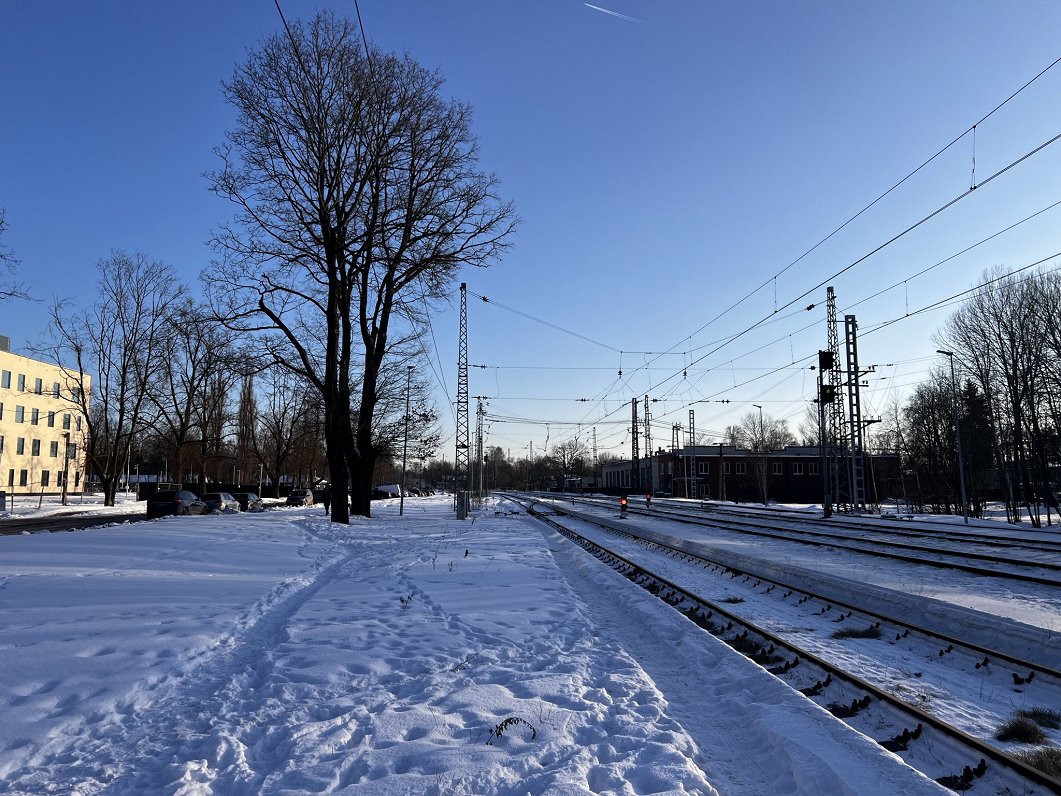
It has been decided to build a new railway stop in Rīga, reports Latvian Radio. The stop will be in Āgenskalns near the Pauls Stradiņš Clinical University Hospital and will be located on an electrified line, which will allow travellers to head to Jūrmala and Bolderāja, as well as to take a quick trip across the River Daugava to the centre of the capital.
The hospital provides more than 700,000 services a year, which are received by residents from all over Latvia, and this side of the river is seeing significant development in terms of new housing.
However, there is no data yet on how many patients and hospital employees might use the new stop, nor on the key question of how much it will cost to build.
In addition, Latvian Railways (Latvijas dzelzceļš) does not have the best reputation for building new stops, as previous promises have in some cases been delayed for years or have been shelved indefinitely, reports Latvian Radio.
The new railway stop is to be built directly opposite the Stradiņš Hospital next to Atpūtas Street, on the side of which there are many cars parked, most of which are probably patients or hospital employees. Even at the best of times, finding a parking spot in this part of Rīga is difficult, which would suggest that the option of taking a train would be welcomed by many who have to go to the hospital.
Currently, the nearest railway stop in the direction of Jurmala is Zasulauks, which is about a 10-15 minute walk, but the closest one in the direction of the centre is Torņakalns, which is at least a couple of kilometres away. The potential stop would be located on a fairly straight section of the railway track, and this is an important factor in the creation of a new stop.
Latvian Radio met an employee at the hospital who supports the idea:
“People need many different means of transport to get here. [A bus or a trolleybus] are fine, but they have to be combined. You can’t come with just one. I think this case is similar to [the Business School] “Turība”, which also has its own station, where its flow is high. Given my current circumstances, I wouldn’t use the railway station, but if something were to change and I had some mobility restrictions or my family had one car instead of two and it would be easy for me to get to Rīga station, then definitely, yes.”
Hospital manager Lauris Vidzis pointed out the current parking problem. In his opinion, the railway stop would significantly improve access to the hospital, as it is currently difficult for patients and their relatives to get to the hospital. It is difficult to estimate how many people could use the new stop, Vidzis admitted, saying that more than 600,000 people use the Zasulauks stop annually, a large part of whom are patients and hospital employees.
New stop has high potential
As part of the troubled “Rail Baltica” project, it was originally planned to build or rebuild 10 stops between the Airport and the Central station. This included the new stop “Āgenskalns/Stradiņi”. However, seeing that the Rail Baltica project is years behind schedule and looking for every possible way of saving money, those minor stops do not look like being a priority any time soon.
Consequently, Latvijas dzelzceļš has included the new stop in its own Jūrmala line modernization project.
“At the end of last year, we received procurement offers. We see that the two cheapest offers include the construction of Āgenskalns [stop]. Accordingly, from the project budget, we can say with certainty that we will build Āgenskalns station as part of this project,” said Agra Melne, the Latvijas dzelzceļš project management director.
“The project implementation deadline is 2029, when this station should be in place. If everything goes as planned, our goal is to make a final decision on this procurement in March. Then we can conclude a contract for the performance of this work at the moment when we have funding available, namely, an agreement has been concluded with the Central Financial Contracts Agency on the allocation of funding for this project. And if everything goes well, then May is the month when we have concluded both the financing agreement and the contract for the performance of this work and the design work will begin,” said Agra Melne.
But plans and projections do not always work out as promised, as Māra Heimane, a resident of Saulkrasti municipality, knows well. A year and a half ago, after numerous requests from residents, the Public Transport Council decided to move the isolated Inčupe train stop closer to the popular Balta Kapa (White Dune) tourist attraction at the south of the town. The plan was to do it by 2029. But last summer the money intended for the work was suddenly redistributed to the “Rail Baltica” project, and the residents’ hopes were dashed.
“Hope appeared in our neighborhood. New families wanted to settle down. Neither visually, theoretically, nor practically, there is no announcement about the relocation of the Inčupe stop. Currently, the Inčupe stop is absolutely useless. It is impossible for residents to get to it from the city of Saulkrasti, because a forest trail down a railway embankment leads to the stop,” said Heimane.
Expert: Latvian practice is not normal
Transport expert and former head of the Road Transport Directorate, Artūrs Caune, believes that Latvia’s practice in such matters is not normal.
“For example, in Germany, there is a clearly visible concept for 2040, what the entire regular interval schedule for all of Germany will be. Switzerland is currently planning a modernization project until 2050. In Latvia, all of our policy planning documents have short deadlines – five to seven years. Therefore, there is not really a place to record a response to residents, such as, for example, about Inčupe, which would clearly state that it is not expected in the next five years, but it is expected, for example, in another three years. So in eight to nine years. Then there will be this clarity of planning and then residents could also be informed accordingly and follow this development,” said Caune.
By 2029, a total of 25 stops across the rail network are planned to be renovated or built on various lines, including the Torņakalns, Zasulauks, Depo, Dobele and Liepāja stops.
But Latvijas dzelzceļš is still dragging on previous projects worth many tens of millions of euros, which involve 48 stops. They were originally supposed to be completed by the end of 2023. A large number have been completed, but, for example, two stops on the Bolderāja line, where a passenger train has not run for almost 70 years, are scheduled to be completed only this November – several years behind schedule. Whether the new Stradiņš hospital stop does open by the end of 2029 remains to be seen.