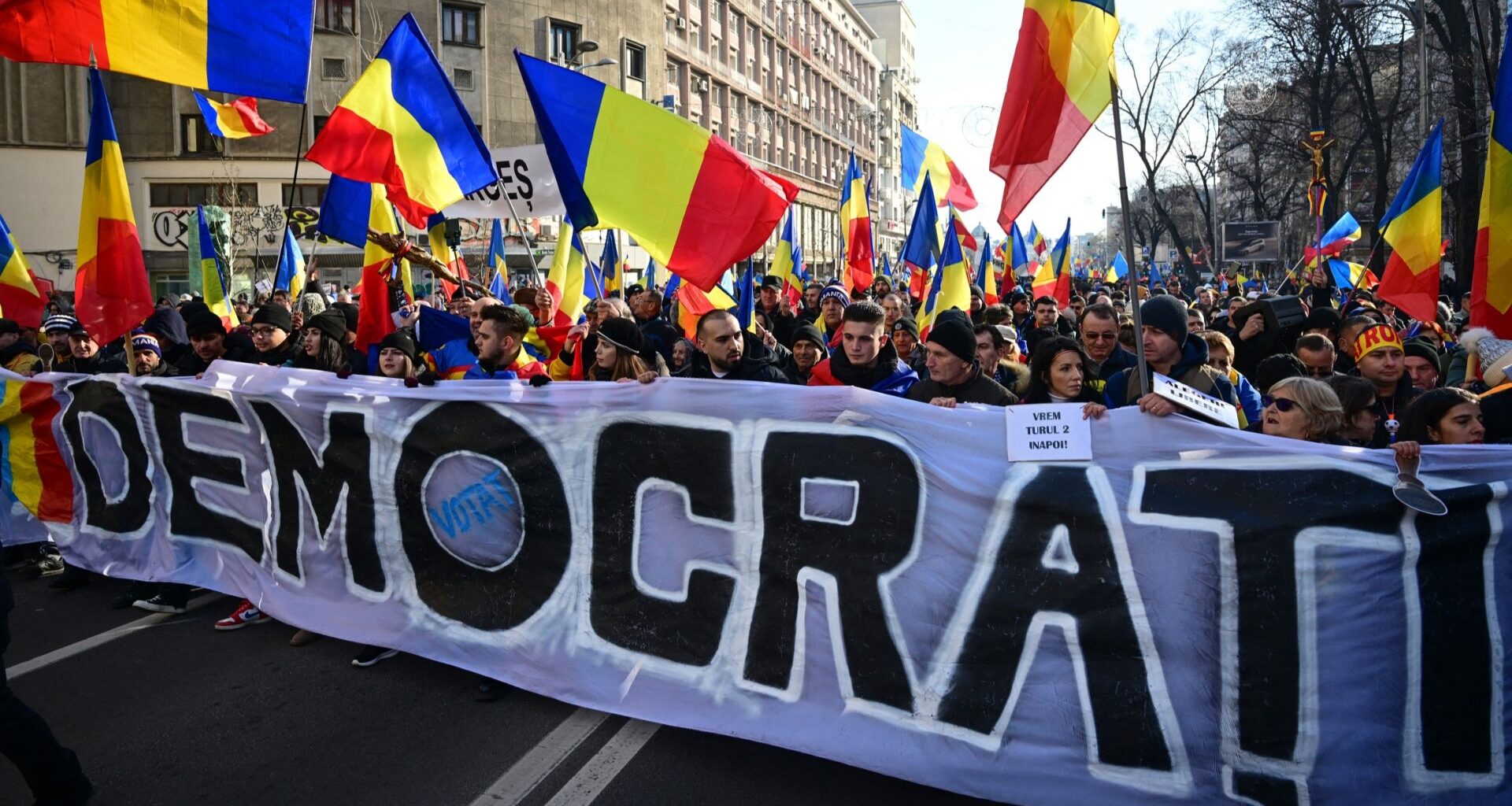
For years, Europeans have been comforted with a simple explanation whenever an election produced an outcome deemed ‘undesirable.’ The culprit, politicians and institutions alike assured us, was always the same external force: Russian interference.
But the events surrounding Romania’s recent presidential elections suggest a far more worrying trend—not from the Kremlin, but from within the very heart of the European Union itself.
According to a recent report (The Foreign Censorship Threat, Part II: Europe’s Decade-Long Campaign to Censor the Global Internet and How It Harms American Speech in The United States), documenting the European Union’s decade-long campaign to control political speech and electoral processes, the decisive influence in Romania’s presidential race did not come from Moscow. It came from Brussels.
In early 2024, the first round of Romania’s presidential election was canceled after widespread allegations of foreign interference. According to official European statements, these claims suggested Russian involvement intended to manipulate public opinion and electoral outcomes.
Yet when independent and reliable observers—MCC Brussels—examined the data, they found a glaring absence of publicly disclosed evidence linking Russia to concrete influence operations. In April 2025, MCC Brussels formally filed an official complaint with the European Ombudsman against the European Commission for refusing access to the full documents related to the DSA procedures regarding the elections in Romania, after which the EU supported the narrative alleging Russian involvement—given that they did not present clear evidence from TikTok about a direct link between Russia and influencing the Romanian electorate. The complaint argued that Brussels did not provide the requested data on the record submitted by TikTok to support the claims of foreign interference.
This was not a rhetorical demand. It was a request for the fundamental pieces of evidence underpinning Brussels’s own narrative on foreign interference.
Despite the EU’s heavy reliance on the Digital Services Act’s enforcement mechanisms and narrative framing around safeguarding elections, the European Commission did not produce the TikTok data that would demonstrate the direct connection to Russia. Brussels instead maintained that investigations were ongoing, while simultaneously rejecting MCC Brussels’s allegations of non-transparency. But now, it has been proved that MCC Brussels’ criticisms were not allegations.
This refusal to release the sources raises profound questions: if there were clear proof of Russian meddling, why withhold it? And if not, why proceed with a narrative that justified resetting an entire democratic contest?
Democracy pending Brussels’ approval
The interference did not arrive in the form of clandestine cyberattacks or tanks at the border. It came clothed in the language of democracy: “protecting electoral integrity,” “fighting against disinformation,” and “safeguarding freedom of expression.”
Each phrase, on its face, sounds noble. But in practice, what unfolded in Romania was a preemptive regulatory action that shaped political communication and curtailed electoral legitimacy without the transparency that any democratic system must guarantee.
By exerting pressure long before any legal adjudication and refusing to share the key data on which its claims rested, the EU demonstrated that its understanding of democracy is less about citizens’ will and more about validation.
In this model, elections are not purely a matter of citizen choice; they are a process to be approved by Brussels.
A democracy of permission
What happened in Romania reveals a fundamental shift. The principle of popular sovereignty—the idea that citizens, not some bureaucratic institutions, determine their government—is being quietly hollowed out.
In the EU’s new architecture, political speech online is monitored and regulated by Brussels-aligned frameworks, platforms are pressured to act before evidence is made public, allegations of interference are treated as truth until proven otherwise, and when independent entities ask to see the evidence—as MCC Brussels did—the answer is silence.
This is not transparency. It is managed legitimacy.
When electoral outcomes depend on conformity to approved narratives, voters are no longer citizens exercising constitutional rights—they are just pawns in a supervised process. Democracy exists, but only within boundaries set by unelected institutions.
From Romania to Hungary: the next test
This is where the Romanian precedent becomes genuinely dangerous.
If the logic applied to Romania became European normality, then it can be applied anywhere within the EU. Any state where voters choose outside the range of ‘validated’ outcomes could be subjected to the same mechanisms of narrative control and electoral revision—all justified under the banner of “defending democracy.”
In April 2026, Hungary will hold parliamentary elections. Prime Minister Viktor Orbán remains Brussels’ most persistent political adversary—a leader repeatedly accused of undermining ‘European values,’ resisting EU migration policy, and challenging the ideological consensus on sovereignty, culture, and governance. In Brussels’ view, Viktor Orbán is at fault for refusing to betray Hungary’s national interest and the well-being of its citizens.
If Romania was the test case, Hungary may well be the target.
The mechanisms are already in place: Digital Services Act enforcement, election-specific ‘guidelines,’ coordinated pressure on platforms, and a narrative framework that treats populist or sovereigntist victories as inherent threats to democracy. All that is required is an allegation—disinformation, foreign influence, systemic risk.
Evidence can come later. Or not at all. The lesson from Romania is clear: once Brussels decides an outcome is unacceptable, democracy becomes optional.
The soul of Europe is at stake
The European Union was conceived as a community of free nations committed to democracy, rule of law, and pluralism. But when electoral integrity becomes equivalent with compliance to Brussels’s criteria—rather than trust in the electorate—the foundational idea begins to crumble.
Romania should have been a story about democratic resilience. Instead, it became a case study in how institutional prerogative can override citizens’ will.
This is not about fear of foreign meddling—that is a real concern for all democracies. It is about the lack of transparency, the control of narratives, and the acceptance of regulatory power without public accountability.
Democracy cannot be a process that only exists with the permission of unelected bureaucracies. And it certainly cannot thrive in an environment where evidence is withheld and dissent is treated as a risk.
The Romanian case challenges us to ask: What does democracy mean in Europe today?
If democracy means that the will of the people must first be approved by Brussels, then we have already crossed the line from democratic union to managed polity.
And that is a problem for all of Europe’s member states.