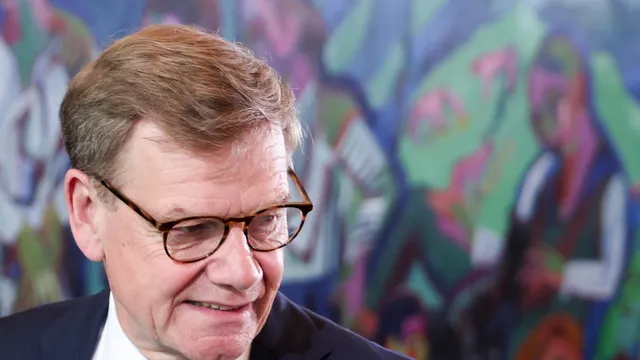
Wadephul said Brussels could “move faster” through qualified majority voting or through agreements among smaller groups of EU member states.
German Foreign Minister Johann Wadephul called on the European Union to remove the requirement for unanimity on a number of key decisions, saying the mechanism has allowed the bloc to be held “hostage” by national interests.
EU leaders have repeatedly voiced frustration with outgoing Hungarian prime minister Viktor Orban, who blocked important decisions.
Wadephul said Brussels could “move faster” through qualified majority voting or through agreements among smaller groups of EU member states.
Decision-making blockades by individual EU countries have “sometimes held the EU hostage to national and external interests”, Wadephul said in a speech to the Konrad Adenauer Foundation, which is linked to his centre-right CDU party.
EU member states already use qualified majority voting when adopting legislation proposed by the European Commission.
However, some measures, including sanctions, enlargement, foreign policy decisions and EU tax matters, can still only be adopted unanimously.
Wadephul stressed that even without the unanimity requirement, Berlin would not abandon the search for consensus.
Orban’s heavy defeat in Hungary’s mid-April elections brought major relief to many leaders in the 27-member bloc.
Orban had often delayed decisions on sanctions against Russia and aid to Ukraine after Moscow’s full-scale invasion in 2022. Most recently, he held up a €90 billion, or $106 billion, EU loan for Kyiv.
In a world marked by conflicts and unstable global relations, the EU must be able to use its collective weight and economic power to defend its interests, Wadephul said.
“When it comes to security, the principle of unanimity can put us in existential danger, because these are matters of life and death,” he said.
In his speech, Wadephul also called for Brussels to be given greater powers to suspend EU funds for countries “that violate our common values”.
He did not explicitly name Hungary, but the EU was often at odds with Orban’s government over rights and rule-of-law issues and froze part of Budapest’s EU funding.
On enlargement, Wadephul backed the creation of a “structured phased process” for joining the EU.
New countries should go through “gradual integration” into the bloc before becoming full members, he said. This, according to Wadephul, could ease concerns about “premature” accession. | BGNES