
Greenland’s Ice Sheet is shrinking, and the difference is visible from space. Its rapid melting could lead to “catastrophic consequences” for the entire world, says the European Space Agency.
The ESA released radar images from the Copernicus Sentinel-1 satellite showing changes in the Greenland Ice Sheet, which covers 80% of the island’s surface. It’s the second-largest ice mass in the world, with the largest being the Antarctic Ice Sheet, according to the international organization devoted to space exploration.
The agency scanned an area, including three glaciers that form the main front ends of the Northeast Greenland Ice Stream (NEGIS) from January to March, and analyzed the changes that occurred over that period. The NEGIS is a major drainage system that annually discharges 12–17% of the Greenland Ice Sheet into the North Atlantic Ocean. The images showed changes in the constantly moving ice.
In the last 10 years, the Greenland Ice Sheet has changed rapidly, and the ESA stated that it has thinned along its edges. Greenland’s glaciers are dumping more ice into the sea, and the ice sheet as a whole has lost mass.
The changes mark a larger issue affecting the entire world.
Microplastics in the sky? Tiny troublemakers may be warming Earth.
Emperor penguins added to endangered list, losing to climate change
1 of 10
A female emperor penguin hatches an egg at an oceanarium in Nanjing, Jiangsu province Feb.10, 2009. Emperor penguins were added to the endangered list as climate change threatens the sea ice they depend on to survive.
See radar images of Greenland taken from space
The white in the image represents stable ice, while grey shows ice that has very little to no change. The colors centered in the water “show visible changes in type and cover of the constantly moving sea ice.”
Why is the Greenland Ice Sheet melting?
Global warming and climate change are causing the Greenland Ice Sheet to melt rapidly, which could be dire for the entire globe.
“The Greenland Ice Sheet contains 12% of the world’s glacier ice, and if it melts completely, the global seas will rise by up to 7 meters (around 23 feet) with catastrophic consequences,” according to the ESA.
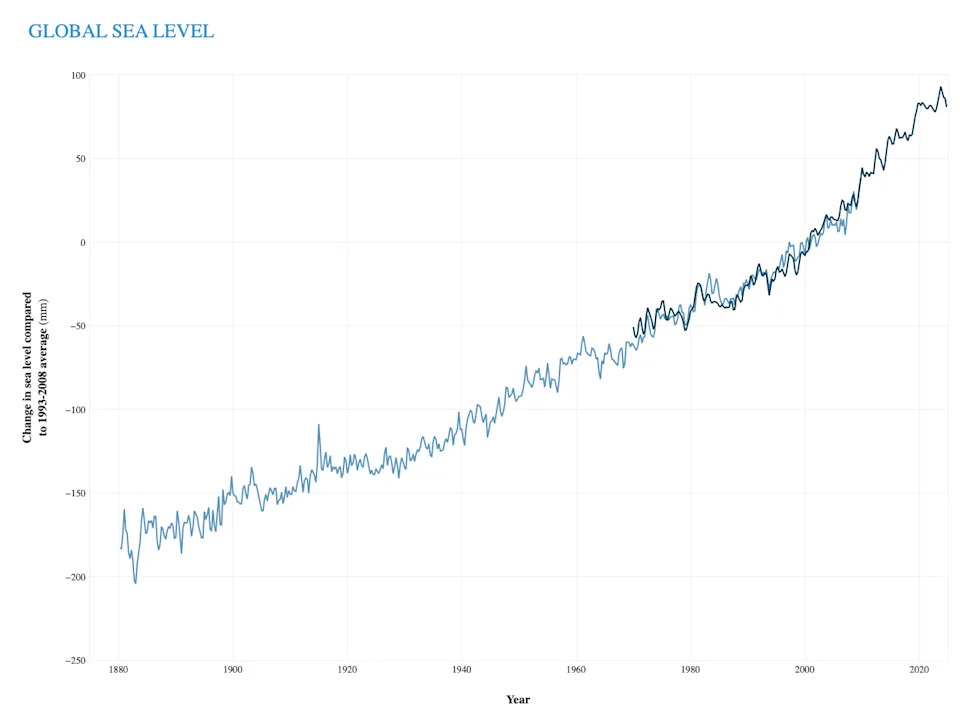
Since 1880, sea level has risen around 8 to 9 inches, according to NOAA
Since 1880, global sea levels have risen by 8 to 9 inches, according to the National Oceanic and Atmospheric Administration (NOAA). The main contributor to rising sea levels is the melting of glaciers as the oceans continue to warm.
Sea level rise can lead to devastating consequences, especially in coastal areas, where nearly 30% of the U.S. population lives, NOAA stated on its website.
According to NOAA, a rising sea level plays a role in the following:
Julia Gomez is a Trending reporter for USA TODAY and covers invasive species, space phenomena, scientific studies, natural disasters and trending news. Connect with her on LinkedIn, X, Instagram, and TikTok: @juliamariegz, or email her at jgomez@gannett.com
This article originally appeared on USA TODAY: Global warming is changing Greenland, photos from space show how