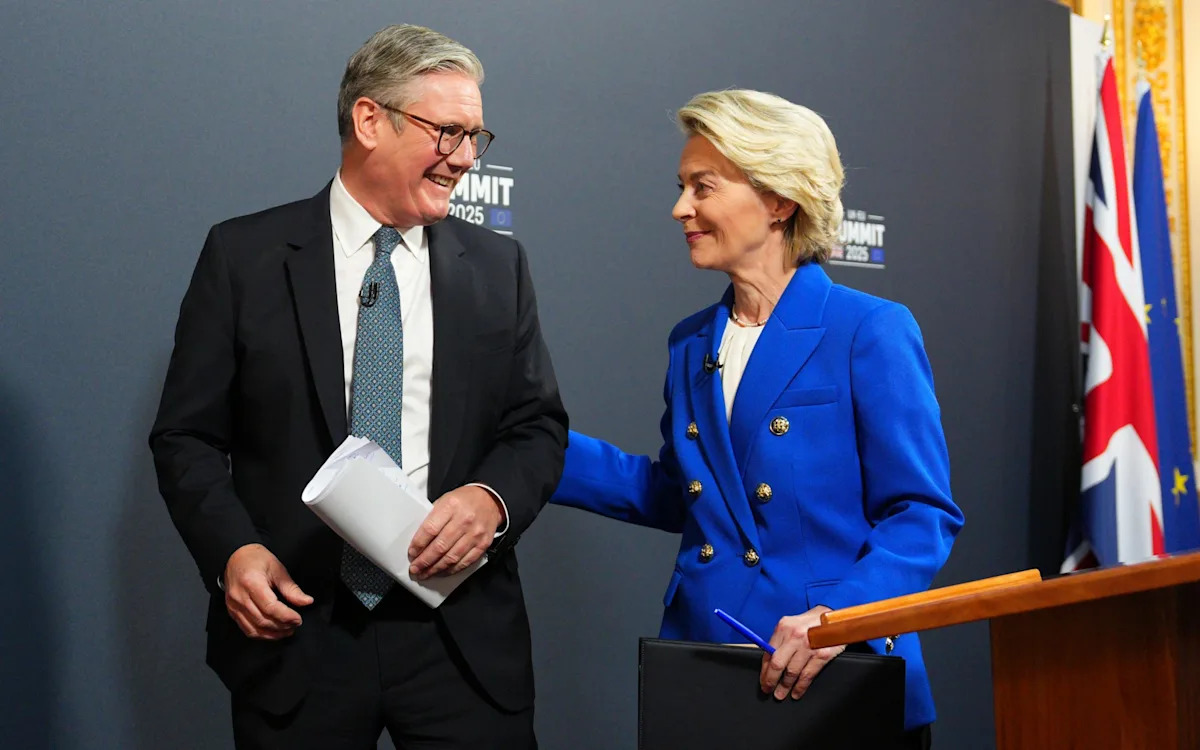
Brussels won’t save an embattled Sir Keir Starmer, it will use his weakness against him.
Sir Keir wants to save his premiership and shore up his base by getting closer to Europe.
The British Government and the European Commission are negotiating new post-Brexit arrangements before a July summit in the Belgian capital.
They include a youth mobility scheme, a trade-boosting food and drink deal and an attempt to revive the failed negotiations on UK membership of an EU rearmament programme.
Sir Keir’s allies may hope that Eurocrats will give the UK some “wins” in those talks to bolster his leadership after the humiliation of the local elections.
Labour is, after all, far more pro-European than its Right-wing rivals in the Tories and Reform UK.
Brussels knows Nigel Farage well from his more than two decades as a member of the European Parliament (MEP), and endured years of painful Brexit negotiations with successive Conservative governments.
There is no doubt it would rather be dealing with Sir Keir than Kemi Badenoch or Mr Farage.
But to assume that translates to an easy ride or free lunch in the “reset” negotiations is to misunderstand the Commission and how it works.
EU negotiators are flinty-hearted when it comes to getting the best possible deal for a bloc many of them are theologically devoted to.
Ursula von der Leyen, president of the European Commission, talks of “new beginnings” with old friends when discussing UK-EU relations.
But the truth is her Commission is split internally between officials willing to be more pragmatic in the talks and those insisting on the hardest line possible.

Europe would rather be dealing with Sir Keir Starmer than Nigel Farage or Kemi Badenoch, but it does not mean it will go easy on him – REUTERS/Vincent Kessler
Some of those are veterans of the lengthy and painful first Brexit negotiations. Often supported by Paris, they have not abandoned the trenches of insisting Britain must not be allowed to “cherry-pick” any advantage of EU membership.
They also don’t think the war in Ukraine is reason enough to tear up their beloved rulebook.
That became obvious in the negotiations over the SAFE loans-for-weapons scheme, which collapsed in disagreements over the fee.
While the UK went into the negotiating room willing to pay €300m (£250m), the Commission demanded €6bn (£5bn).
Sir Keir wants to align with EU animal and plant health rules, making Britain a Brussels rule-taker.
But the Government also wants to negotiate opt-outs from alignment, which is a tough ask from a supplicant Prime Minister who has already signed away 12 years of fishing rights.
It is made more complicated because there are other countries, such as Ukraine, the Western Balkans and perhaps soon Iceland, looking to join the EU.
Brussels cannot be seen to give a country that left the EU a better deal than its prospective new members.
Even EU capitals keen for closer relations with Britain, such as Germany and the Netherlands, warn that the bloc’s rules cannot be bent.
In his speech on Monday, Sir Keir was fiercely critical of Brexit, which he said had made Britain poorer, less secure and had increased migration.
But he did not go so far as to suggest the UK should rejoin the EU, which some claim would deliver economic growth and sharply differentiate Labour from both the Tories and Reform UK.
He said a UK-EU youth mobility deal would be central to his reset deal and would restore some of the freedom of movement rights lost after Brexit, enabling young Britons to live, work and study in the EU.
What the Prime Minister didn’t mention was that the youth mobility deal was an EU ask when the reset deal began to take shape in May 2025. A deal has been delayed so far by discussions over whether numbers can or should be capped. What is clear from Sir Keir’s speech is that the Prime Minister is determined to get an agreement that Brussels has made clear it wants.
Sir Keir was asked directly whether he would rule out dropping Labour’s red lines on no return to freedom of movement, the single market or a customs union with the EU. He declined to do so, saying instead that he wanted a “big leap forward” at the July summit before suggesting that could be a platform for even closer relations in the years ahead.
For now, Sir Keir has weakened his negotiating position by staking his future on relations with Europe.
He was already seen as a demandeur, a leader desperate for growth, buffeted by geopolitical tensions and shorn of the protection of a large trading bloc.
The negotiations are tinkering round the edges of the Brexit trade deal and Labour’s red lines of no return to the EU or freedom of movement. This will not deliver game-changing growth.
The European Commission is not sentimental. Its focus is on getting the best possible deal for the EU, not unpredictable British politics.
It will use Sir Keir’s obvious weakness as leverage to drive a harder and more expensive bargain in the reset talks.
The Prime Minister, if he is still in office, will have no option but to accept it.