
STOCKHOLM — The Holy Metropolis of Sweden and All Scandinavia held two days of anniversary celebrations marking the 50th anniversary of the transfer and donation of the Cathedral of Saint George in Stockholm from the “Catholic Apostolic Church” to the Holy Metropolis of Sweden of the Ecumenical Patriarchate — a historic and spiritual milestone for the Orthodox presence in Sweden.
On Saturday, May 2, 2026, Resurrectional Vespers was celebrated, presided over by Bishop Bartholomew of Elaia.


Following the service, Archimandrite Bartholomew, Abbot of the Holy Monastery of Esphigmenou on Mount Athos, delivered a lecture entitled “The Dynamics of Prayer in the Contemporary Era.”
The lecture was distinguished by its theological depth and emphasized the importance of ecclesiastical offering, tradition, and the living faith of Mount Athos as a preeminent center of prayer in the modern world.
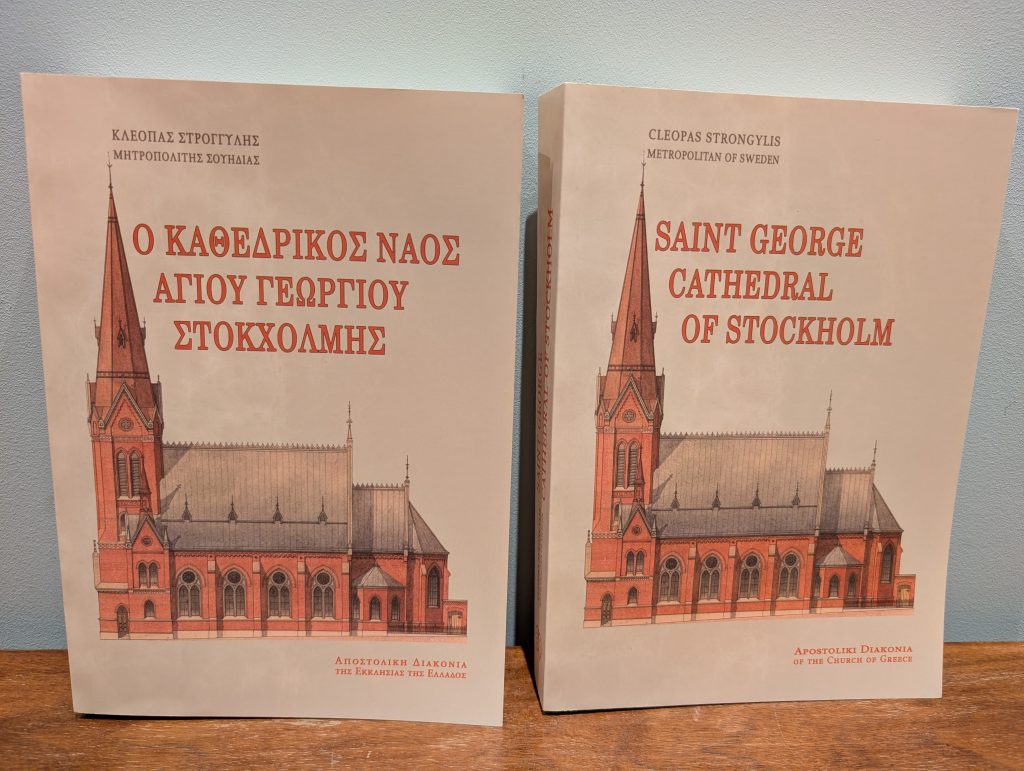
The volume authored by Metropolitan Cleopas of Sweden on the Cathedral Church of Saint George in Stockholm. Photo: Metropolis of Sweden
In his remarks of gratitude, Metropolitan Cleopas of Sweden stated, among other things:
“Most Reverend and Holy Abbot, we thank you from the depths of our hearts for responding to the invitation of the Holy Metropolis of Sweden and All Scandinavia and for honoring with your presence the celebrations marking the fiftieth anniversary of the Cathedral of Saint George in Stockholm, a sacred space of particular historical and spiritual significance, as fifty years have now been completed since its transfer and donation to our local Church.
Your presence in the North is not only an honor, but also a substantial strengthening of the pastoral and missionary work of our Metropolis.
We express our profound gratitude for your prayerful support toward the Holy Metropolis of Sweden, which constitutes a living bond of love and unity between Mount Athos and the Orthodox Diaspora.”
A reception followed in the Cathedral’s reception hall.
The anniversary events culminated in a concelebrated Hierarchical Divine Liturgy attended by a large congregation, as well as official representatives of various Christian denominations and confessions. Among those present were the Apostolic Nuncio of the Holy See to Sweden, Archbishop Julio Murat; the Roman Catholic Cardinal of Stockholm, Anders Arborelius; and the Bishop of the Coptic Orthodox Church, Anba Abakir, who presented Metropolitan Cleopas with commemorative gifts, including a blessing cross and an icon of Christ. Representatives of the “Catholic Apostolic Church” were also in attendance.

From the meal for the entire congregation in the community hall of the Cathedral Church of Saint George. Photo: Metropolis of Sweden
Also present were the Ambassador of Greece to Sweden, Aikaterini Fountoulaki, and the Ambassador of Cyprus to Sweden, Solon Savva.
As part of the commemorative events, Bishop Bartholomew of Elaia presented the commemorative volume authored by Metropolitan Cleopas of Sweden in both Greek (800 pages) and English (620 pages), dedicated to the Cathedral of Saint George in Stockholm and published by the Ecclesiastical Organization of the Apostoliki Diakonia of the Church of Greece.
The publication documents the historical course of the Cathedral, its contribution to the organization of the Orthodox community in Sweden, and significant testimonies and archival material, accompanied by an extensive photographic appendix.
Metropolitan Cleopas noted, among other things:
“Today is not merely an anniversary celebration, but a living testimony to God’s providence in the course of our local Church. Fifty years ago, amid difficult circumstances and limited means, the foundations of a spiritual beacon were laid — one that has since shone unceasingly upon the Orthodox faithful throughout Scandinavia.
This Cathedral is not only an architectural jewel in the heart of Stockholm, but above all a ‘harbor of salvation and ark of grace’ — a place where prayer meets history, where memory is transformed into hope, and where the Church becomes a source of consolation for humankind.
Here, the first Divine Liturgy in the Greek language was celebrated; generations were baptized, Holy Mysteries were performed, and the identity of Orthodox believers was strengthened within a multicultural and demanding society.”